Silver
—
USD / troy oz
—
Connecting to provider
 Strategic Resource Intelligence
Ukraine’s refinery strikes could shift chemical demand toward China and weaken Western leverage. We examine the potential consequences for civilian and military supply chains, data-center cooling, and the ethylene oxide production that depends on silver catalysts.
Open assessmentHow copper cold plates move heat from AI chips into coolant, and why fins, interfaces and fluid conditions shape overall cooling performance.
How copper windings drive drone motors and why tracing wire from reel to finished motor matters for heat, performance and quality.
Don't keep sleeping on this America! Chinese repairers are extending the usefulness of existing GPU silicon. America cannot afford to confuse another hardware sale with technological progress.
The copper price is only one part of the cable bill. A usable delivery can also release cash tied up in inventory and keep the customer’s order moving.
The Army’s Black Widow drone uses thermal imaging. Vanadium oxide helps its documented camera design turn infrared radiation into an image.
Doug Burgum and Juan Ciscomani visited Gunnison’s Johnson Camp Mine, highlighting American copper production, its workforce and planned employee ownership.

The historical record
Trace the decisions, shortages and incentives that keep pressure building.
1717 / Britain · Newton / Gold valuation / Silver circulation
He knew why silver went east.
His cut left the price gap open.
Newton knew that Asian prices were drawing silver east. Yet in 1717 he recommended an initial cut of 6 old pence in the guinea’s payment value—a cut that left the wider Asian price gap he described open. On 22 December, George I reduced the guinea’s maximum payment value from 21 shillings and 6 pence to 21 shillings, about 2.3%. Intended to curb silver melting and exports, the valuation became part of Britain’s later development of a gold standard in practice.
Open full dossier
1764–1766 / British American colonies / Britain · Coin scarcity / Colonial paper / Imperial taxation
Coin was scarce.
The payment rules tightened.
Colonial resistance to British taxation had a monetary grievance. The Currency Act of 1764 restricted new colonial paper bills’ legal-tender status. In 1765, the Stamp Act Congress said scarcity of gold and silver coin made recent parliamentary duties impracticable to pay. Franklin later linked trade restraints, paper-money restrictions and the stamp tax to Americans’ diminished respect for Parliament. These records connect cash scarcity with the political crisis that preceded the Revolution.
Open full dossier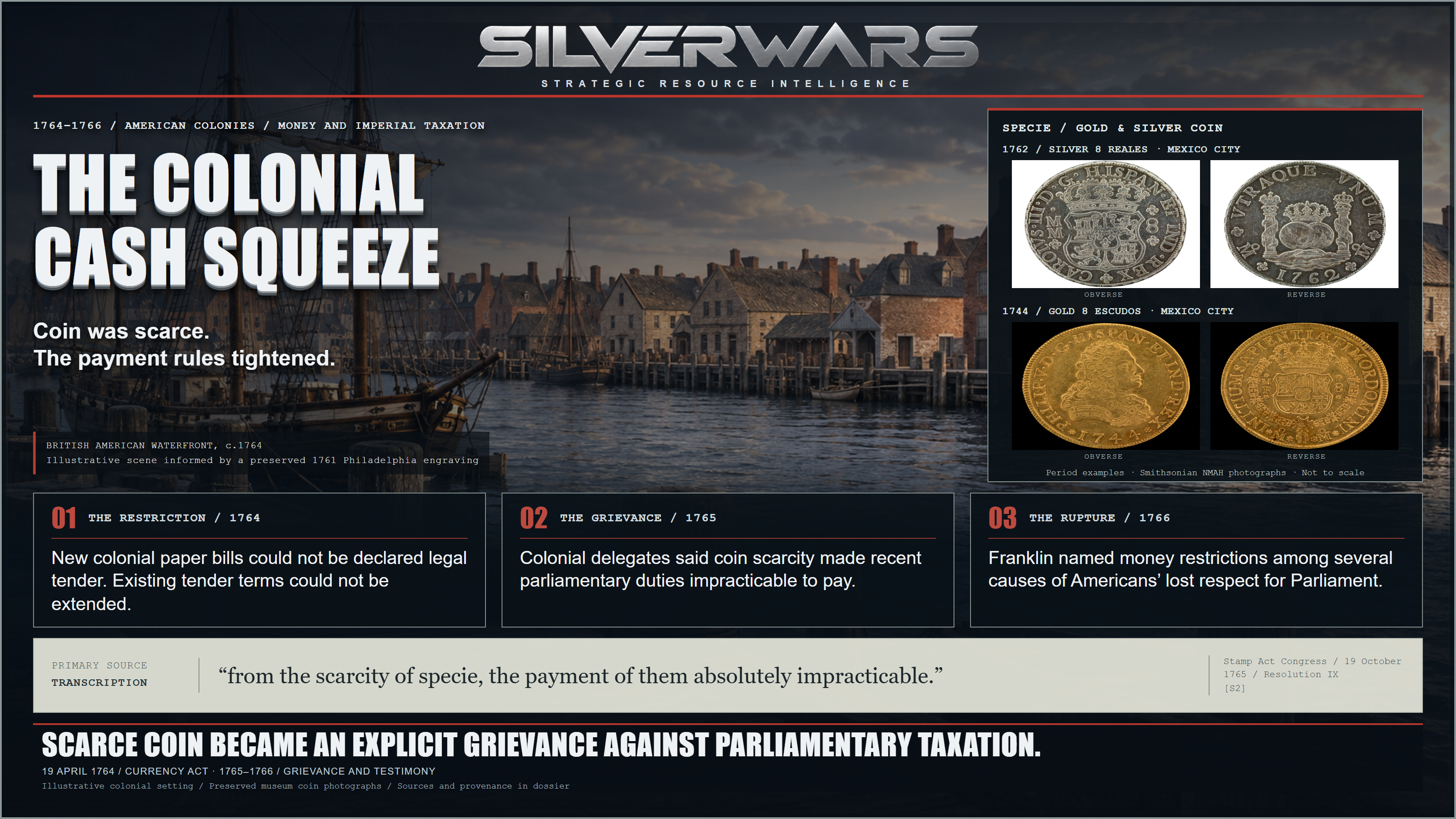
1792 / United States · U.S. coinage law / Legal metallic ratio
Congress fixed a relationship.
Pure silver to pure gold, by weight.
The U.S. Coinage Act of April 2, 1792 set a 15:1 relationship between pure silver and pure gold by weight. It also assigned legal payment values to mint-issued gold and silver coins, subject to the Act’s weight rules.
Open full dossier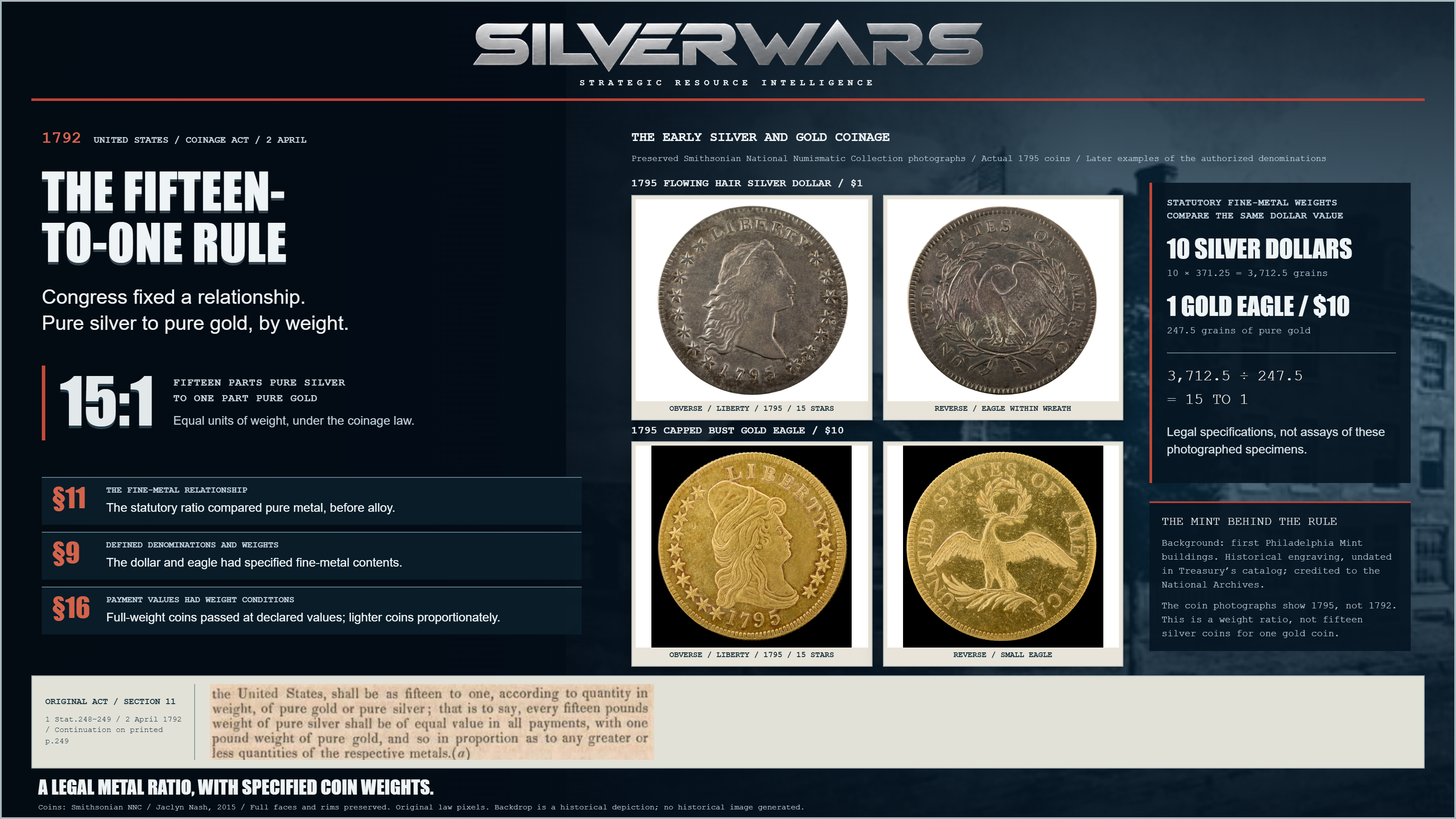
1816 / United Kingdom · Gold standard / Silver legal tender / Coinage control
Gold became the standard.
Silver received a payment ceiling.
The Coinage Act of 22 June 1816 declared gold the sole standard measure of value, with silver permitted within the Act's limits. It provided that silver coin would cease to be legal tender for payments above forty shillings from a day to be appointed by royal proclamation. The Act also authorized a new silver coinage at sixty-six shillings per troy pound of standard silver. Silver continued as money within a restricted role. This entry concerns the enacted framework; the proclamation commencing the tender ceiling has not been verified here.
Open full dossier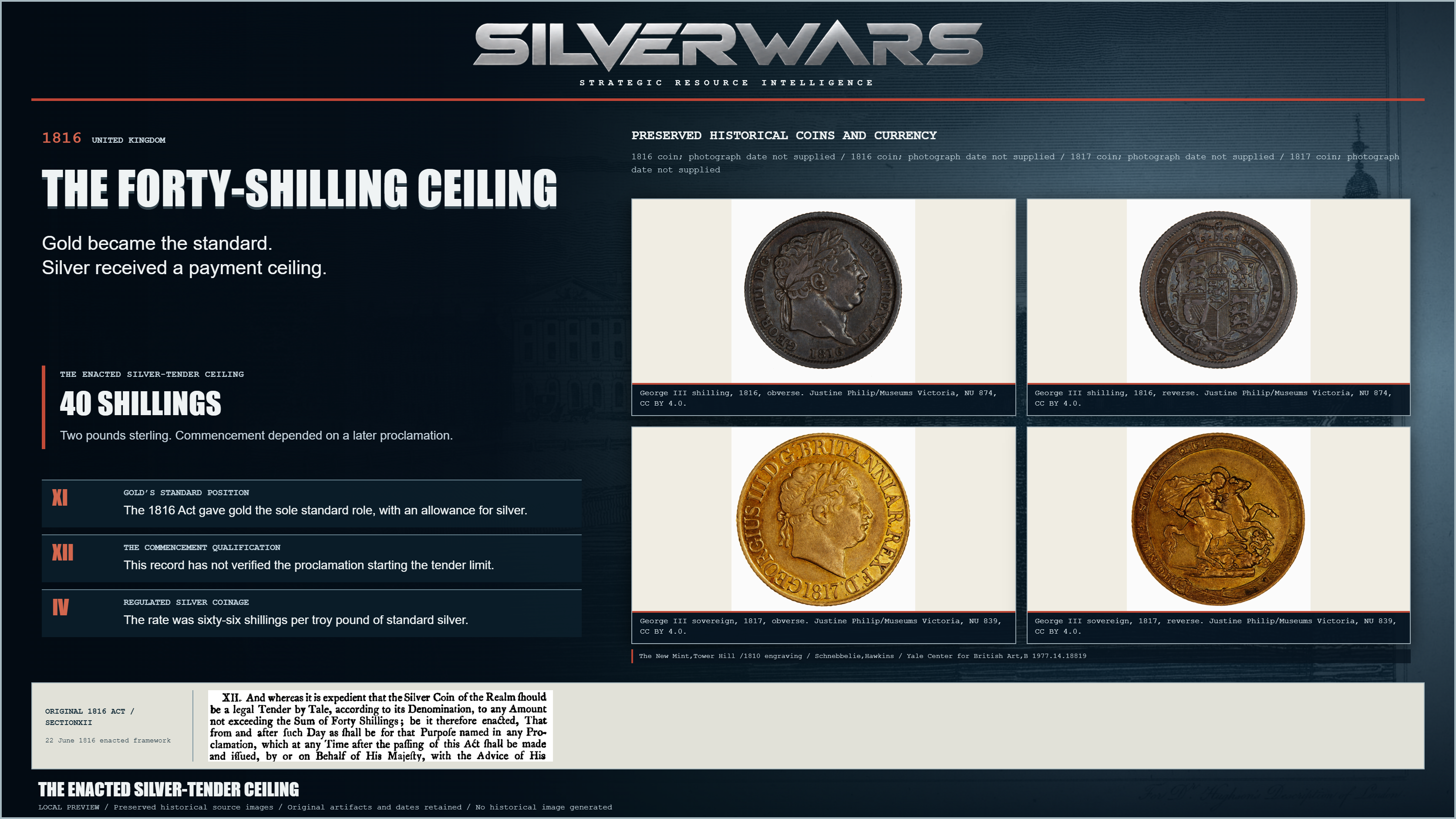
1824 / New Brunswick · Silver leaves commerce
The silver did not disappear.
It followed a better price.
Traders carried circulating silver to Boston and New York, exchanged it for Spanish doubloons, and returned to capture the higher value at home.
Open full dossier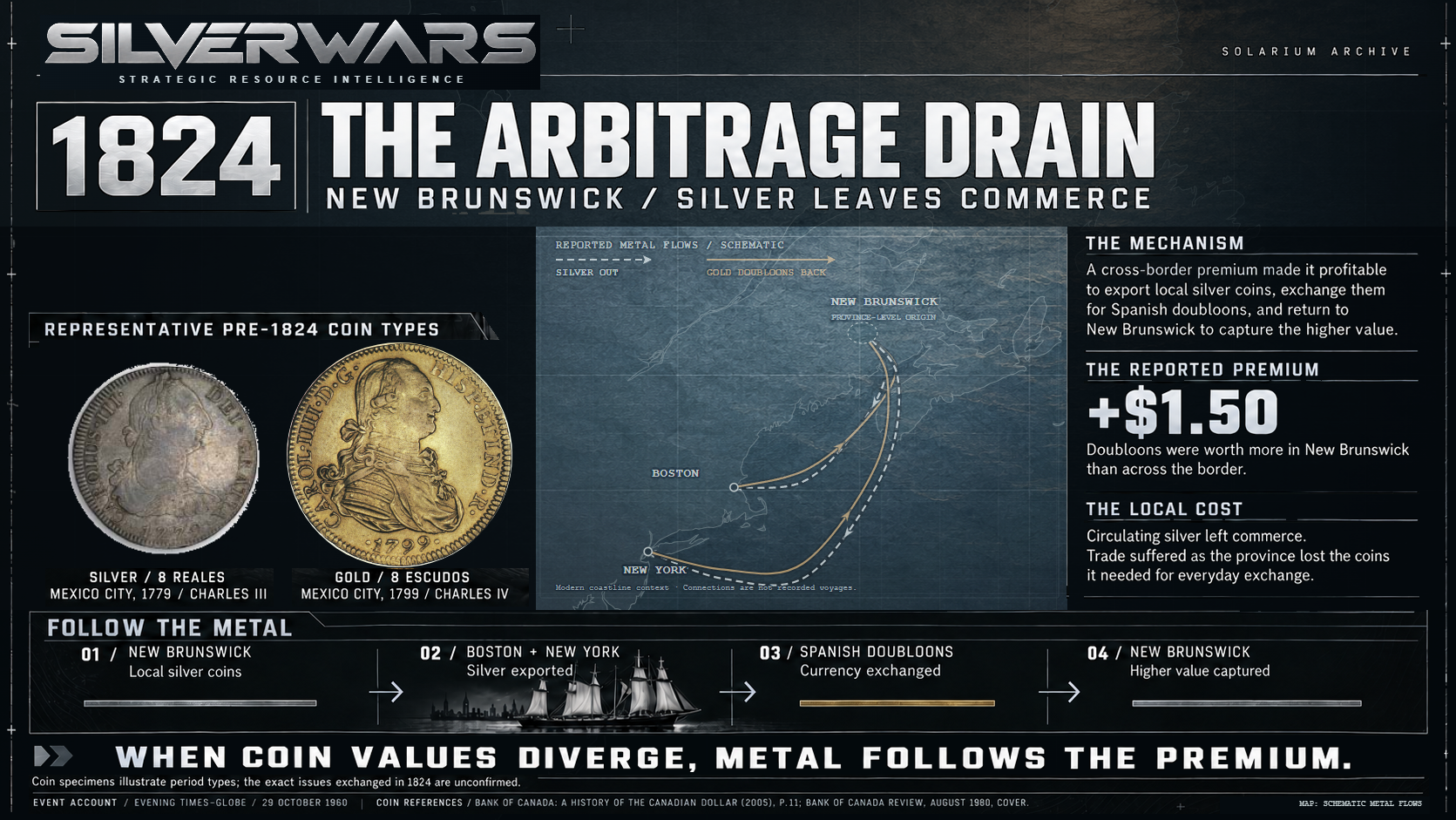
1834 / United States · Coinage law / Gold content / Monetary ratio
The dollar value stayed.
The gold content fell.
On 28 June 1834, Congress reduced the pure gold specified for the ten-dollar eagle from 247.5 to 232 grains. Against the unchanged silver-dollar specification, the new gold content implied a mint ratio of about sixteen parts silver to one part gold, replacing the earlier fifteen-to-one relationship. The Act took effect after 31 July. This was a change in the legal metallic terms of payment, not the removal of silver dollars from law.
Open full dossier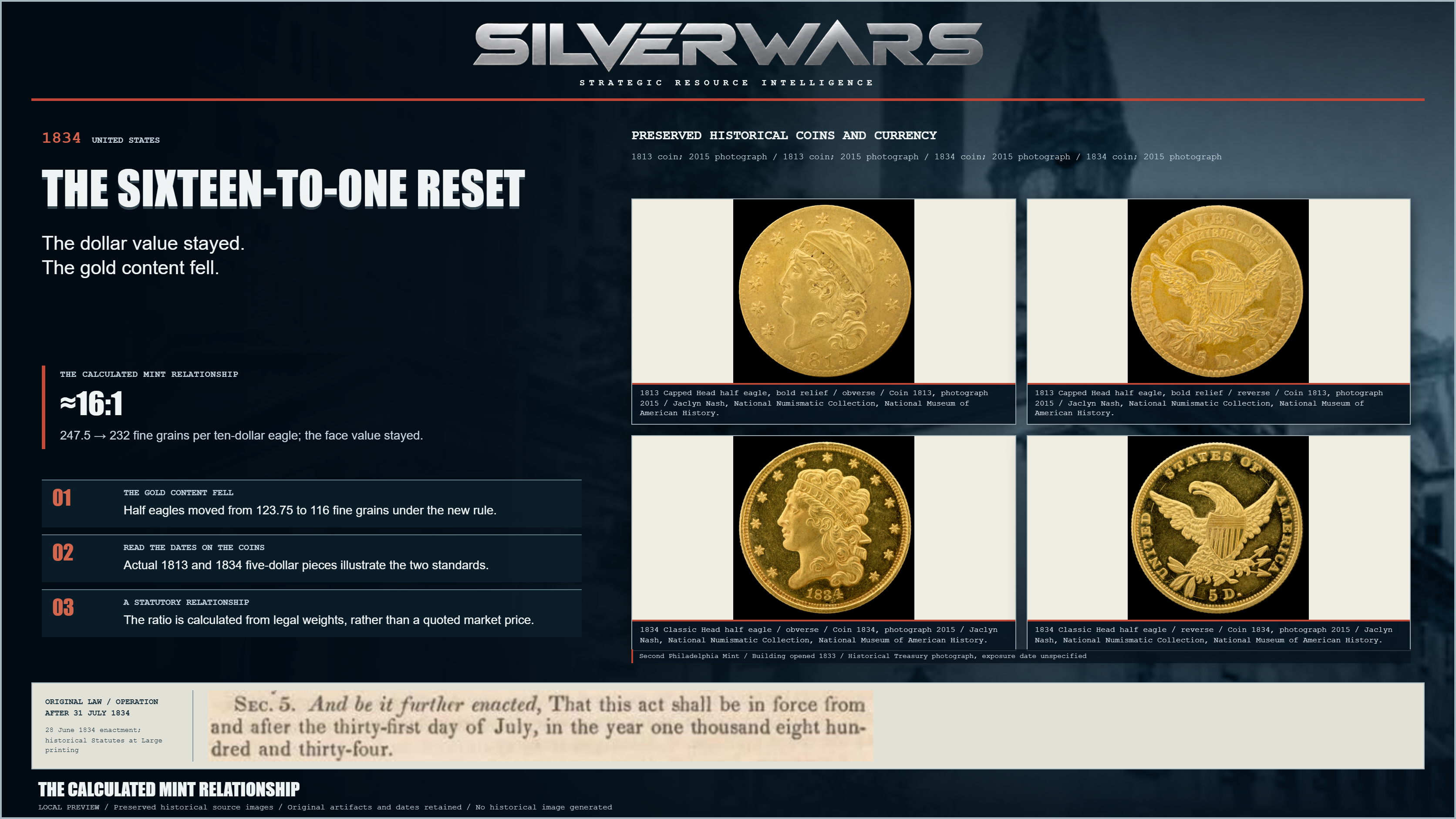
1836 / Qing China / British Indian trade · Opium proceeds / Imported silver / Qing policy debate
Opium sales supplied money.
The need to bring foreign silver diminished.
In 1836, Qing official Xu Naiji, named Heu Naetse in the preserved English translation, described how opium changed the silver side of China's foreign trade. Foreign merchants had previously brought money to buy Chinese goods; illicit opium sales now supplied funds locally and reduced their need to import silver. His memorial complained that money was leaving instead. This was an argument within a debate over how to control the trade, including relaxation of prohibitions, rather than Lin Zexu's later crackdown. The document establishes a contemporary warning about the payment circuit, not an audited national silver balance or a dated beginning of the reversal.
Open full dossier
1839 / Canton, Qing China / British trade superintendency · Opium surrender / Government pledge / Disputed compensation
Elliot invoked the British government.
The compensation claim remained disputed.
On 27 March 1839, Charles Elliot, Britain's Chief Superintendent of Trade in China, required British subjects at Canton to surrender British-owned opium to him for transfer to Qing authorities. His notice claimed responsibility on behalf of the British government and left proof of ownership and valuation to rules yet to be defined. Elliot framed his action as a response to detention and the High Commissioner's demands. Physical delivery followed through later arrangements. Merchants testified that they relied on his pledge, while Parliament subsequently disputed whether it bound the Treasury. The pledge was not itself an appropriation or a completed compensation payment.
Open full dossier
1842 / Britain / Qing China · Treaty payments / Opium compensation / Imperial trade
The war ended.
China received the bill.
The Treaty of Nanking, signed on 29 August 1842, required China to pay 21 million Dollars: six million for opium surrendered at Canton in 1839, three million for Hong merchants’ debts to British subjects, and twelve million for British expedition expenses. It also opened five ports to British residence and trade and ceded Hong Kong. The payment schedule ran through 1845.
Open full dossier
1848–1851 / California / Australia / France · Gold discoveries / Monetary circulation
New gold reached the market.
The old metallic balance came under pressure.
California’s 1848 gold discoveries and Australia’s 1851 rushes expanded the supply story. Chevalier’s 1859 analysis described gold replacing silver in French circulation. That contemporary interpretation is distinct from an automatic worldwide monetary outcome.
Open full dossier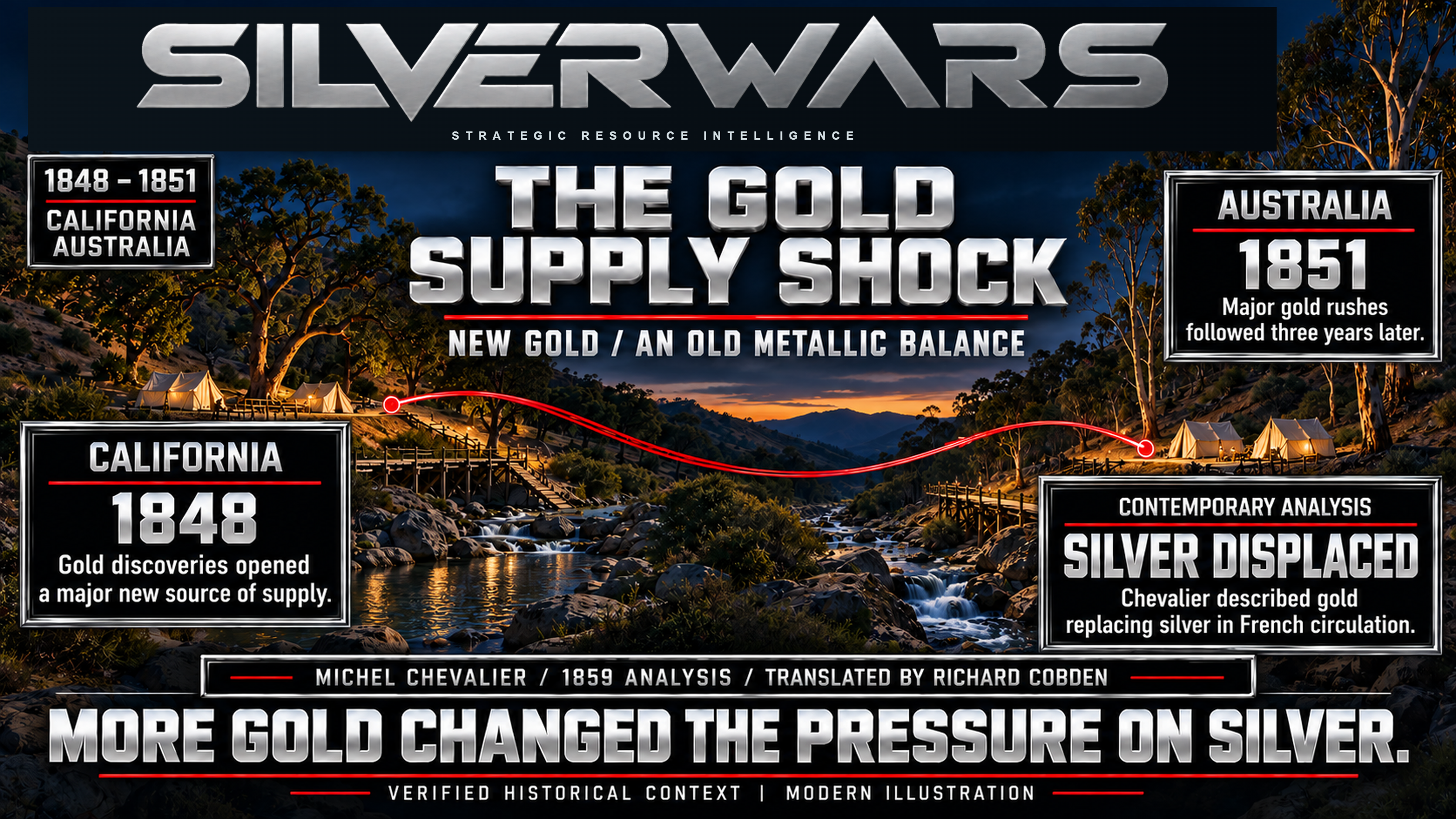
1853 / United States · Subsidiary silver / Coinage control / Legal tender
Smaller silver coins stayed money.
Their payment power had a ceiling.
The Act of 21 February 1853 reduced the weight of the half dollar, quarter, dime and half dime, and limited the new coins’ legal-tender use to five dollars. It also reserved deposits for this coinage to the Mint’s treasurer on government account. A 3 March amendment advanced operation to 1 April. The silver dollar was outside the listed weight changes: this was a move toward controlled small-change coinage, not its 1873 omission.
Open full dossier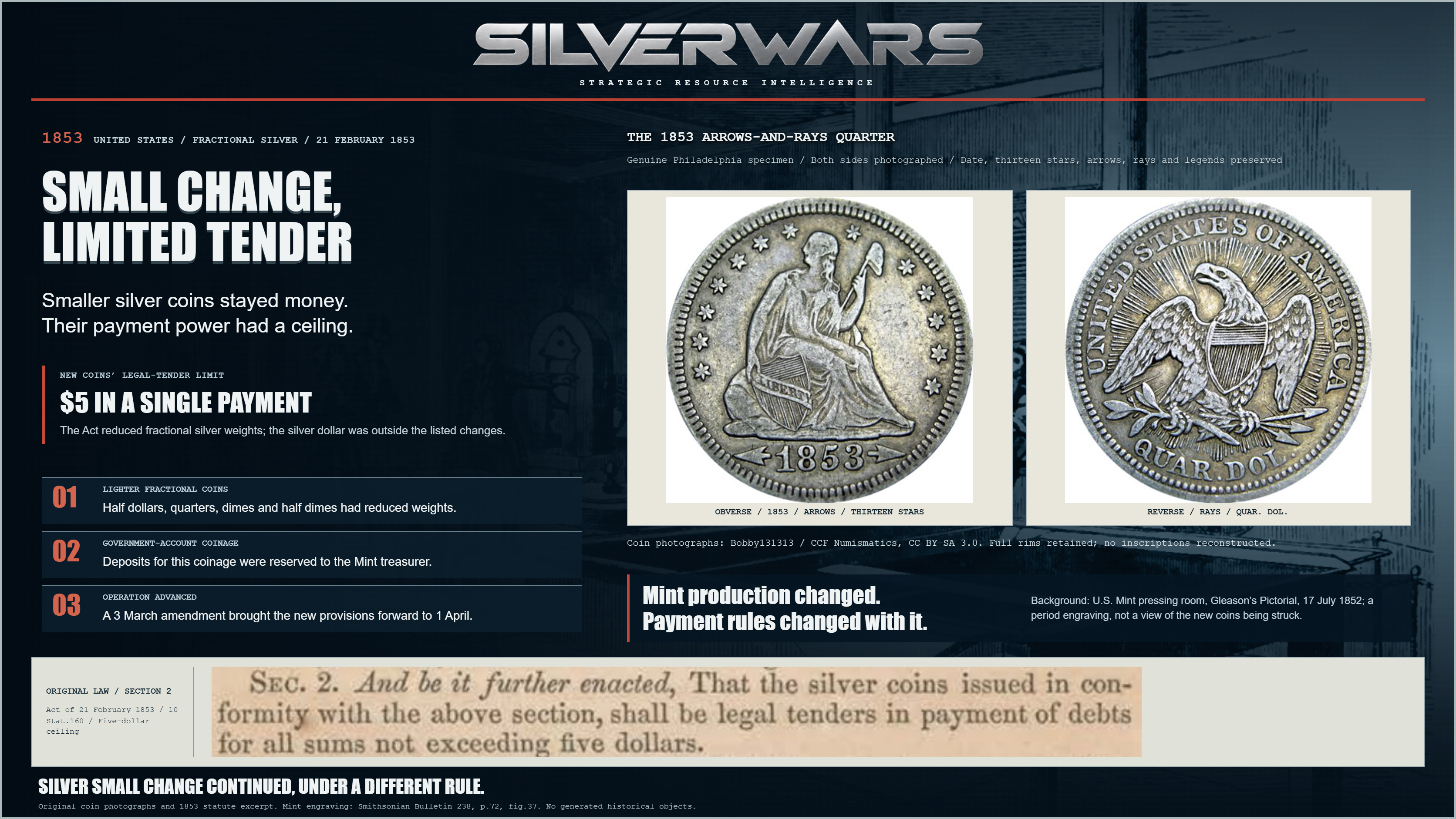
1857 / United States / Spanish and Mexican coinage · Foreign coins / Legal tender / Recoinage
Congress changed what counted.
Foreign coin lost legal-tender status.
On 21 February 1857, Congress repealed the laws giving foreign gold and silver coins legal-tender status in the United States. Specified Spanish and Mexican silver fractions remained receivable at federal offices at stated rates, but received coins were to be recoined rather than paid back out. The original Act also authorized a two-year exchange of those fractions for new copper-nickel cents at their old nominal values. The law established withdrawal and recoinage channels alongside the loss of legal-tender standing.
Open full dossier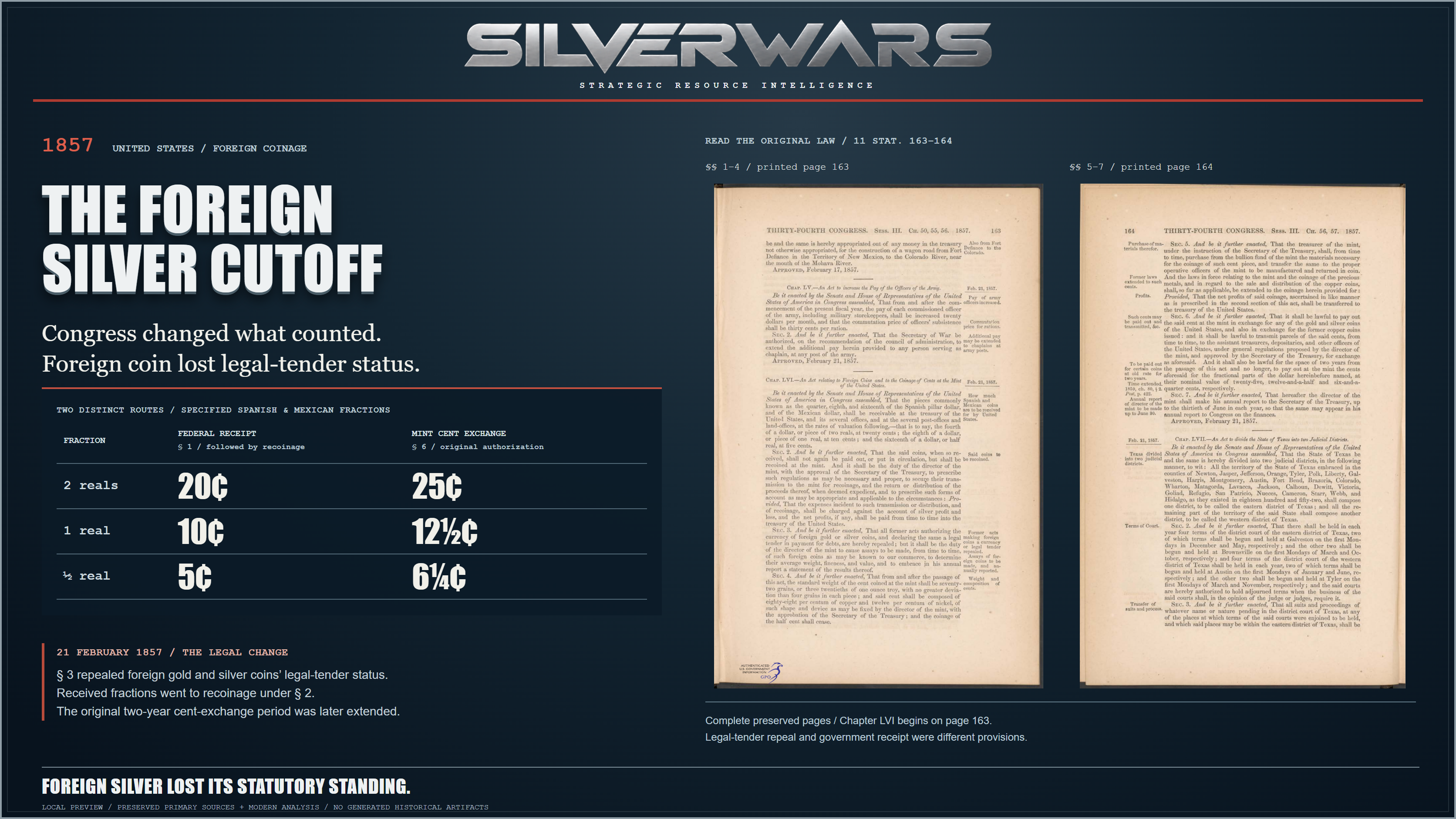
1859 / Western Utah Territory / Present-day Nevada · Silver and gold discovery / Mining expansion
The lode carried silver and gold.
A mining district followed.
The 1859 Comstock breakthrough drew a rush to the Washoe mines and expanded a major source of precious metals. The area was then western Utah Territory; competing discovery claims and earlier placer work complicate any single-discoverer story.
Open full dossier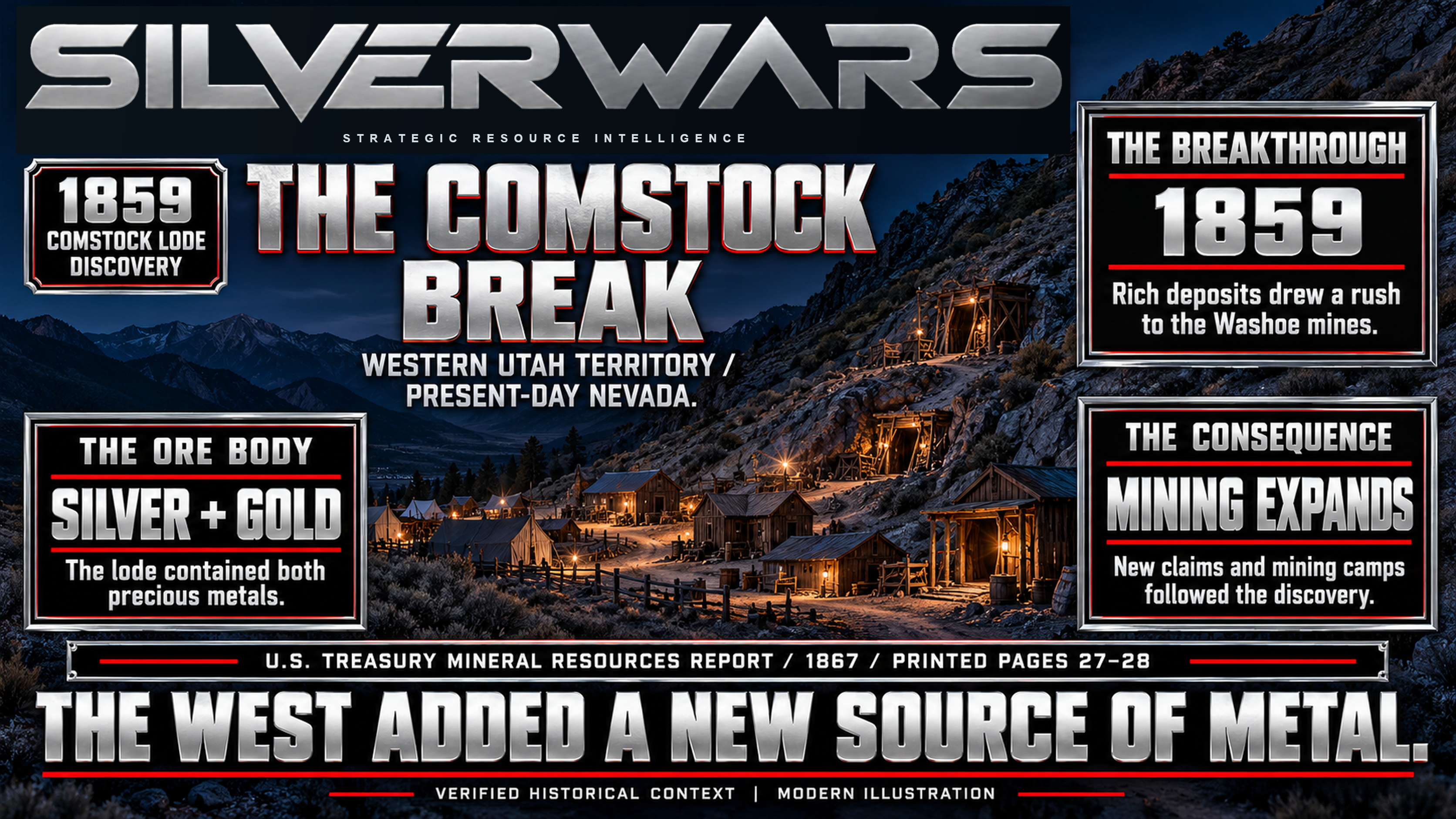
1862–1869 / United States · United States notes / Legal tender / Coin repayment
Paper paid ordinary debts.
Coin kept a privileged place.
The Civil War put United States notes, known as greenbacks, into circulation as legal tender for most debts. Import duties and public-debt interest were excluded from the new notes’ legal-tender reach. After the war, Congress authorized limited note retirement in 1866, suspended that authority in 1868, and pledged eventual coin redemption in 1869. A wartime currency had become a Reconstruction-era dispute over the amount of paper money and the terms of repayment.
Open full dossier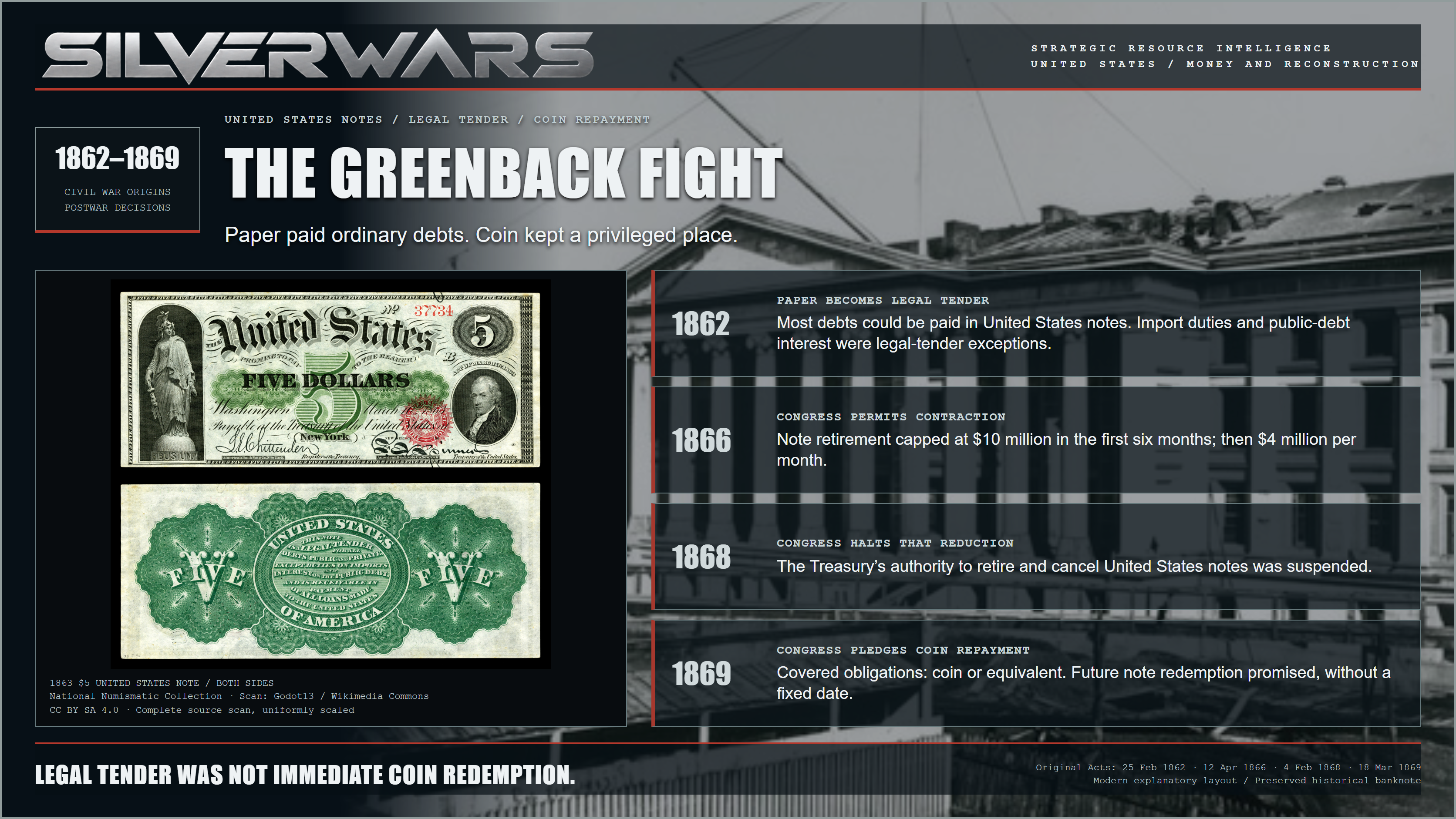
1867 / Paris / International conference · Monetary unification / Gold recommendation
Delegates favored a gold basis.
Governments still had to act.
The 1867 Paris monetary conference favored a gold basis for monetary unification. Its plan was to be proposed to the represented governments. A conference recommendation did not itself create a world currency or abolish silver.
Open full dossier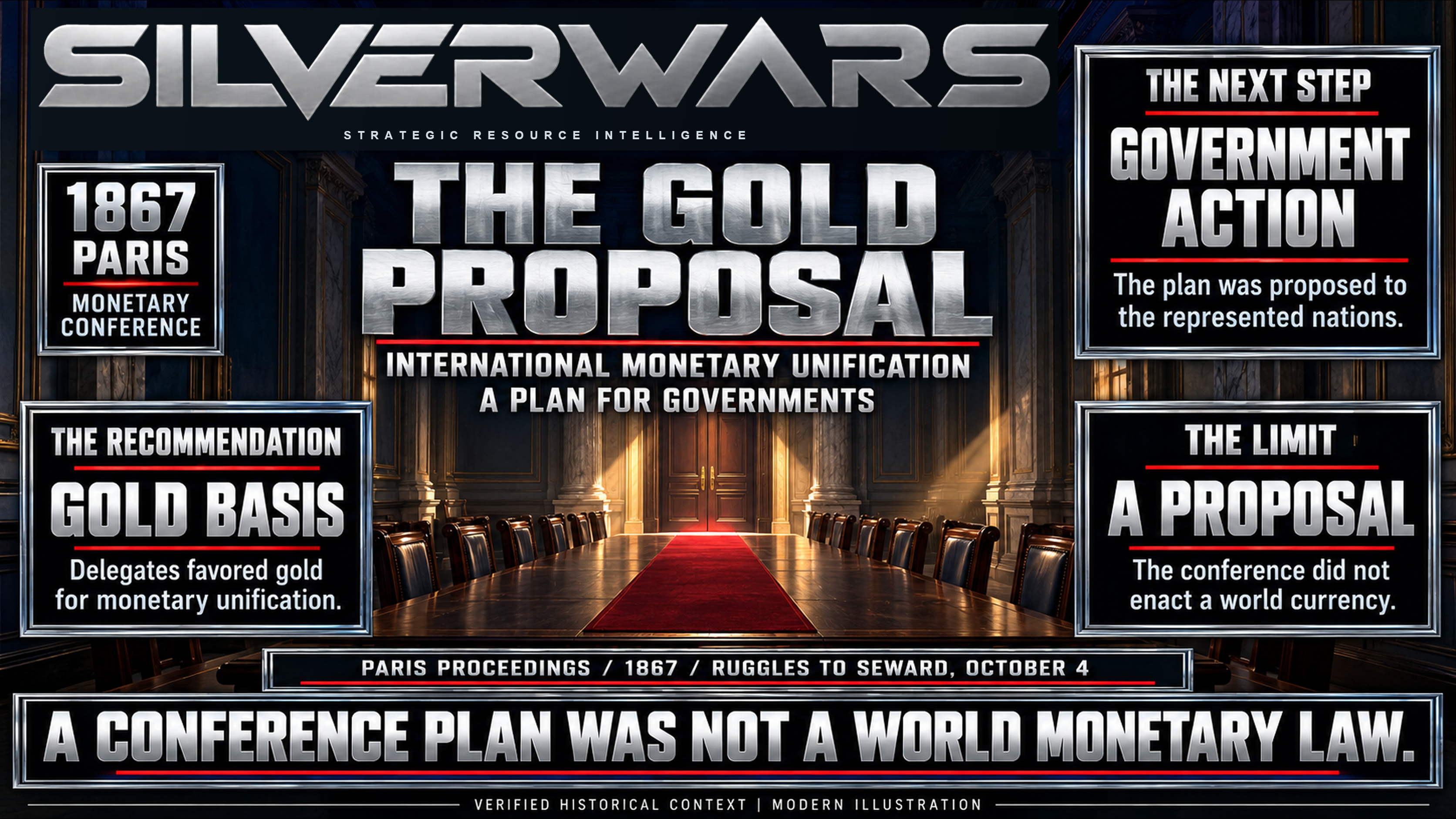
1871–1873 / German Empire · Coinage legislation / Transition to gold
The standard changed.
Silver coins did not disappear.
Imperial acts in 1871 and 1873 advanced Germany’s gold coinage system. A later official German account still recorded imperial silver and old thalers in circulation. A gold standard and continuing silver coins were compatible.
Open full dossier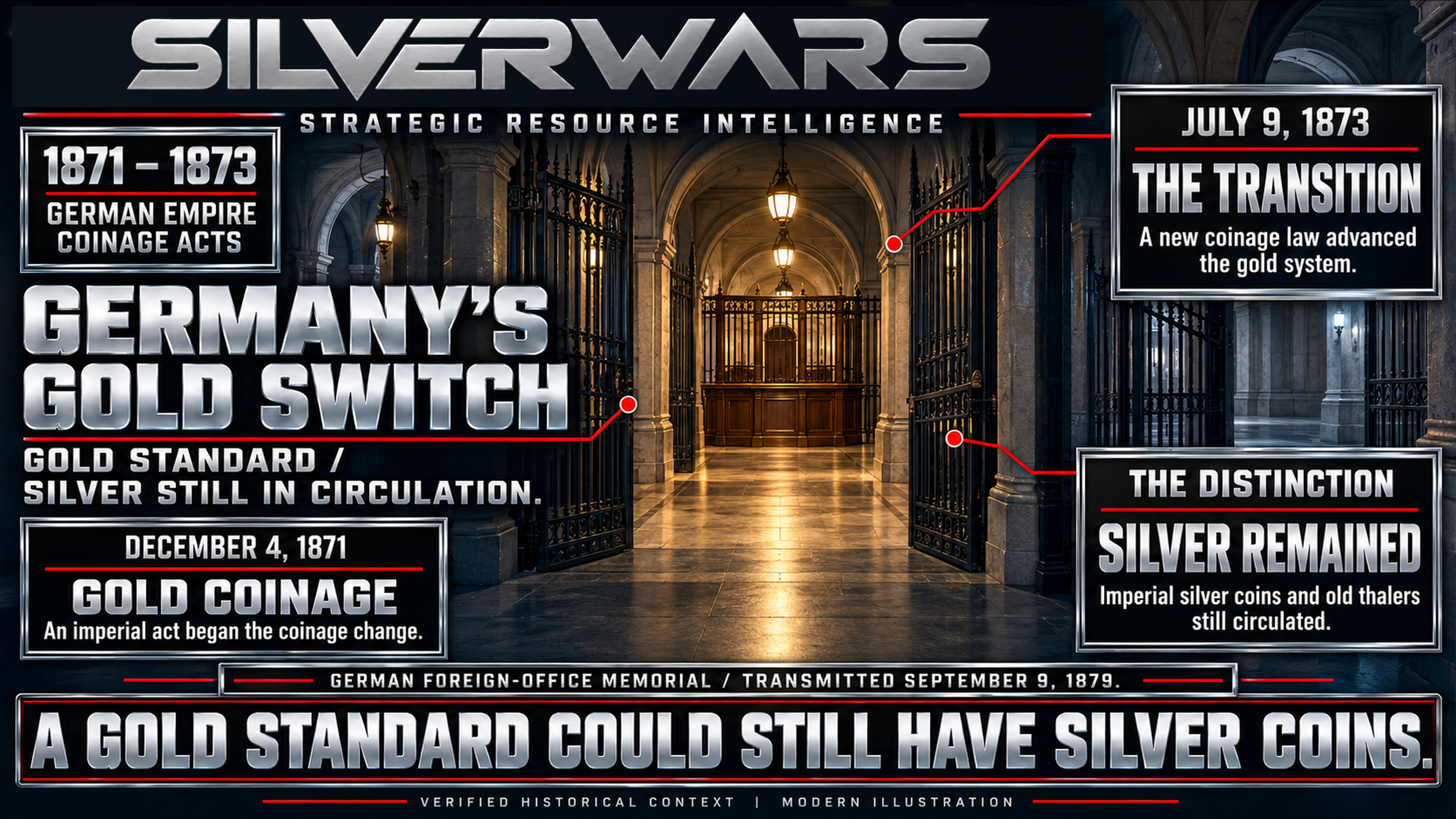
1872 / United States · U.S. mining law
Discovery could establish a claim.
Land title required a separate step.
In 1872, U.S. Congress formalized a system for claiming valuable mineral deposits on federal lands open to mineral entry. A valid claim established possessory rights; a separate patent process could convey the land into private ownership.
Open full dossier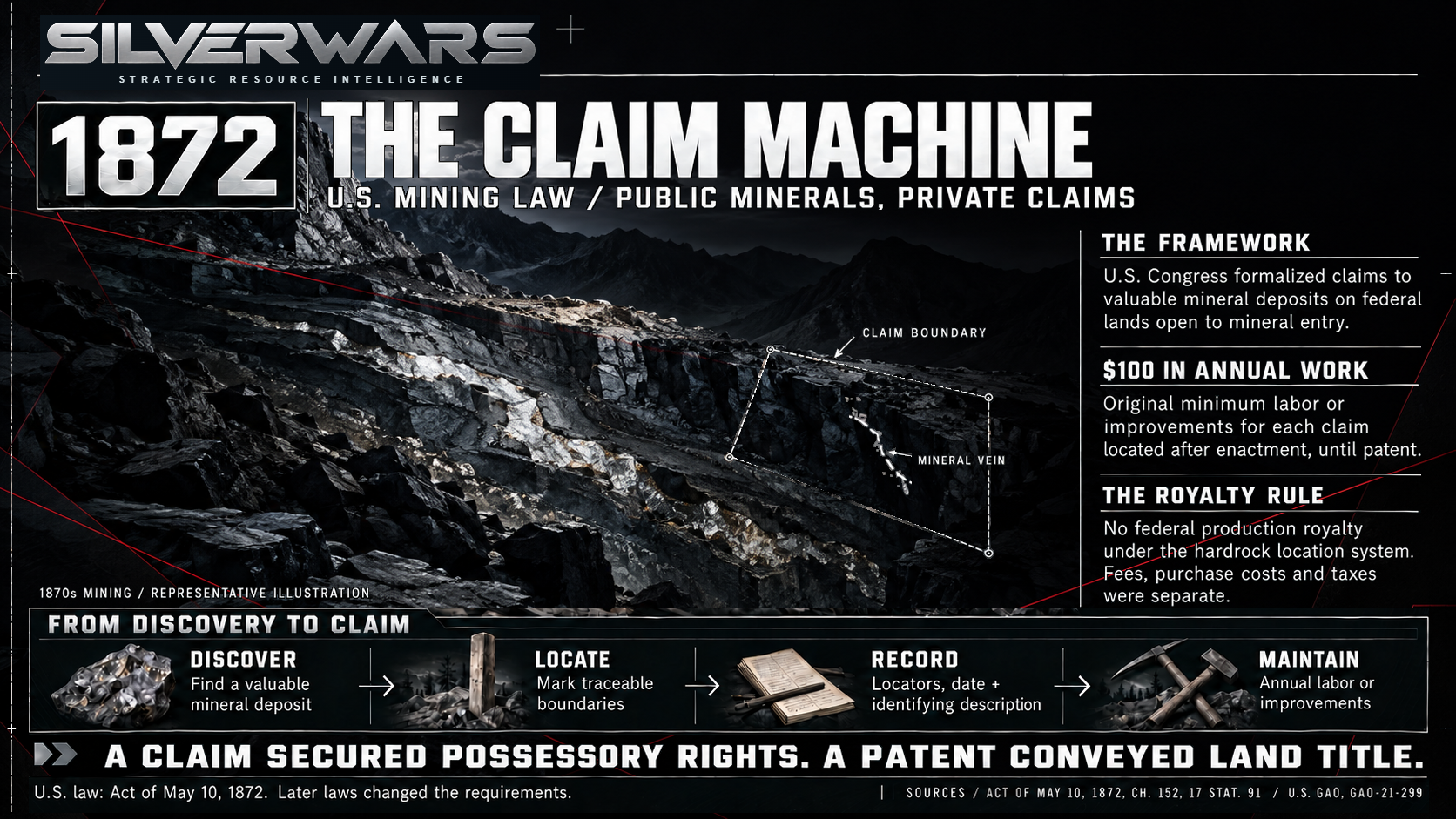
1873 / United States · Reconstruction / Silver-dollar coinage / Gold unit of value
The coin list changed.
Silver’s route into money changed with it.
During Reconstruction, Congress named the gold dollar the unit of value and omitted the standard silver dollar from authorized coinage. Smaller silver coins continued, and the new trade dollar had a separate role. The law closed the standard silver-dollar route for private bullion deposits. Its later political significance lay in the fight over whether silver could again become standard money—a controversy critics called the “Crime of ’73.”
Open full dossier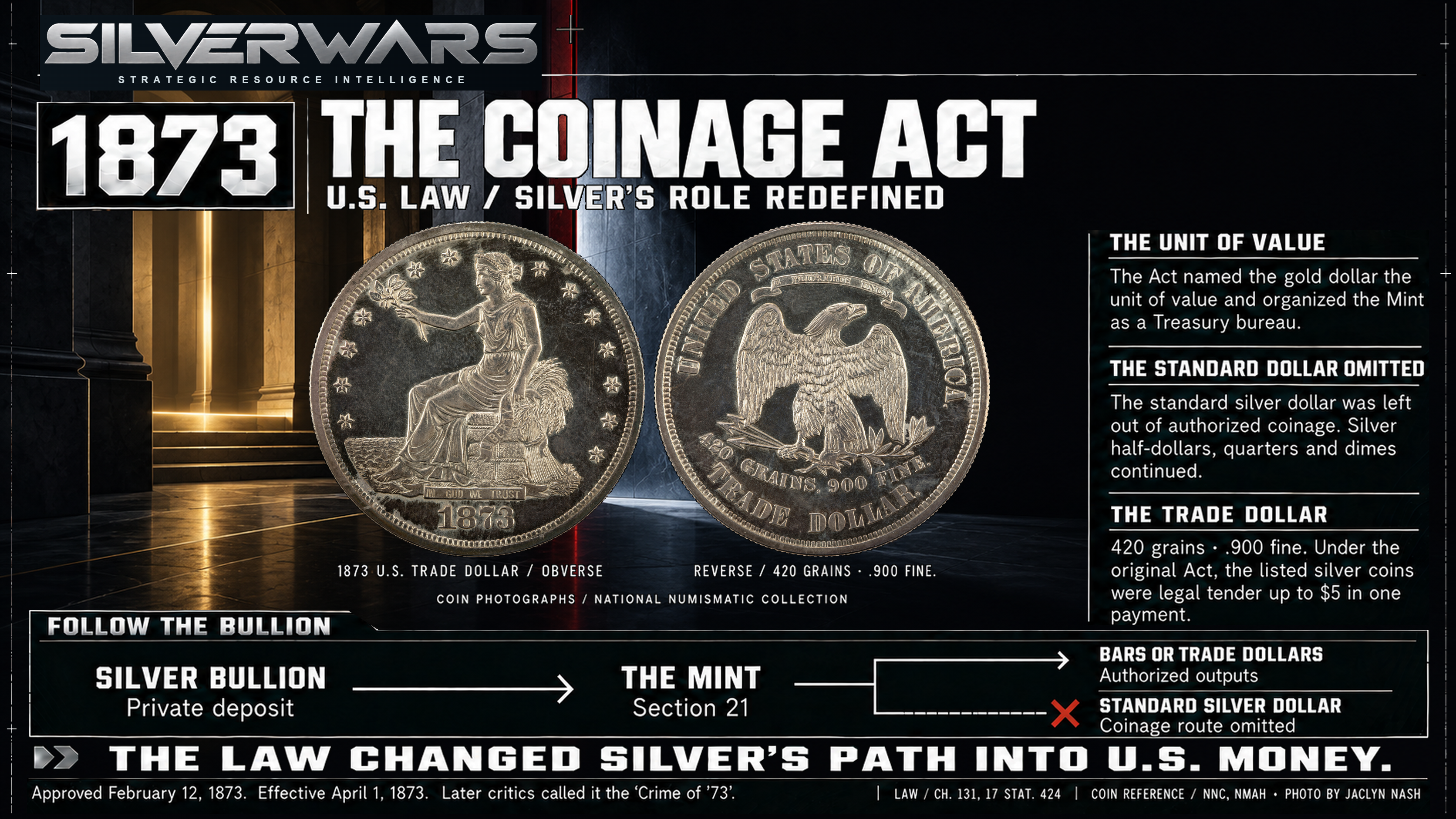
1876 / United States / Export trade · Trade dollar / Legal tender / Export coinage
A U.S. silver coin lost its standing.
Congress removed its legal-tender status.
On 22 July 1876, Congress removed the trade dollar's legal-tender status. Section 2 of the joint resolution also authorized the Treasury Secretary to limit its coinage to an amount considered sufficient for export demand. This was a change to the status of an existing U.S. silver coin, distinct from the 1873 omission of the standard silver dollar. The same resolution separately supported subsidiary silver coinage, making the trade-dollar cutoff a specific policy rather than the removal of all silver money.
Open full dossier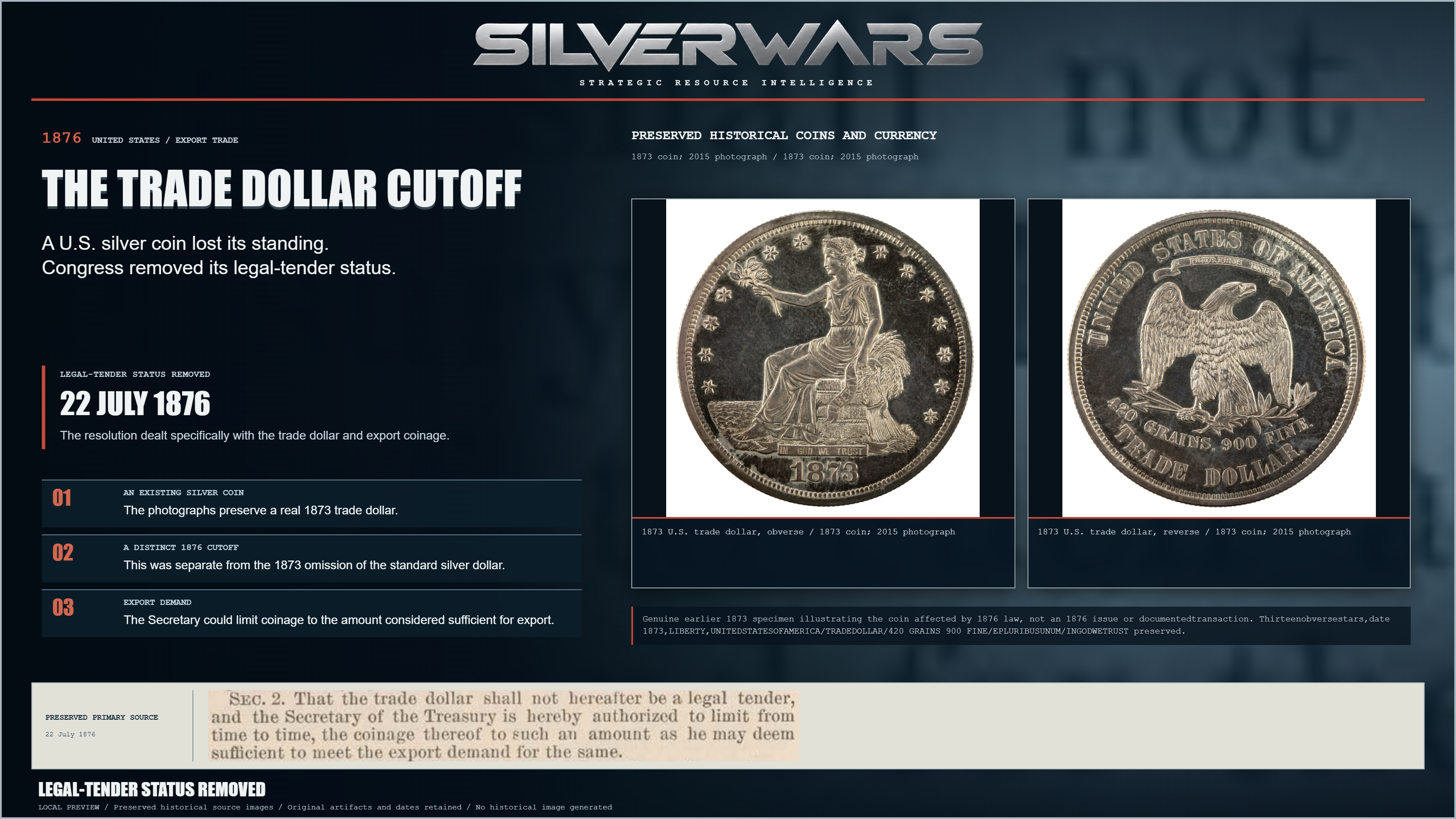
1878 / United States · U.S. silver purchase law
Silver demand became
a federal obligation.
The 1878 U.S. Bland–Allison Act required the Treasury to buy $2 million to $4 million worth of silver bullion each month at market prices, and have it coined into standard silver dollars.
Open full dossier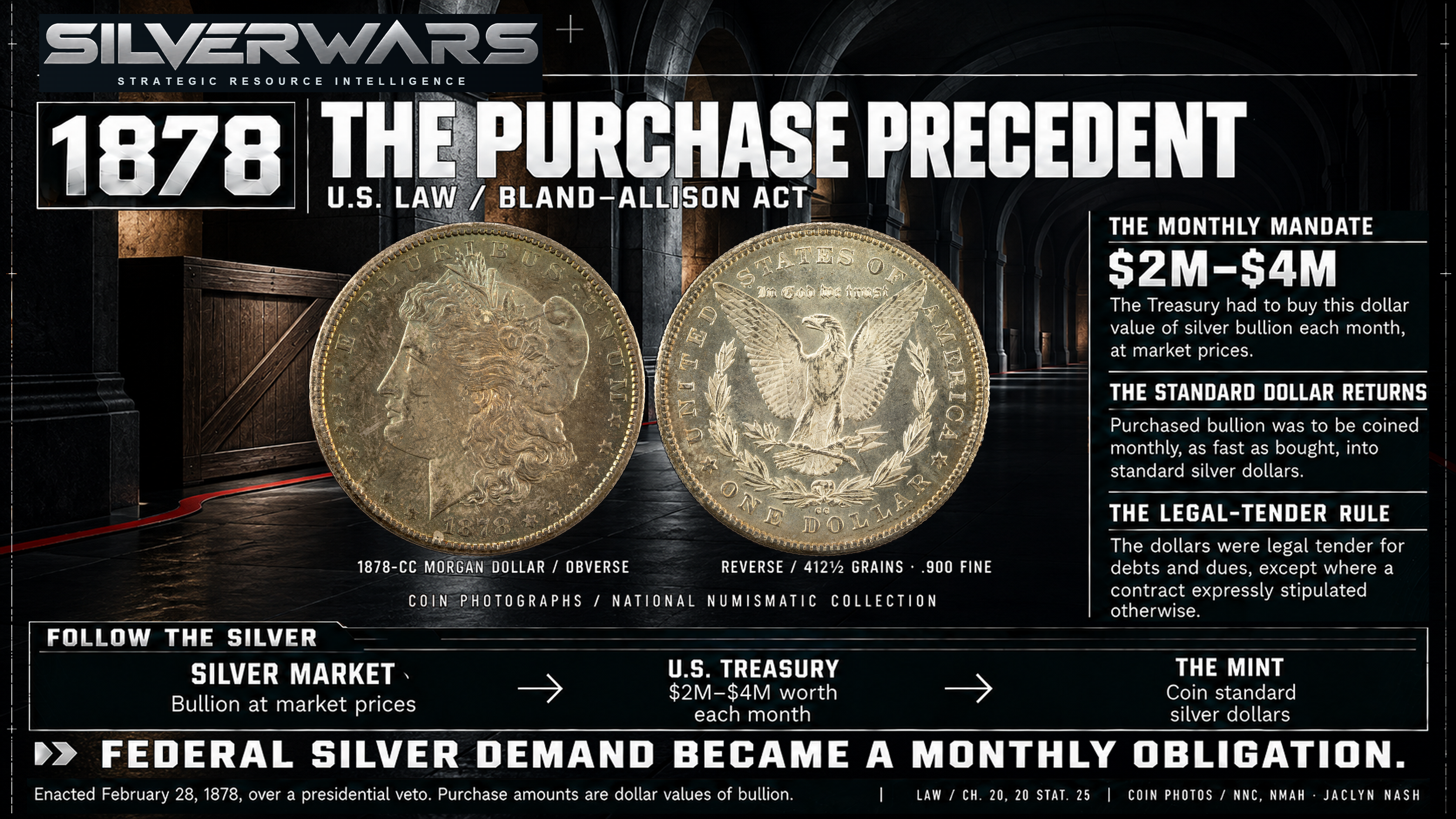
1878 / 1881 / Paris / International conferences · Bimetallic diplomacy / No common ratio
The conferences returned to silver.
A common ratio remained out of reach.
The Paris conference of 1878 failed to agree a common gold–silver ratio. Talks resumed in 1881 without the intended monetary settlement; the planned 1882 reassembly was postponed. These were diplomatic efforts, separate from the U.S. purchase law of 1878.
Open full dossier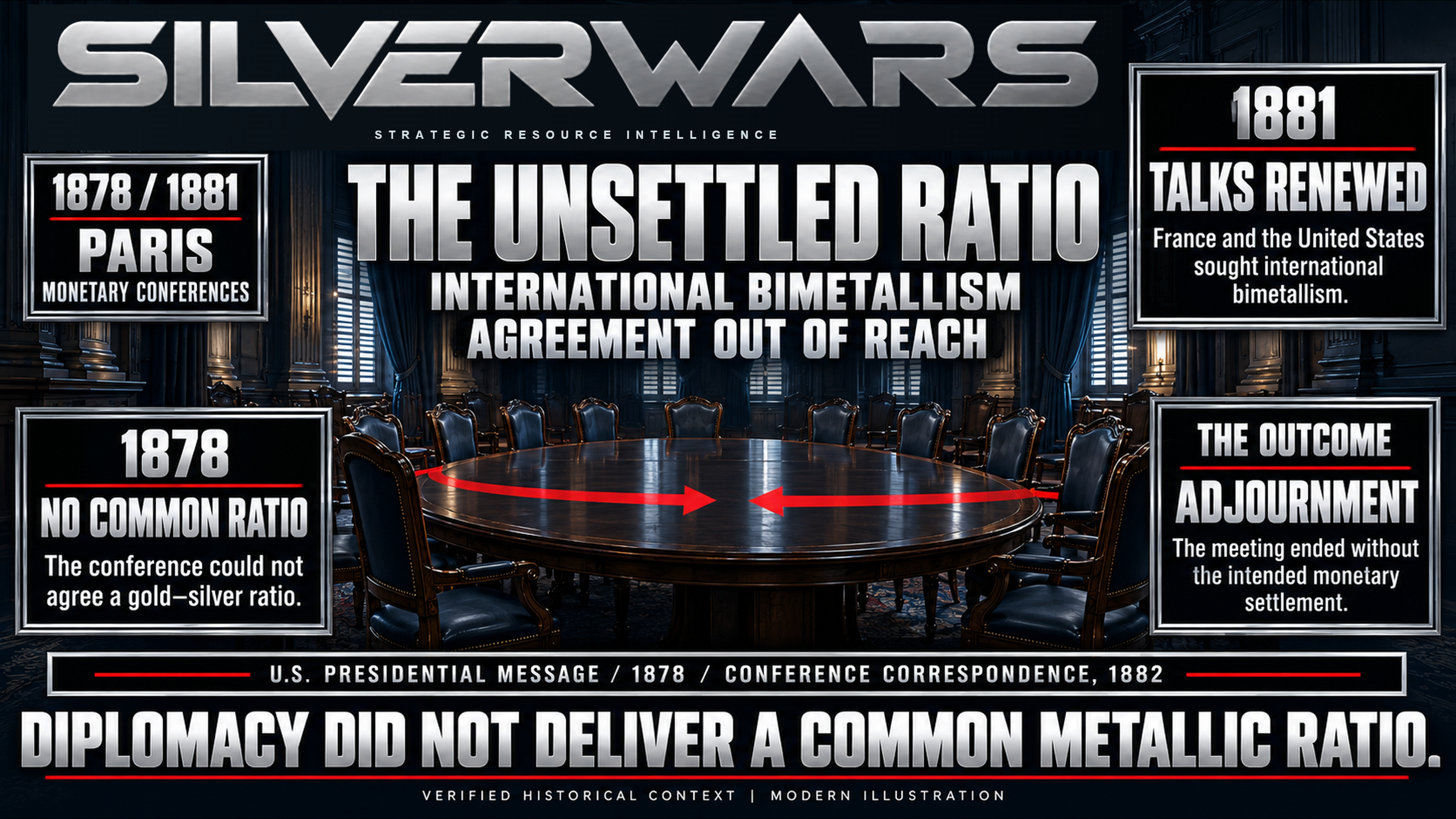
1873–1878 / France / Latin Monetary Union · Silver mint restrictions / Gold–silver ratio / Treaty control
The coins could stay.
Restarting their minting required unanimous consent.
As silver fell relative to gold, the Latin Monetary Union restricted five-franc silver coinage. The fixed legal ratio of 15½ parts silver to one part gold created an opening for bullion arbitrage: cheaper silver could replace gold in circulation. The convention signed in Paris on 5 November 1878 kept silver five-franc minting provisionally suspended and required unanimous agreement to restart it. Its main provisions became executable on 1 January 1880. Existing silver five-franc coins continued to be accepted, and subsidiary silver coinage remained a separate regulated category.
Open full dossier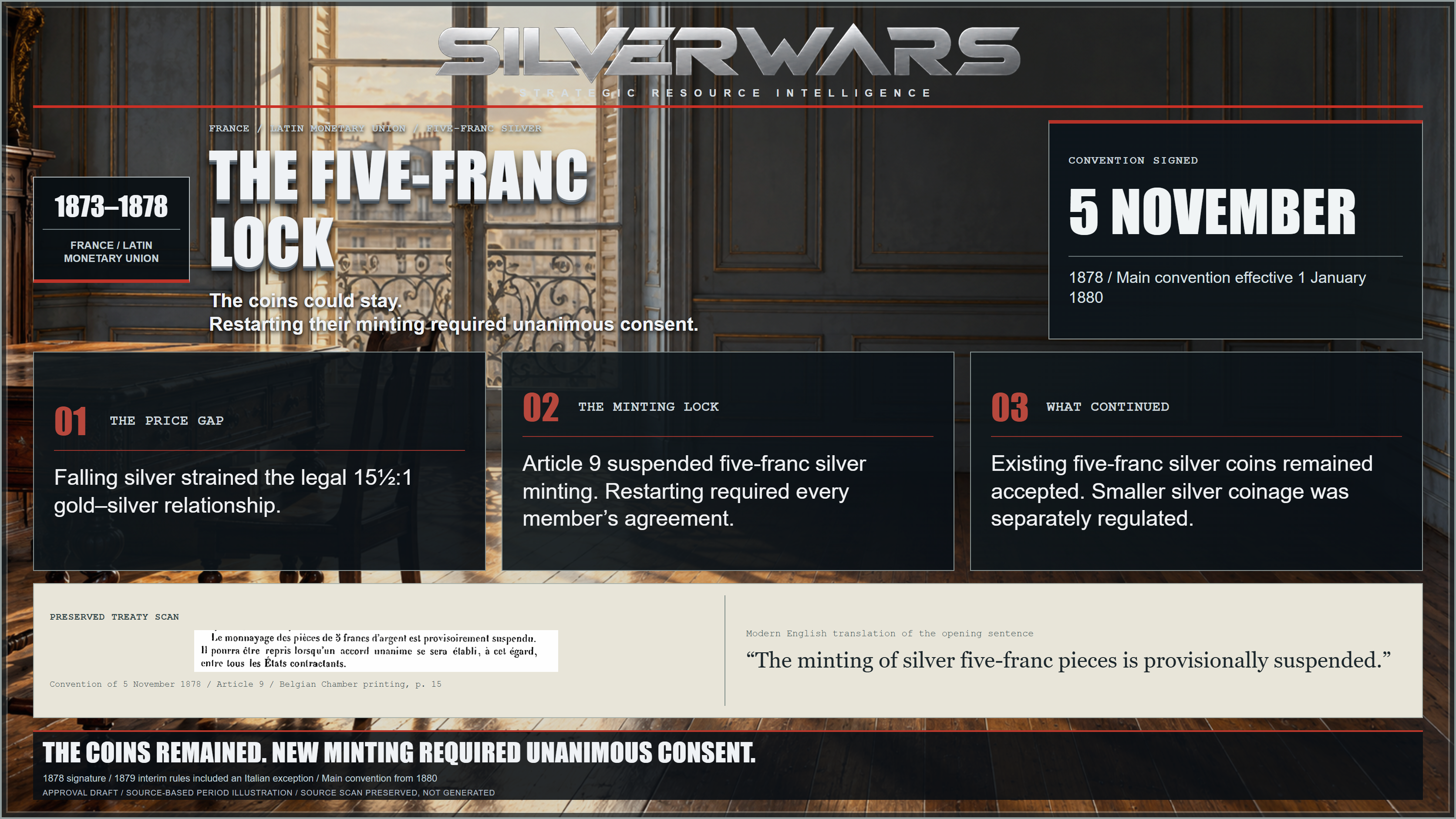
1890 / United States · U.S. silver purchase law
A monthly silver target.
Treasury notes in payment.
The 1890 U.S. Sherman Silver Purchase Act directed the Treasury to buy 4.5 million fine ounces of silver each month, or as much as offered, at market prices within a statutory ceiling. Treasury notes paid for the bullion.
Open full dossier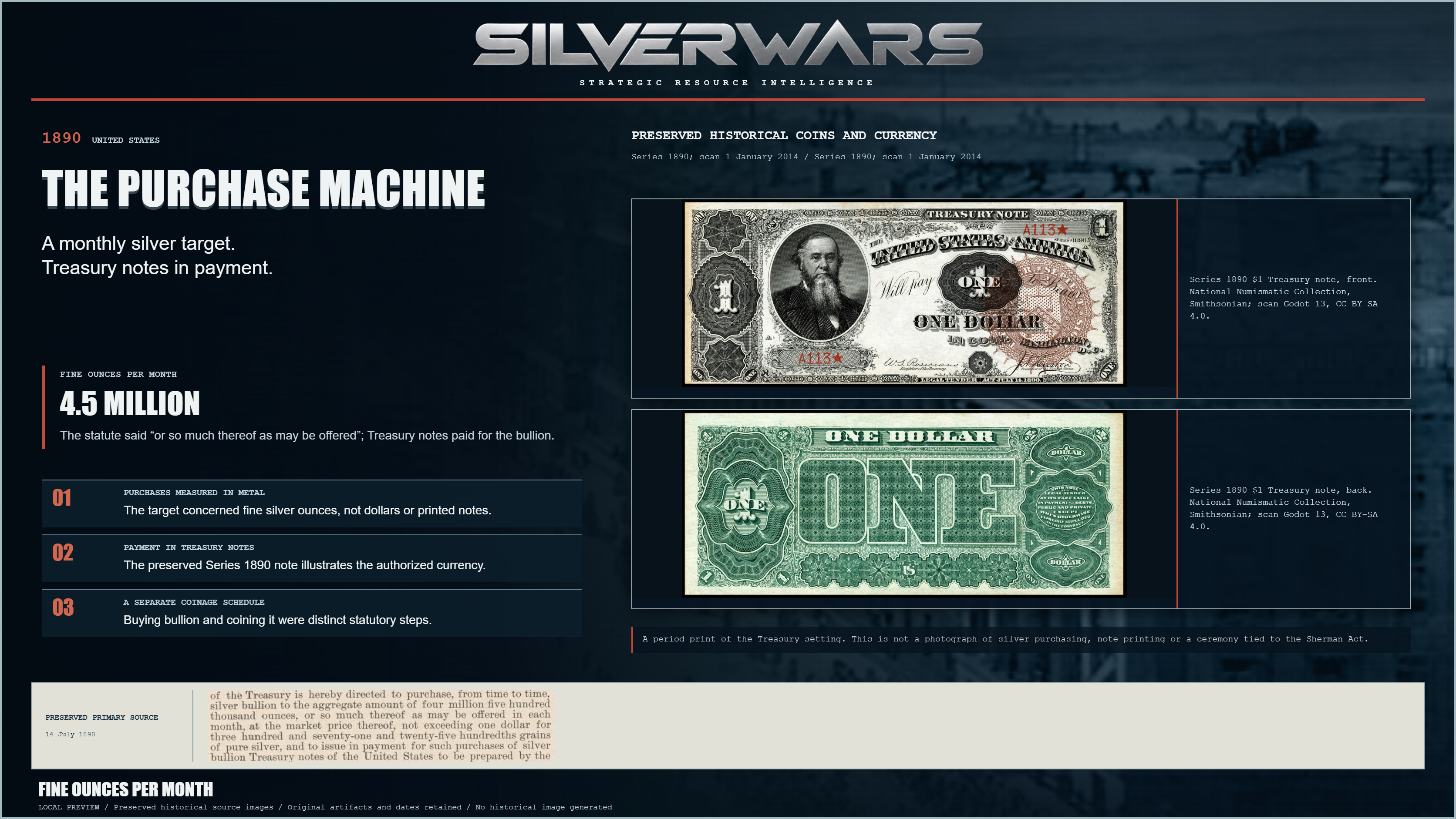
1893 / British India / Britain · Colonial currency / Free silver coinage / Gold link
Silver could still circulate.
Bullion lost its open route to the rupee.
On 26 June 1893, Gladstone announced that British India’s mints had closed to free silver coinage with immediate effect. The government proposed issuing rupees against gold at sixteen old British pence per rupee. It intended a gold standard but explicitly withheld gold’s legal-tender status for the time being. The decision shut the public bullion-to-rupee route while existing silver currency continued.
Open full dossier
1896 / United States / Britain · Western mining finance
Western mineral wealth.
Transatlantic capital.
In June 1896, the financial press reported that the Rothschild–Exploration Company–Cassel syndicate had purchased 270,000 existing Anaconda Copper Mining shares from the Hearst estate. The Chronicle named Kuhn, Loeb & Co. as financing the transaction.
Open full dossier
1896 / Chicago / United States · Political speech / Monetary debate
Silver became a campaign argument.
A speech was still not a law.
On July 9, 1896, William Jennings Bryan challenged the gold standard in his Democratic convention address. The speech placed silver at the centre of a national political argument; it did not itself amend coinage law.
Open full dossier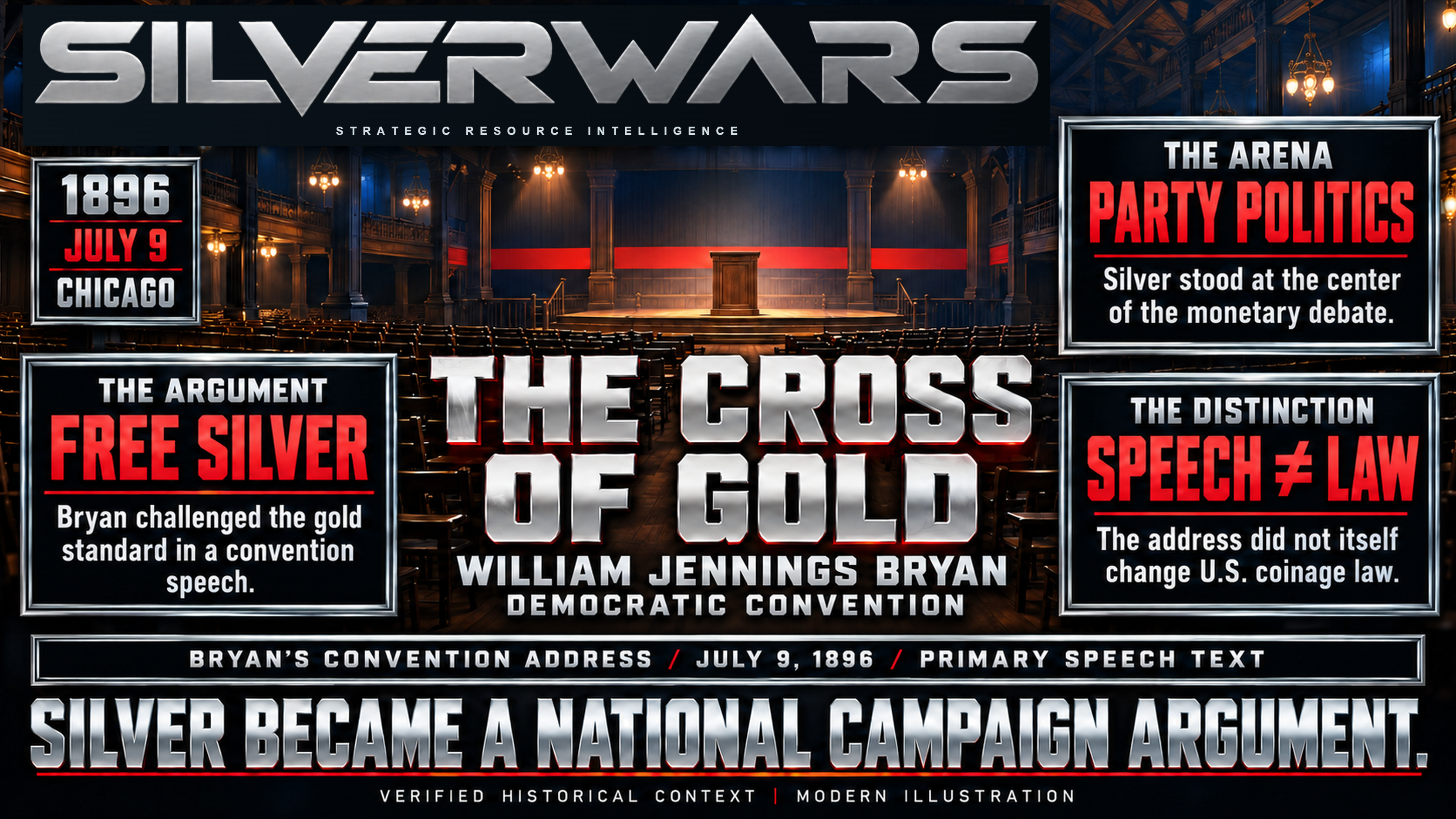
1896–1897 / Yukon / Pacific ports · Gold discovery / Transmission of news
The discovery came first.
The news set the rush in motion.
Rich gold was found in the Klondike district in August 1896. News carried by returning ships reached Pacific ports in July 1897, followed by the 1897–1898 stampede. Discovery, news and mass movement are separate milestones.
Open full dossier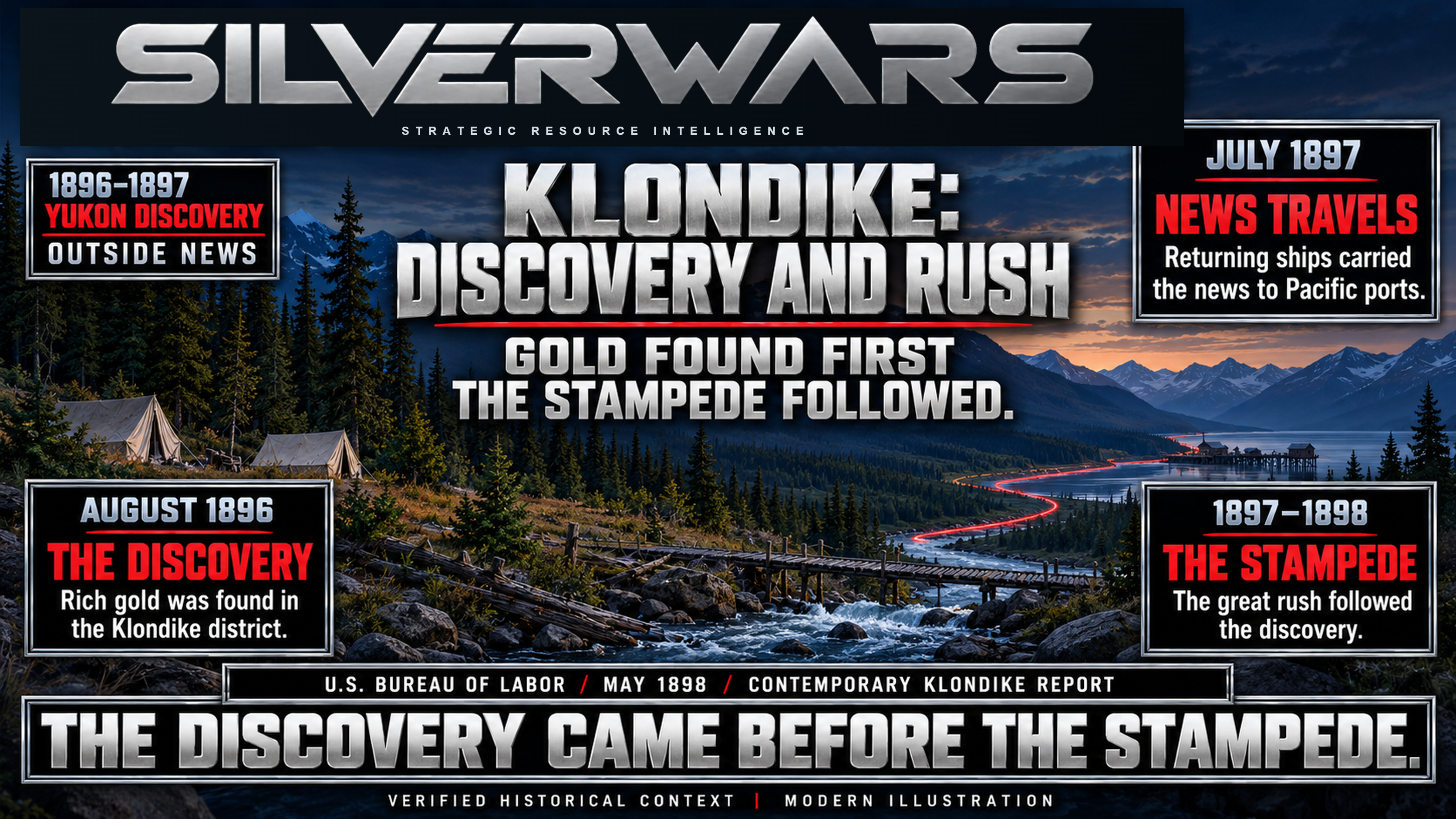
1897 / Japan / Qing China / International finance · Chinese war indemnity / Gold reserves / Currency Act
China paid the indemnity.
Japan changed the standard.
Japan’s Currency Act, promulgated on 29 March 1897, put its main provisions into operation on 1 October. The new monetary standard defined one yen as 0.75 grams of gold. Chinese war-indemnity receipts supplied gold reserves that enabled the change, and Bank of Japan notes became exchangeable for gold rather than silver. Subsidiary silver coins remained legal tender; the law also provided for gradual exchange and transitional circulation of existing silver one-yen coins.
Open full dossier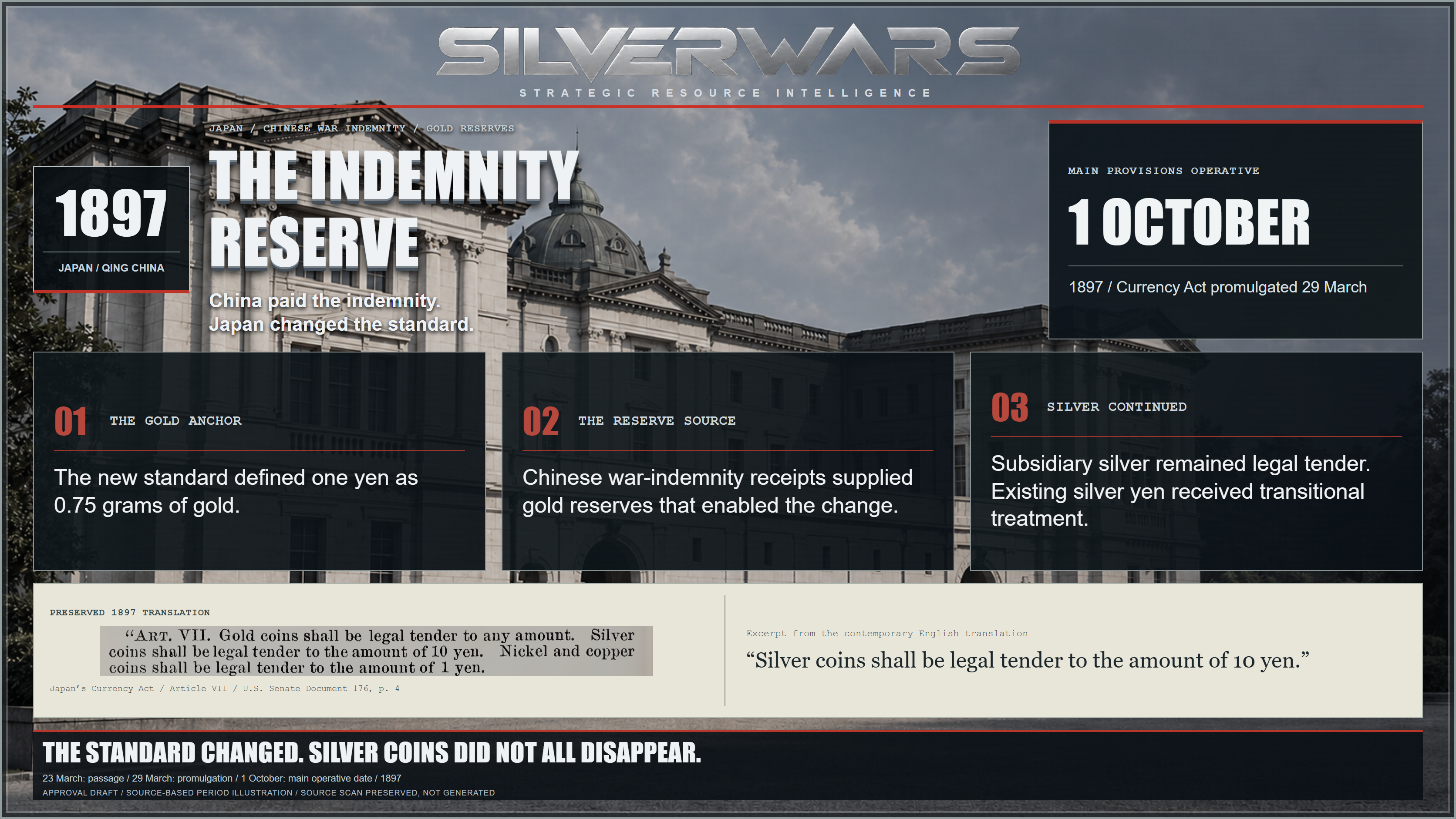
1900 / United States · U.S. monetary law / Gold parity
Gold defined the standard.
Silver remained in the system.
The Gold Standard Act of March 14, 1900 defined the dollar in gold and required parity among forms of U.S. money. It also preserved the existing legal-tender quality of silver dollars and other U.S. money.
Open full dossier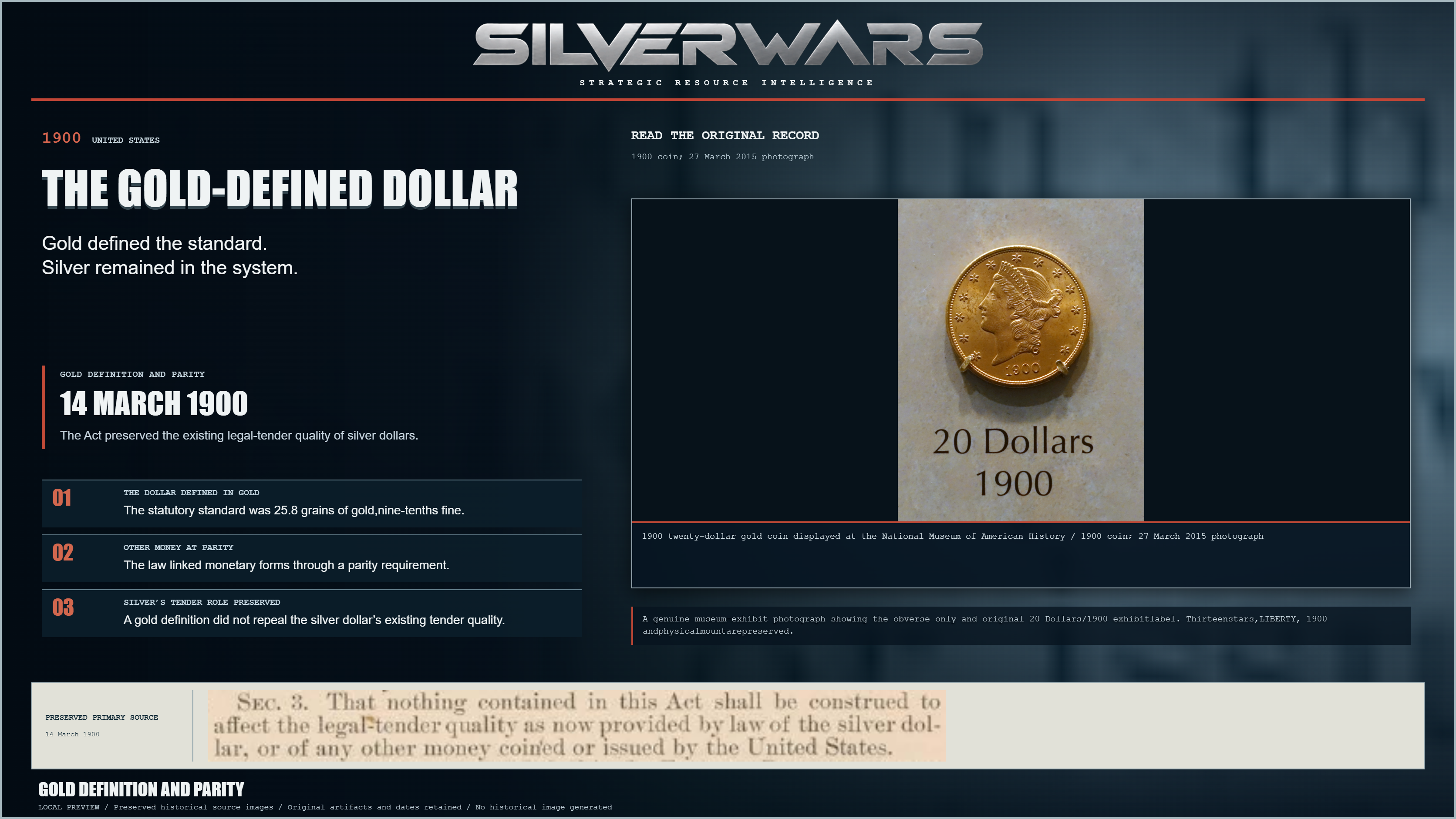
1905 / Mexico · Gold valuation / Silver mint access / Monetary reform
The peso kept its silver.
Its monetary anchor changed.
Mexico’s law of 25 March 1905, effective 1 May, defined the theoretical peso as seventy-five centigrams of pure gold. It ended the private right to bring gold or silver bullion to the mint for coinage, with private bullion intake stopping on 16 April. Silver pesos nevertheless remained unlimited legal tender. Banco de México’s institutional history connects the reform with the worldwide fall in silver prices. The law changed the peso’s standard and controlled mint access while retaining silver money.
Open full dossier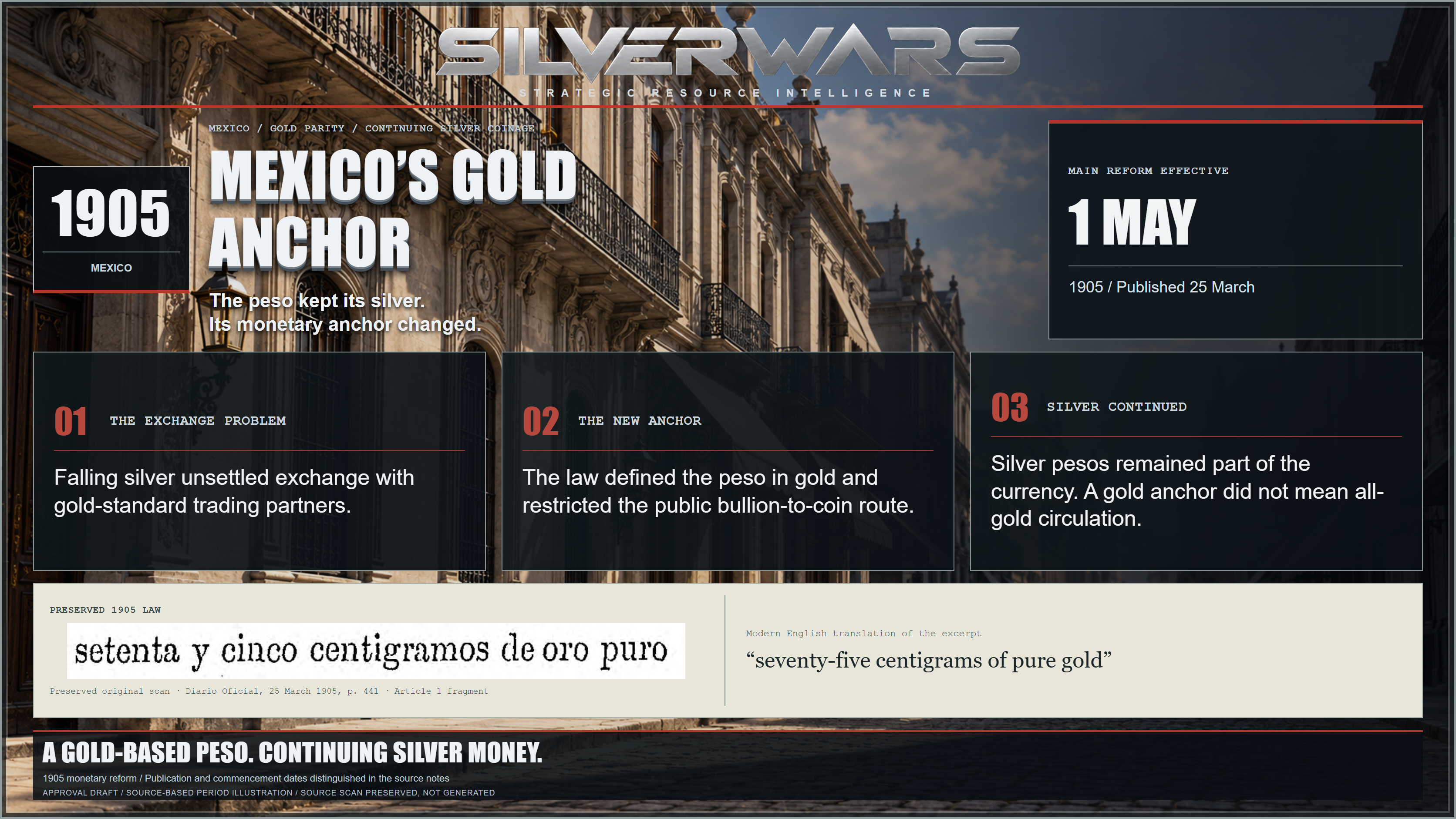
1913 / United States · Federal Reserve Act / Reserve credit
The Act organized
reserve credit.
The Federal Reserve Act established a framework for Reserve Banks, elastic currency, commercial-paper rediscounting and banking supervision. The original enacted preamble and date are preserved in the opening plate.
Open full dossier
1915 / United States · Treasury currency guide / Redemption and silver certificates
Gold at the Treasury.
Silver still in the system.
The Treasury’s guide, revised July 1, 1915, distinguished gold redemption for Federal Reserve notes at the Treasury from the silver-dollar redemption of silver certificates. The explanation documented continuing silver roles alongside the reserve-credit system authorized in 1913.
Open full dossier
1915–18 / Western Front / Britain / United States · Silver-bromide photography / Reconnaissance / Military intelligence
Silver helped record the battlefield.
The image became military intelligence.
During the First World War, silver-bromide photographic plates and films supported aerial reconnaissance. Cameras recorded trench systems and gun positions; photographic interpretation turned those images into information for planning and artillery. The material link is explicit in a former U.S. Air Service photographic officer’s technical account.
Open full dossier
1918 / United States / British India · U.S. law / British imperial finance
American silver.
British imperial priorities.
Under the 1918 U.S. Pittman Act, Treasury silver dollars became bullion. About 200 million fine ounces were sold to Britain, supporting rupee-note redemption, public order and wartime stability in British India.
Open full dossier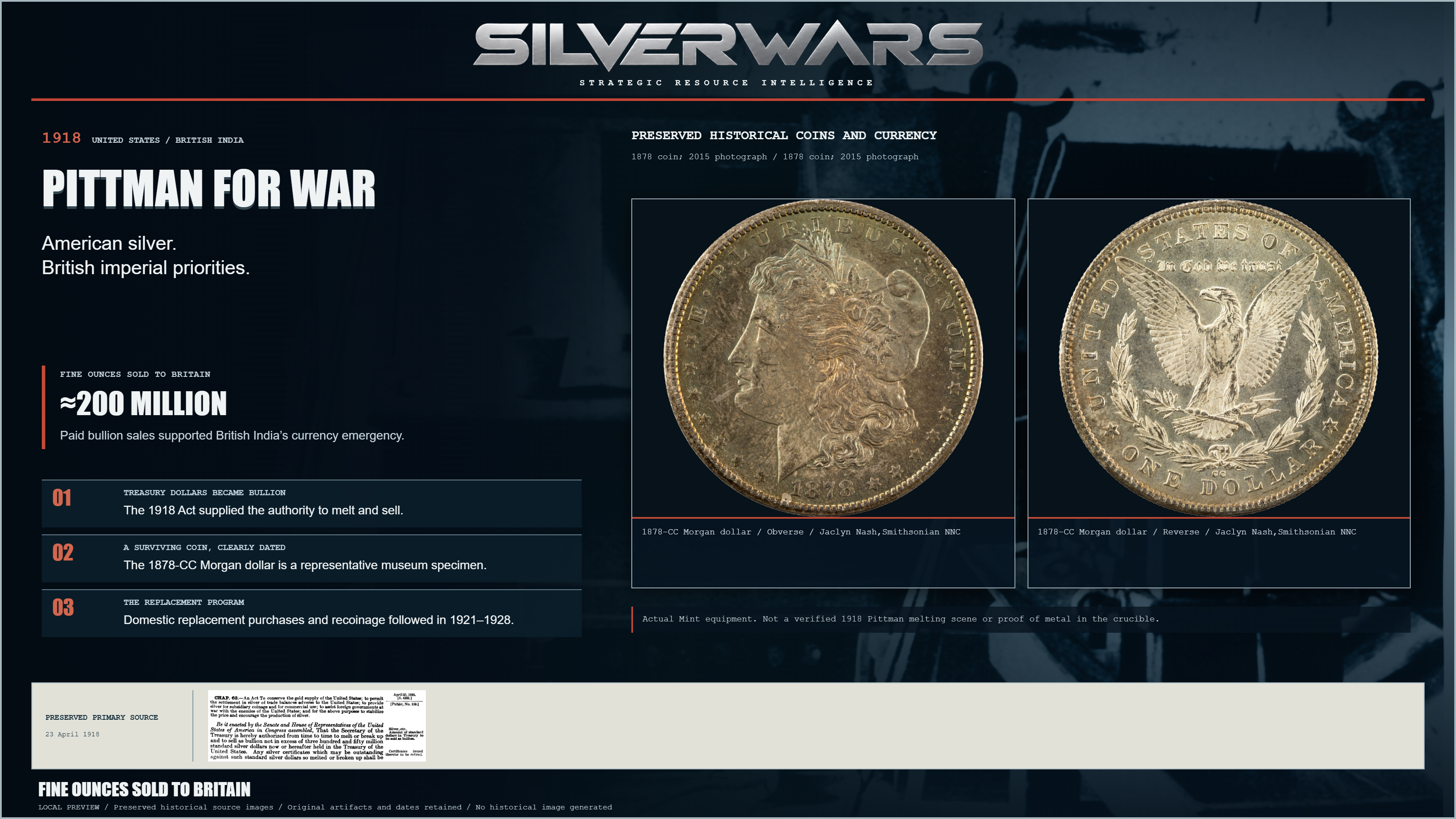
1918 / New York City / United States · Public silver / War Savings stamps / Voluntary metal collection
Household silver went in.
War savings came back.
In 1918, a New York metal market offered to exchange the public’s old silver, gold and jewelry for Thrift and War Savings stamps. Contemporary reports describe expert appraisal and cooperation with the Government Assay Office. The October Scouting issue directed readers to the market and specified payment in War Savings stamps. The drive offered a voluntary route from privately held precious metal into war finance.
Open full dossier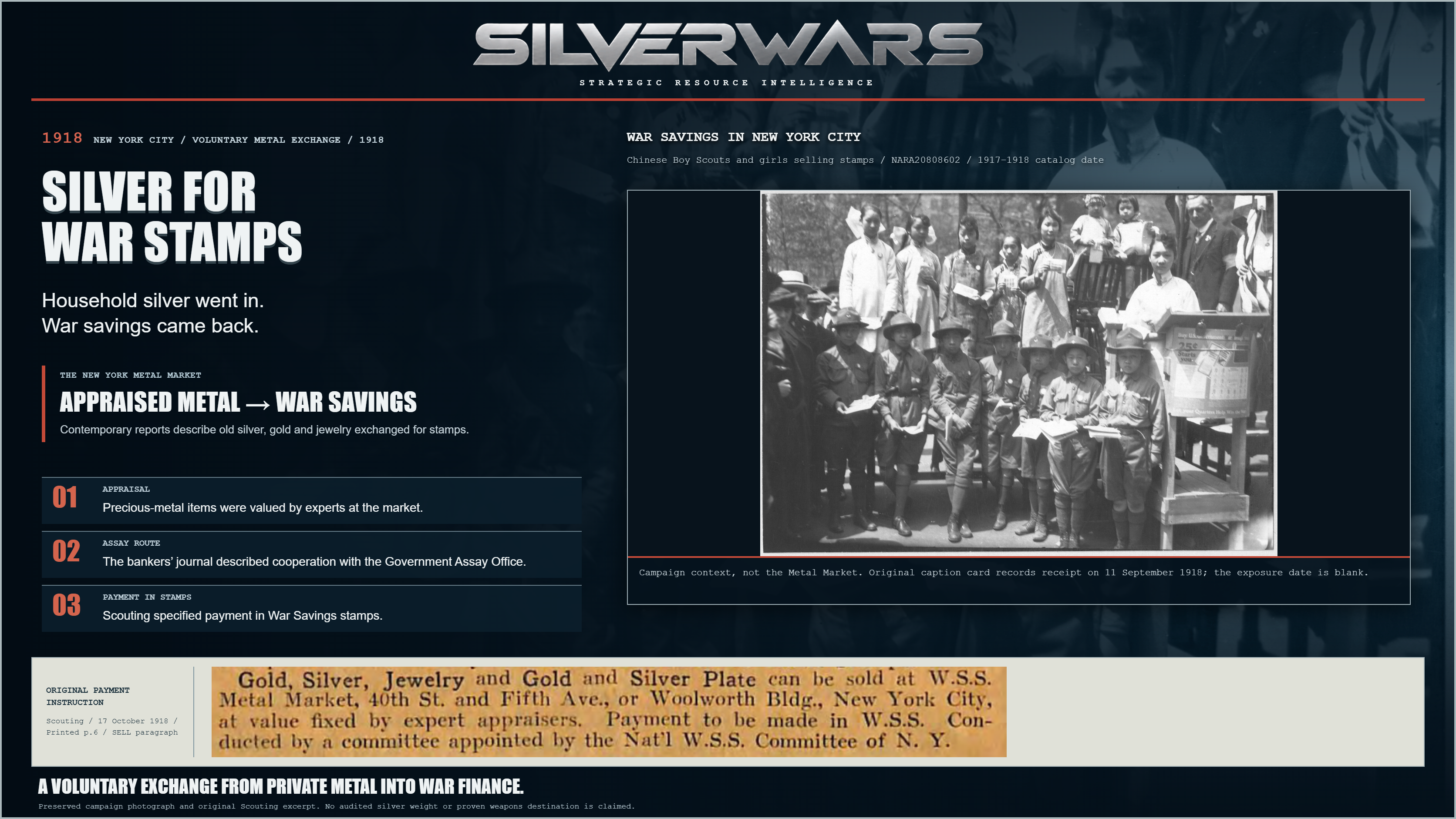
1920 / New York / World silver markets · Contemporary shortage warning
One metal.
Competing claims.
On January 11, 1920, The Brooklyn Daily Eagle warned of a world silver shortage as Asian trade, coinage, paper-currency reserves, and industry and the arts competed for the metal. Its report captured a contemporary warning about the year ahead.
Open full dossier
1933 / London / International agreement · Silver supply / Purchases and sales limits
Limit sales from old stocks.
Absorb part of new mine supply.
The London silver agreement and supplementary undertakings of July 22–26, 1933 combined sales limits with a five-country commitment to absorb 35 million fine ounces of mine production each year. The U.S. share was 24,421,410 fine ounces.
Open full dossier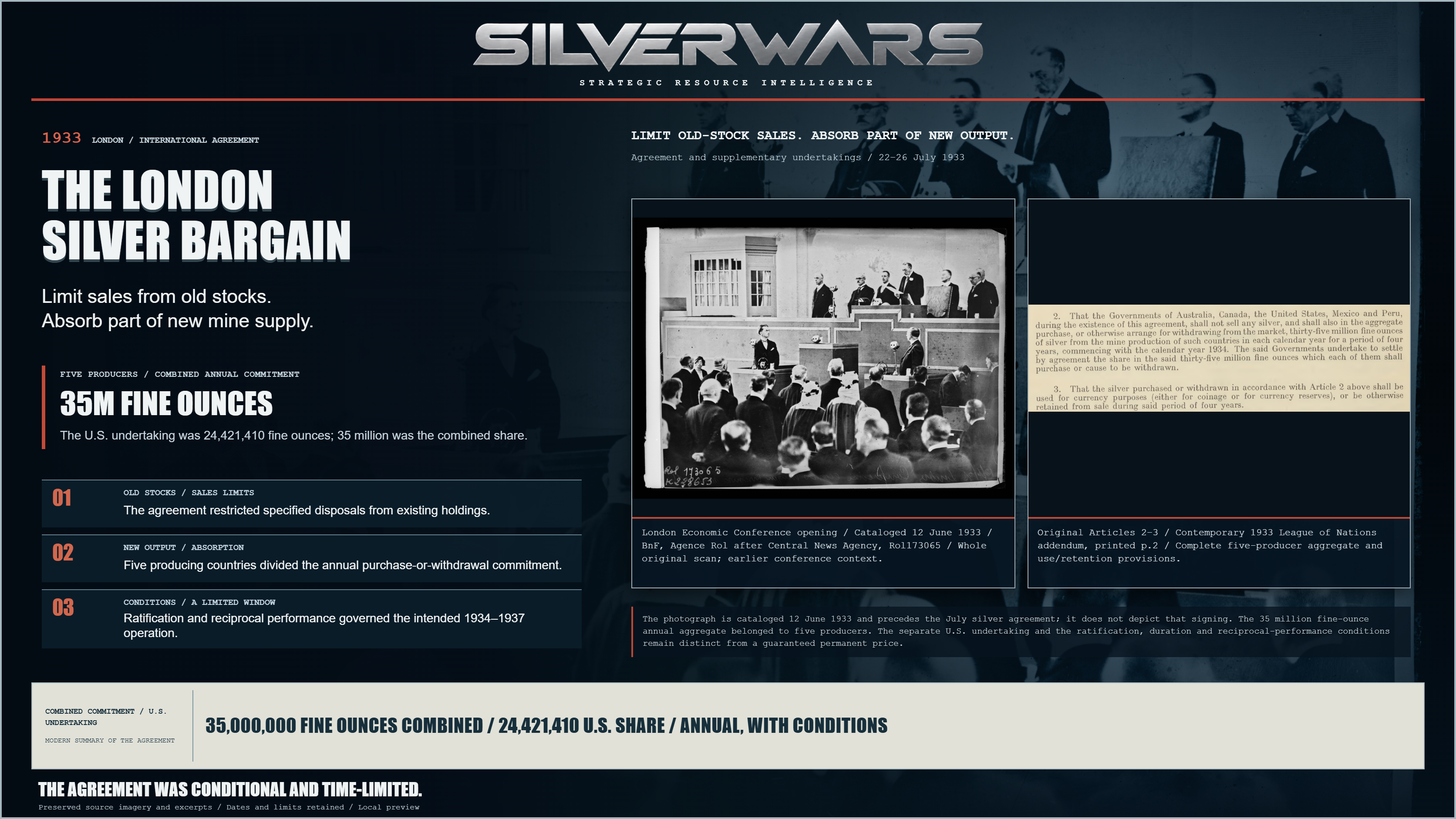
1933 / United States · Presidential proclamation / Mint deposits
Eligible silver entered the mint.
The deposit carried a fifty-fifty split.
Proclamation 2067 of December 21, 1933 opened the U.S. mints to eligible newly mined domestic silver. With the owner’s voluntary consent, half was retained for seigniorage and services and half was coined for the depositor.
Open full dossier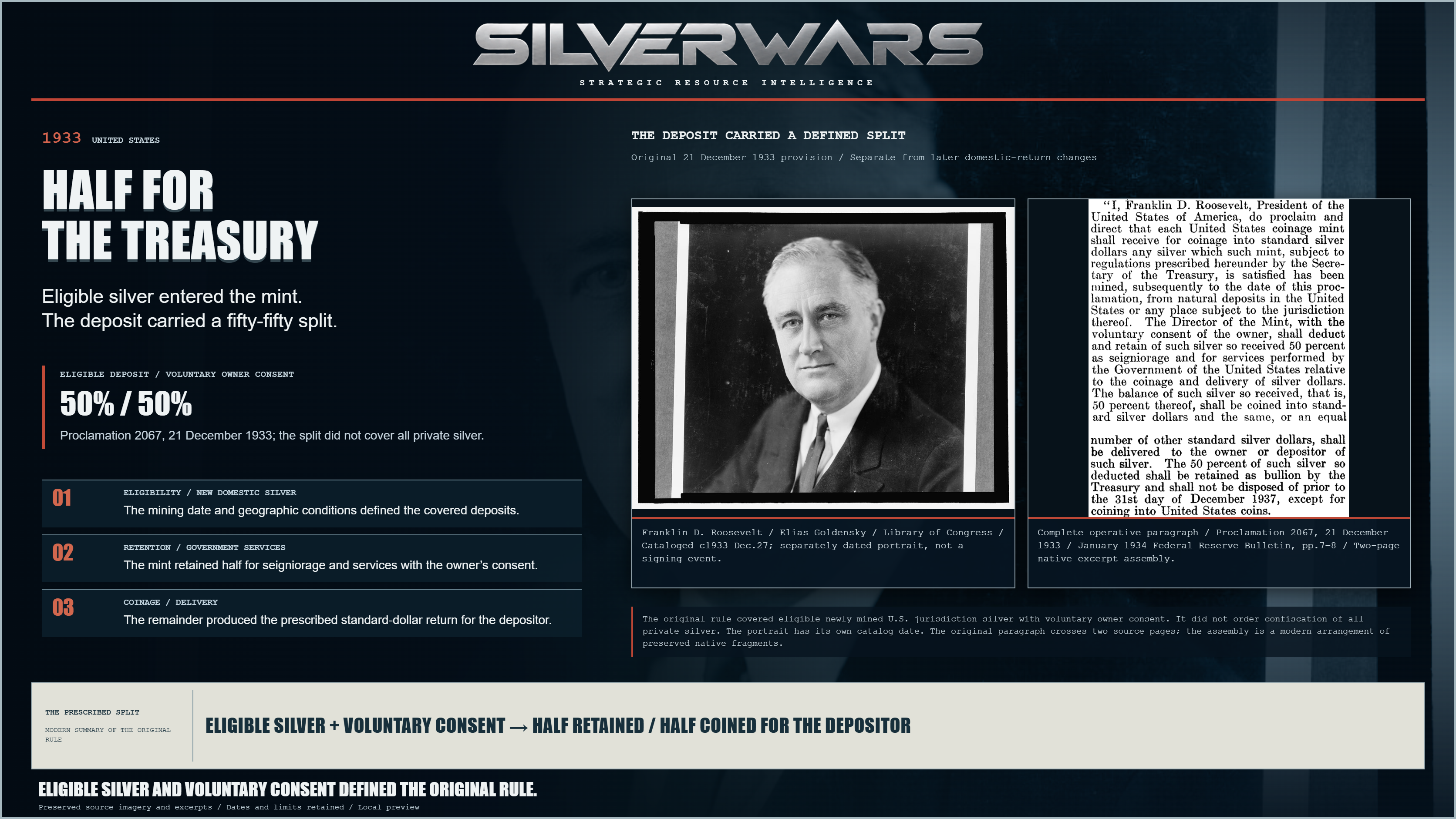
1934 / United States · U.S. law / Silver Purchase Act and EO 6814
Private bullion.
Federal mandate.
The June 19, 1934 Silver Purchase Act gave the President delivery authority. Executive Order 6814, issued August 9, required covered silver bullion in the continental United States to be delivered to U.S. mints, with payment and specified exceptions.
Open full dossier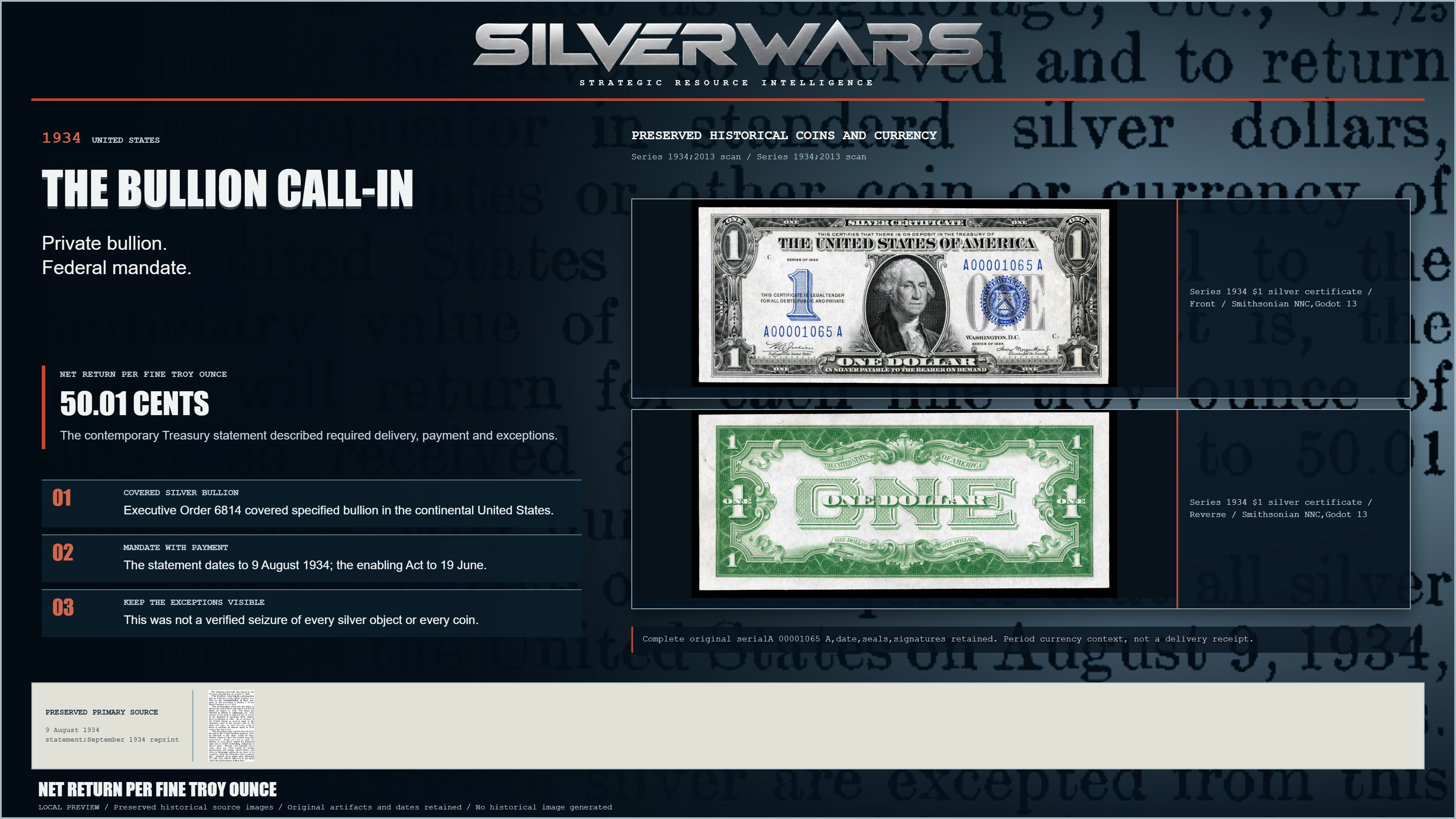
1935 / Mexico · Silver-price crisis / Coin recall / Banknote legal tender / Subsequent return
Silver rose in value.
The government recalled the old coins.
Mexico’s reform, signed 26 April and published 27 April 1935, responded to rising silver prices threatening the coinage. It gave Banco de México notes unlimited legal-tender power and called in specified existing silver one-peso, fifty-, twenty- and ten-centavo coins, while allowing transitional limited use. This was a reversible retreat: in 1936, silver pesos and .720 fifty-centavo pieces returned to circulation. Lower-silver fractional coinage also formed part of the response. Banco de México’s history connects the 1935 price pressure with the U.S. silver-purchase program.
Open full dossier
1935 / Republic of China · Currency decree / Silver exchange
The decree changed the payment rule.
Silver was to be exchanged for notes.
China’s decree of November 3, effective November 4, 1935 made notes of three government banks full legal tender and prohibited silver dollars and bullion for currency use. Covered silver was to be handed over through the Currency Reserve Board or its agents.
Open full dossier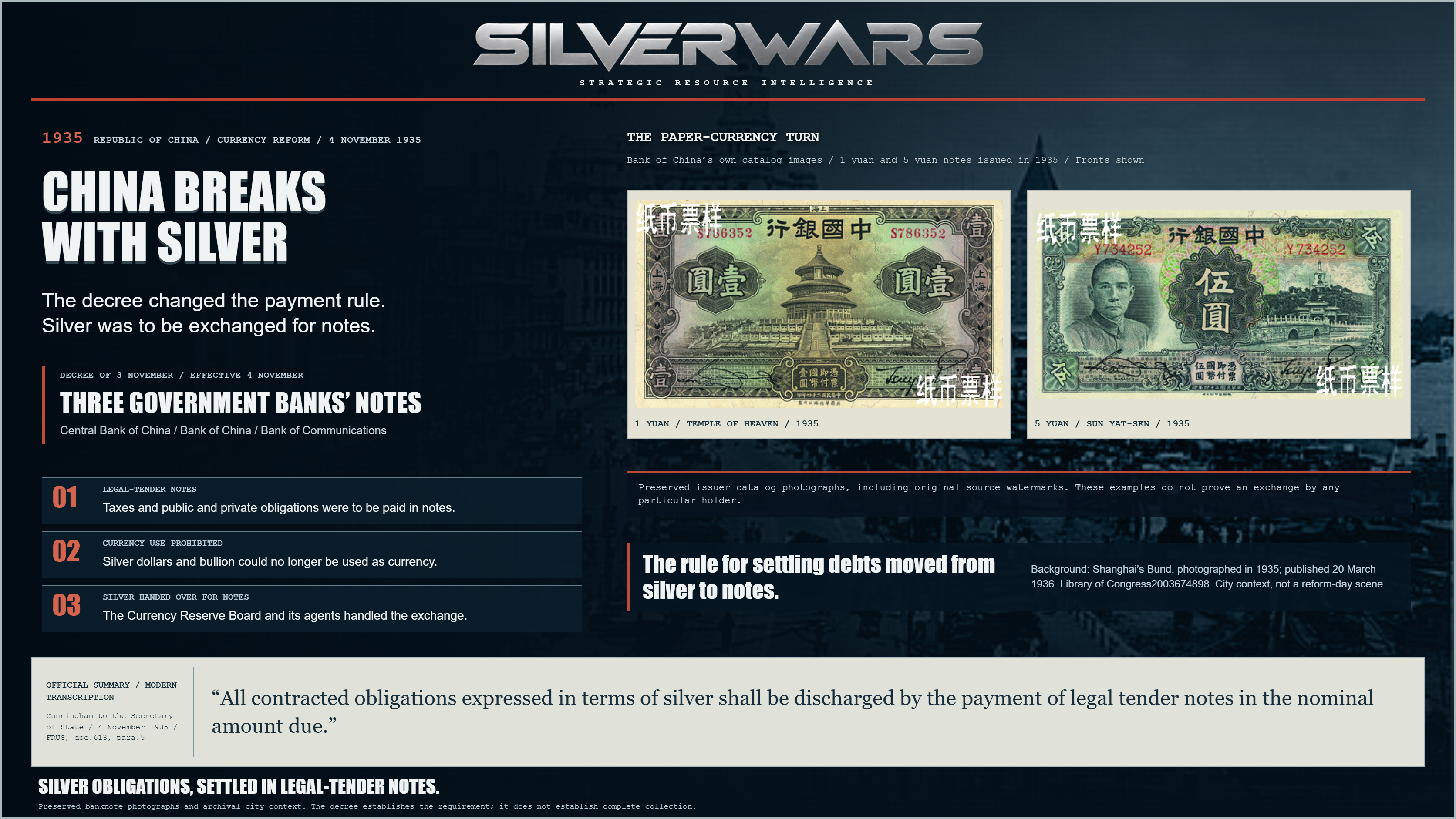
1937 / United States · Presidential proclamation / Domestic silver return
The proclamation was signed in 1937.
The lower return applied to 1938 mining.
The December 30, 1937 proclamation changed the terms for eligible silver mined from January 1, 1938. The net return fell from about 77.57 cents to about 64.64 cents per fine troy ounce, with a 50 percent deduction.
Open full dossier
1938 / United States · Owen’s monetary commentary / Senate Document 23
The law set
the monetary value.
In a commentary with a December 1938 foreword, former Senator Robert L. Owen argued that money rested on law, government credit and public demand. His silver example separated statutory monetary valuation from bullion’s market price.
Open full dossier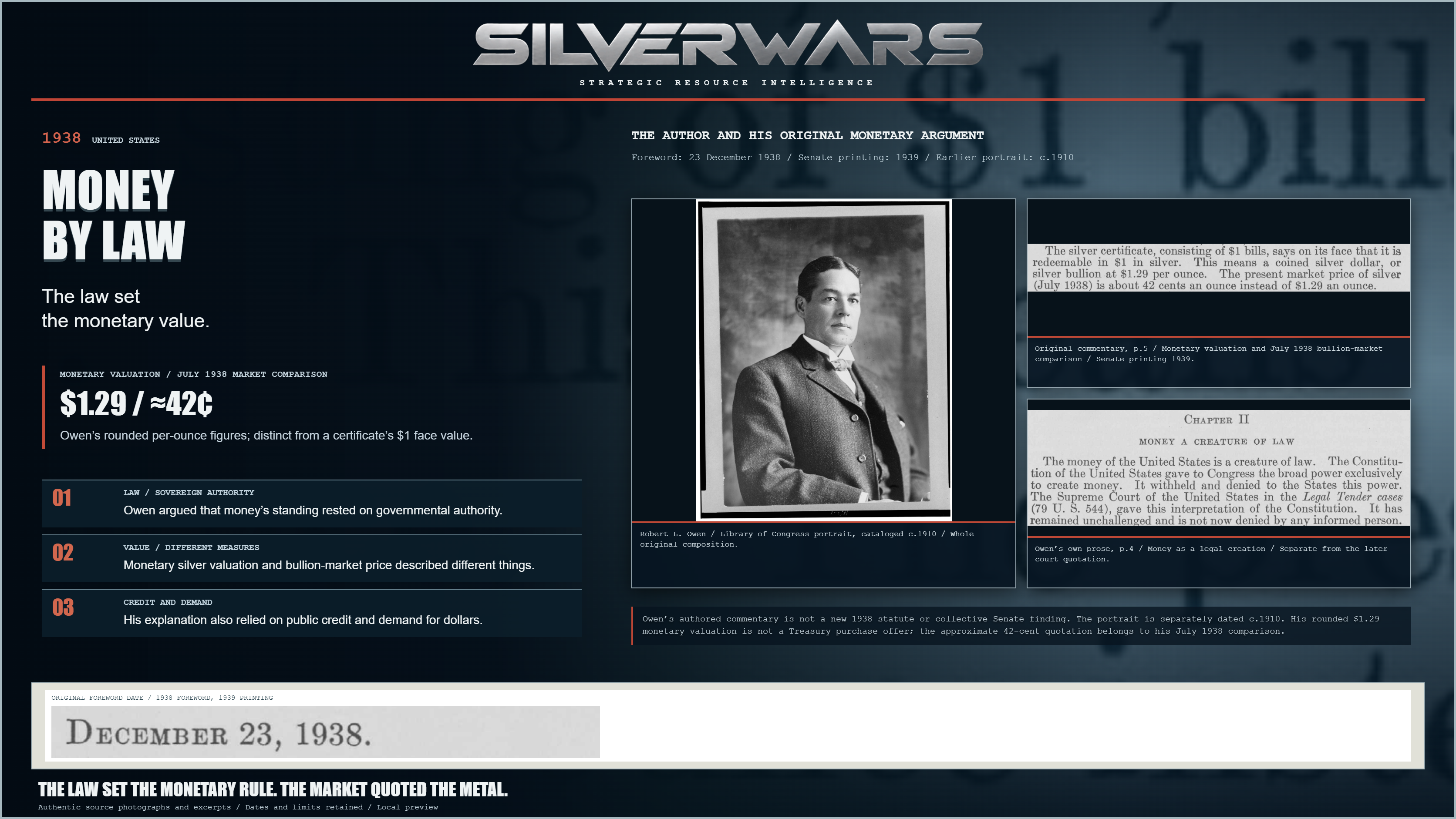
1938 / West Point / United States · Bullion depository / Physical storage
Monetary stocks needed storage.
West Point supplied a physical address.
Construction of the West Point Bullion Depository was completed in June 1938. Built to store silver near the military academy, it was a storage facility long before becoming the official West Point Mint in 1988.
Open full dossier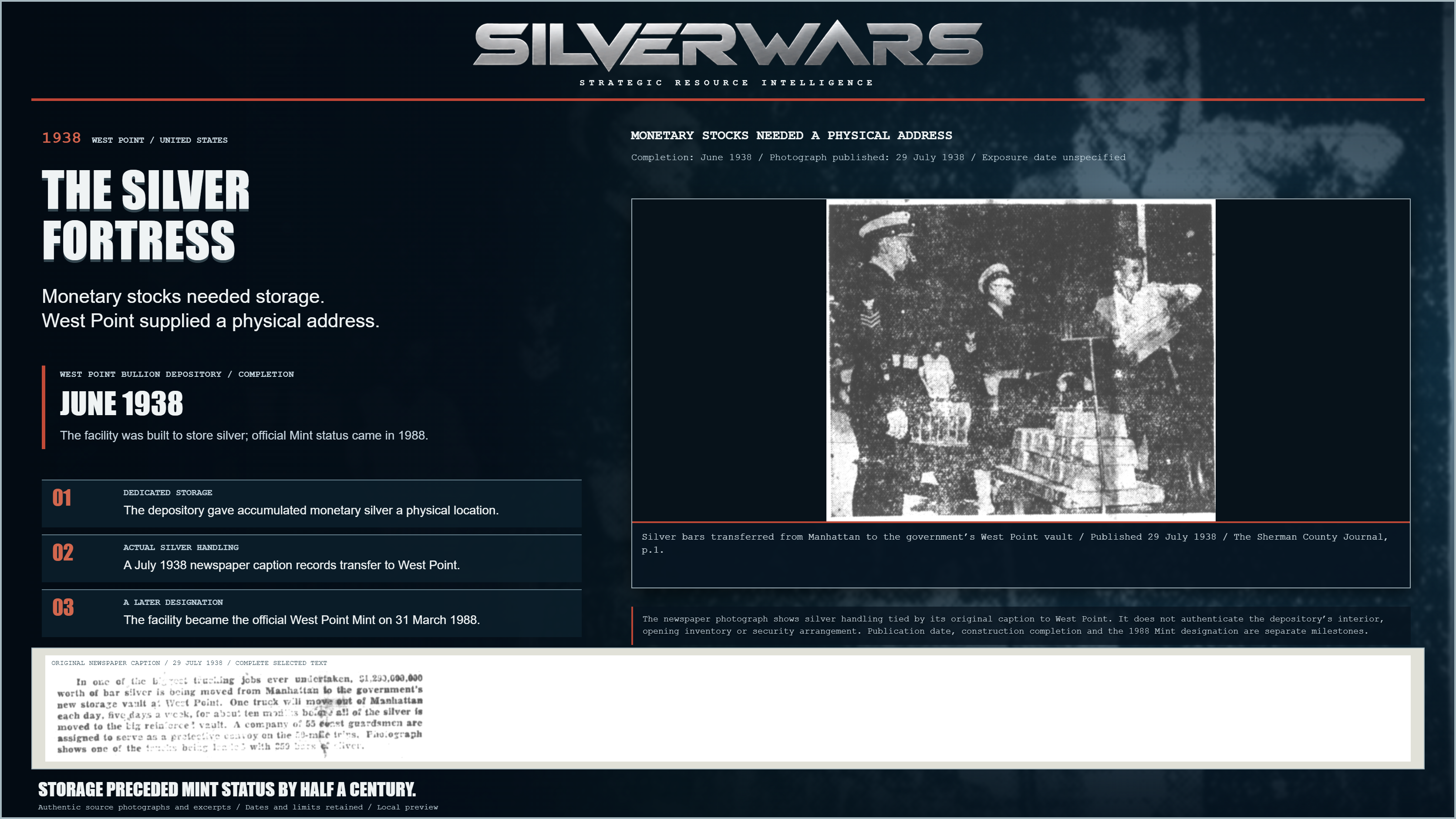
1939 / United States · U.S. law / Newly mined domestic silver
Congress fixed the split.
The eligible depositor received about 71.11 cents.
Section 4 of the July 6, 1939 Act set a 45 percent retention and 55 percent coinage split for eligible newly mined domestic silver. Treasury regulations announced a net return of about 71.11 cents per fine troy ounce.
Open full dossier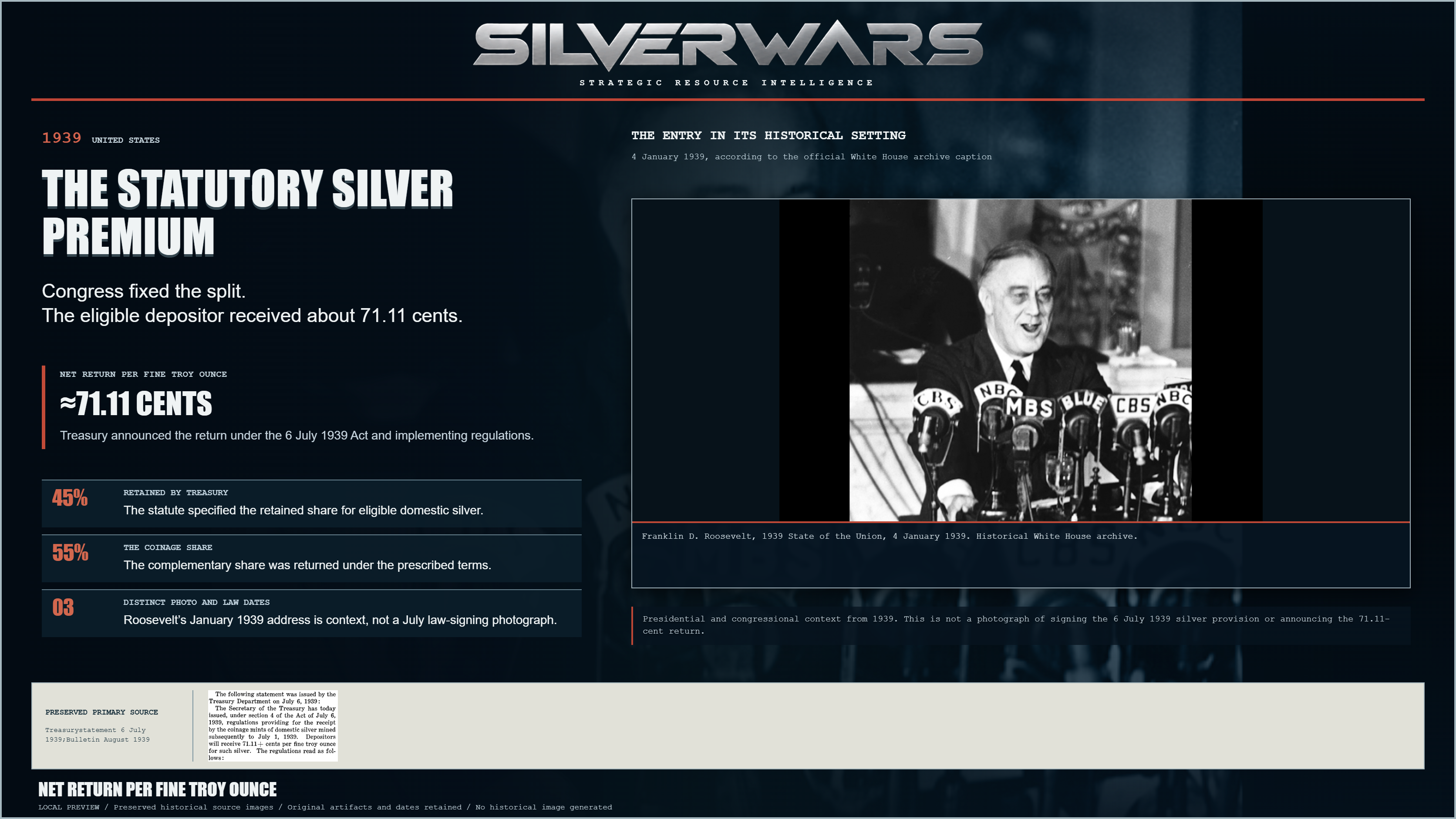
1940–1947 / British India / India · Wartime coinage / Quaternary silver / Nickel replacement
The rupee kept its name.
Its metal changed.
Wartime pressures changed the metal inside British India’s rupee. The RBI dates quaternary silver coinage from 1940 and its replacement by pure nickel to 1947. The earlier standard had been approximately .91666 silver; an official Treasury compilation identifies quaternary issues as 50 per cent silver. These were successive changes in newly issued coinage, separate from the 1893 closure of the mints to free silver coinage and from Lend-Lease transfers. The evidence supports an alloy transition without assigning a single day on which every older silver coin lost legal-tender status.
Open full dossier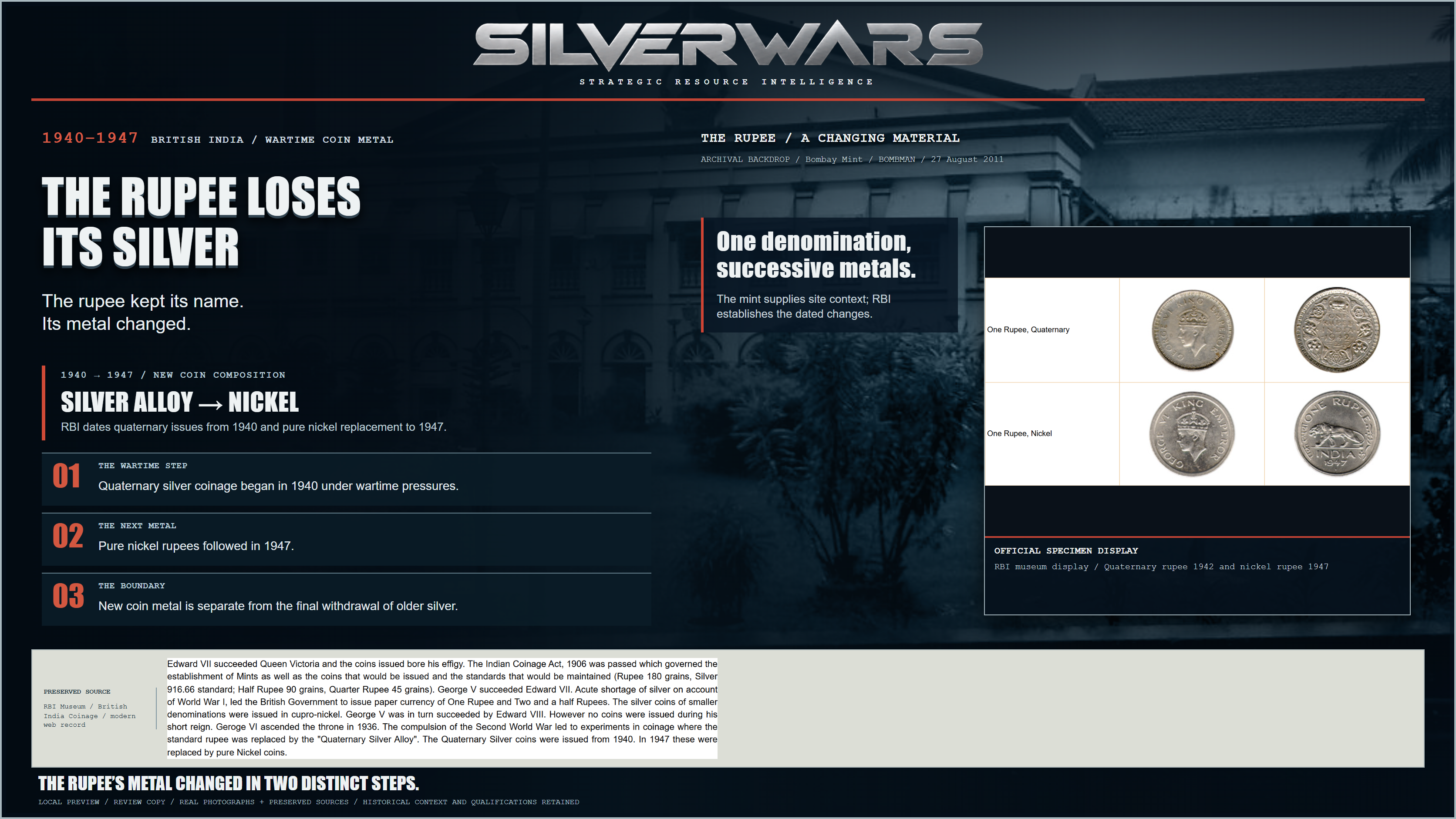
1941 / United States / British India · U.S. law / British imperial wartime stability
Again: silver for
British imperial stability.
U.S. Treasury silver again helped sustain Britain’s wartime imperial economy. Officials sought coinage supply and currency stability in British-ruled India, a base for Allied operations. The 1946 Mint report accounts for silver transfers in fiscal 1943–46.
Open full dossier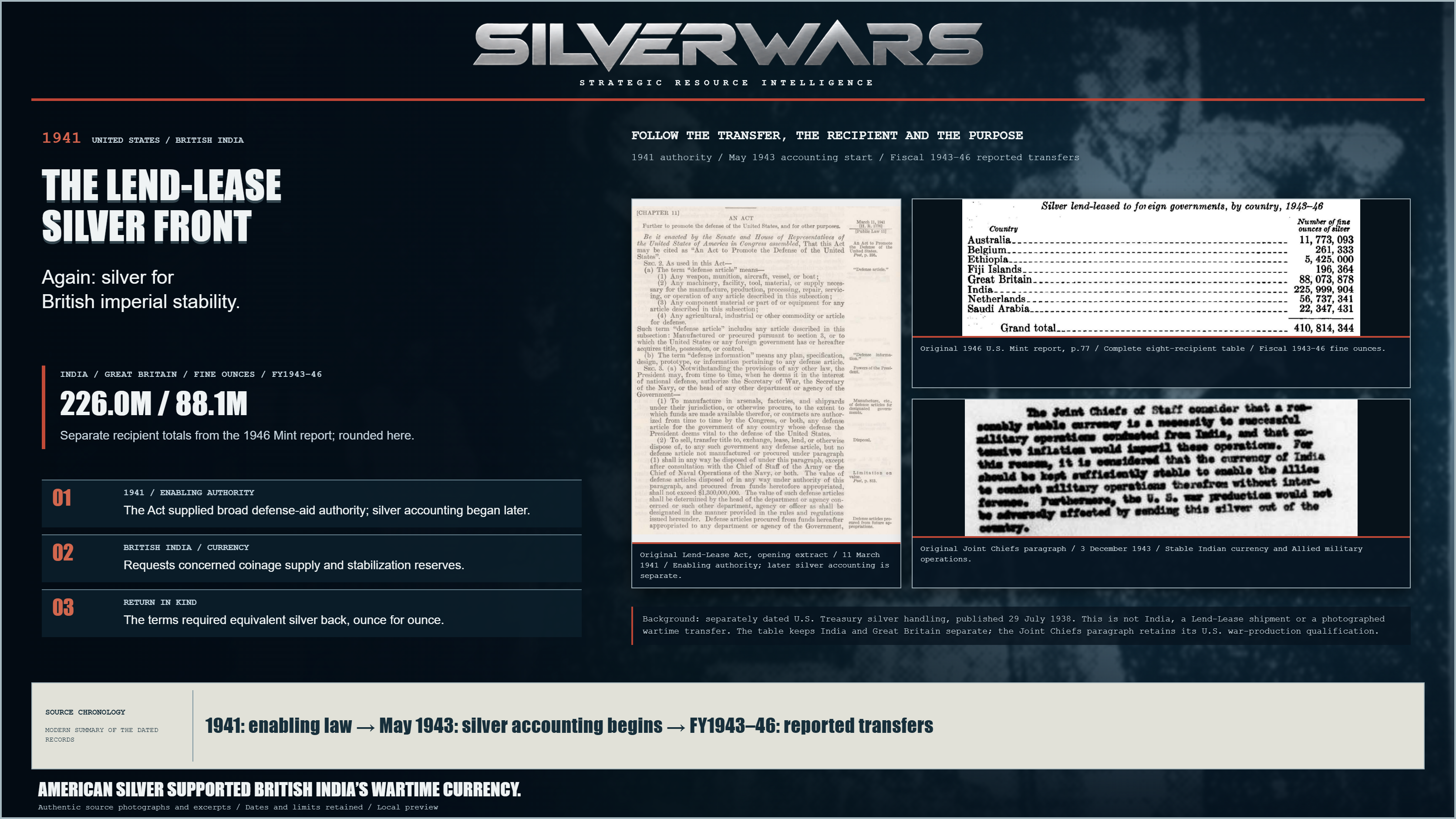
1942 / United States · U.S. policy / Monetary reserves and war industry
A stockpile is not
the same as access.
War factories needed silver, while Treasury’s holdings served different monetary and industrial purposes. A September 1942 newspaper editorial attacked restricted access. The domestic loan program required recoverable use; its later DPC/RFC closeout records full credit for the original loan quantity.
Open full dossier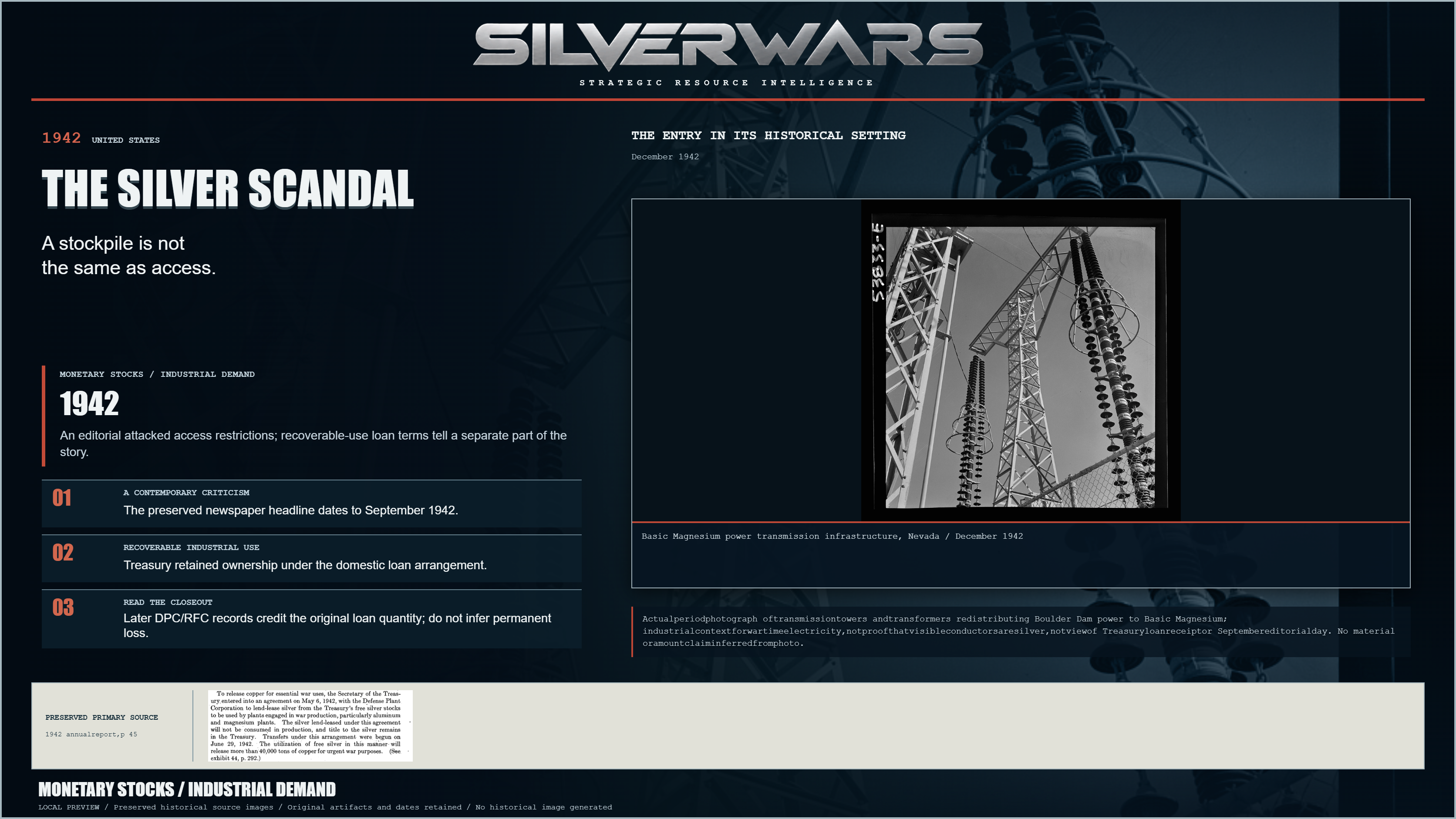
1942 / United States · War Production Board / Silver allocation / Manufacturing restrictions
Silverware faced limits.
Priority orders had exceptions.
On 29 July 1942, the War Production Board issued Conservation Order M-199, citing a defense-related silver shortage. The order restricted sales, purchases and processing of material legally defined as foreign silver for listed uses, including silverware and jewelry. It imposed transitional quantity limits and an October cutoff, with exceptions for orders rated A-3 or higher. Certificates, inventory limits and enforcement provisions made the allocation rules operative. Government agencies and specified small repairs had separate exceptions.
Open full dossier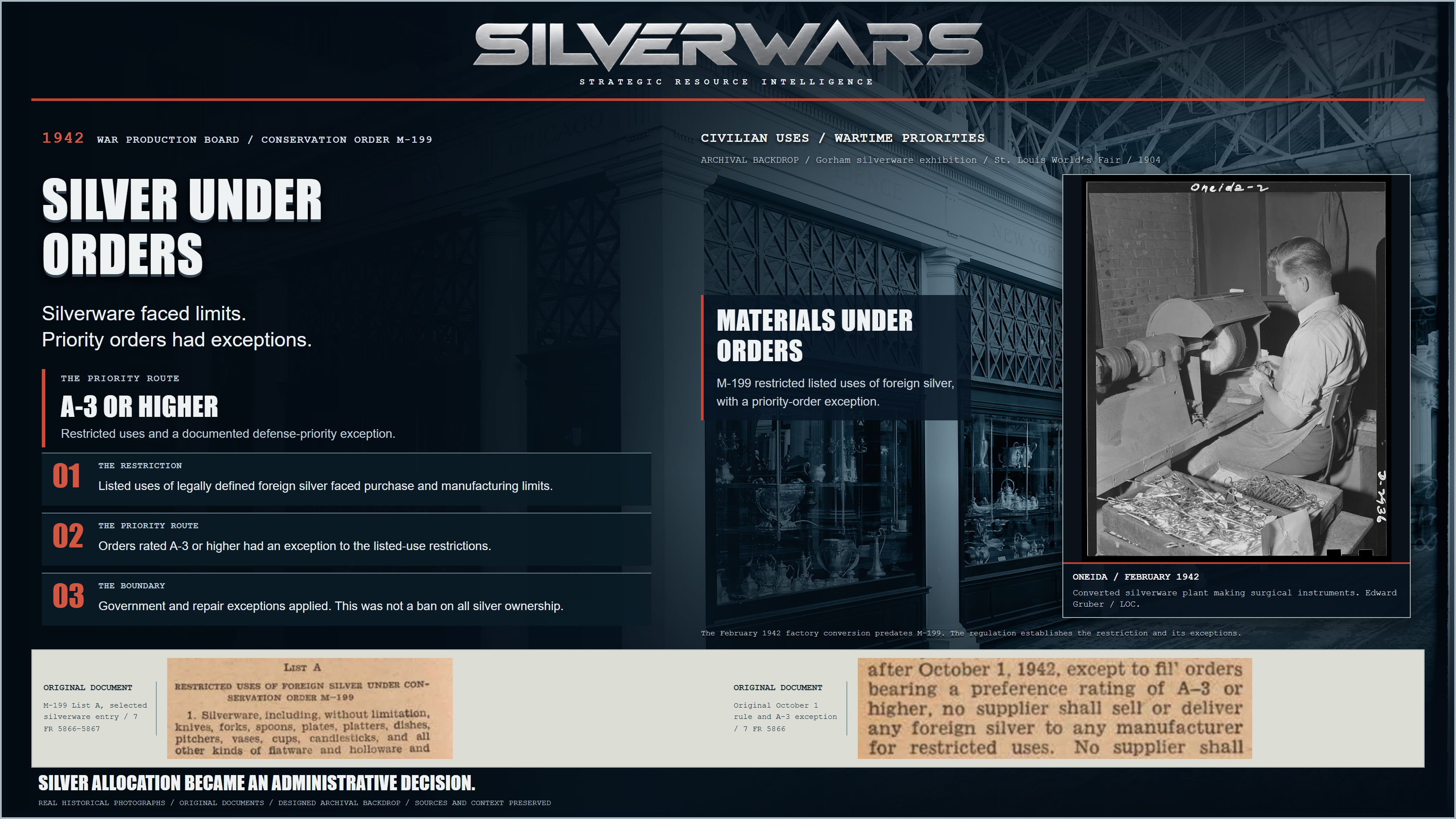
1942 / United States / Silver imports · Office of Price Administration / Imported bullion / Explicit maximum price
The import price had a ceiling.
The ceiling could change.
Effective 10 August 1942, OPA Maximum Price Regulation No.198 capped imports of standard commercial silver bars at 35.375 cents per troy ounce, f.o.b. New York or San Francisco, with specified transportation adjustments. The regulation was issued on 5 August under the Emergency Price Control Act of 1942. Amendment No.1 raised the ceiling to 45 cents effective 31 August and allowed a temporary, reported exception for certain contracts made before 10 August. This is direct evidence of a silver import-price restriction, with a defined scope and a changing rate.
Open full dossier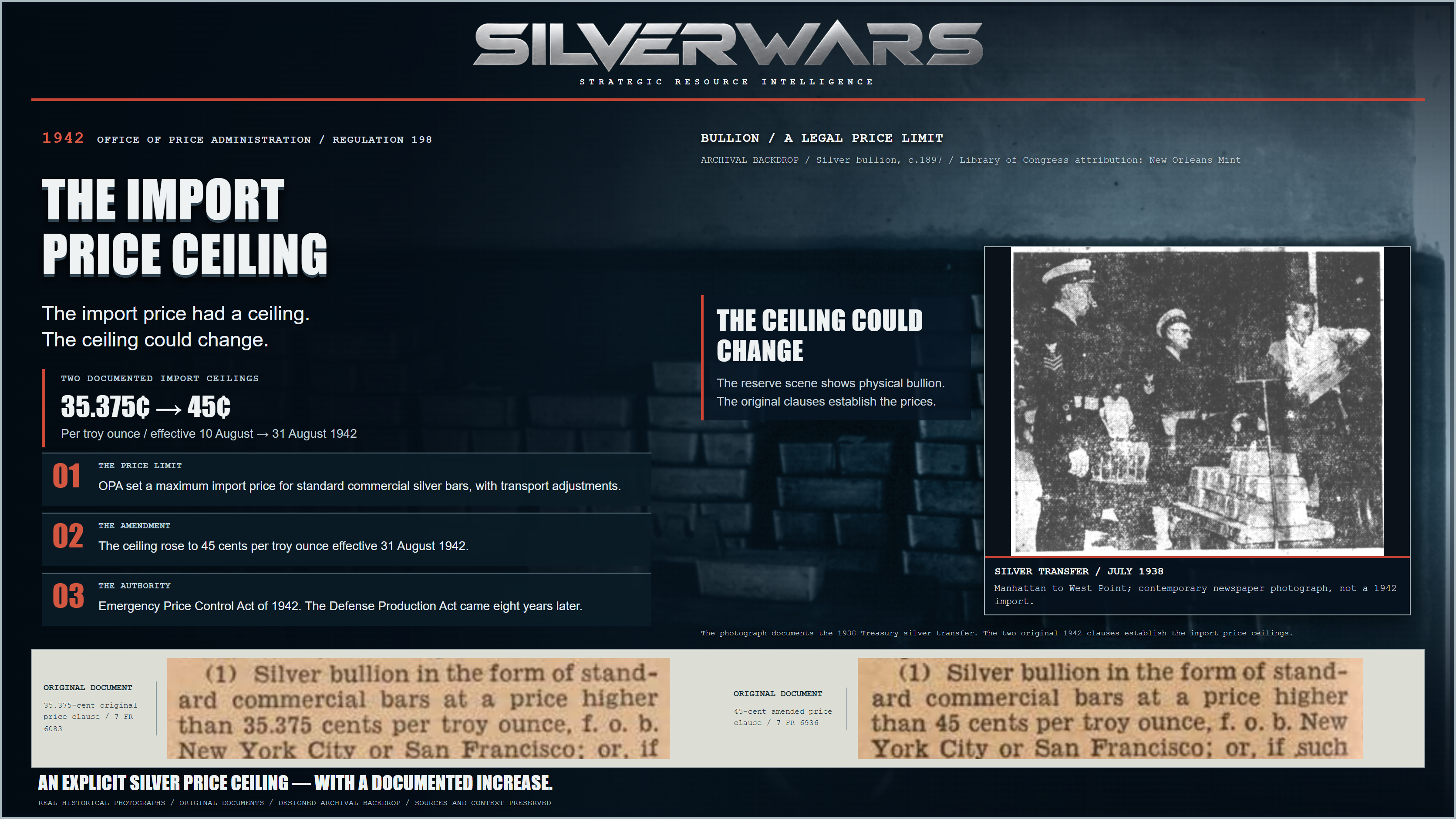
1942–43 / United States / Oak Ridge · Treasury bullion / Uranium enrichment / Wartime copper
Treasury bullion became magnet windings.
A monetary reserve powered uranium enrichment.
The Army arranged a Treasury silver loan in August 1942; withdrawals began on 30 October. Copper supply eased during 1943 and entered the War Production Board’s approximate-balance group in January 1944, while silver fabrication continued into August 1944. The original procurement decision preceded that easing; silver work continued as copper conditions changed. Treasury retained ownership and required the metal’s return.
Open full dossier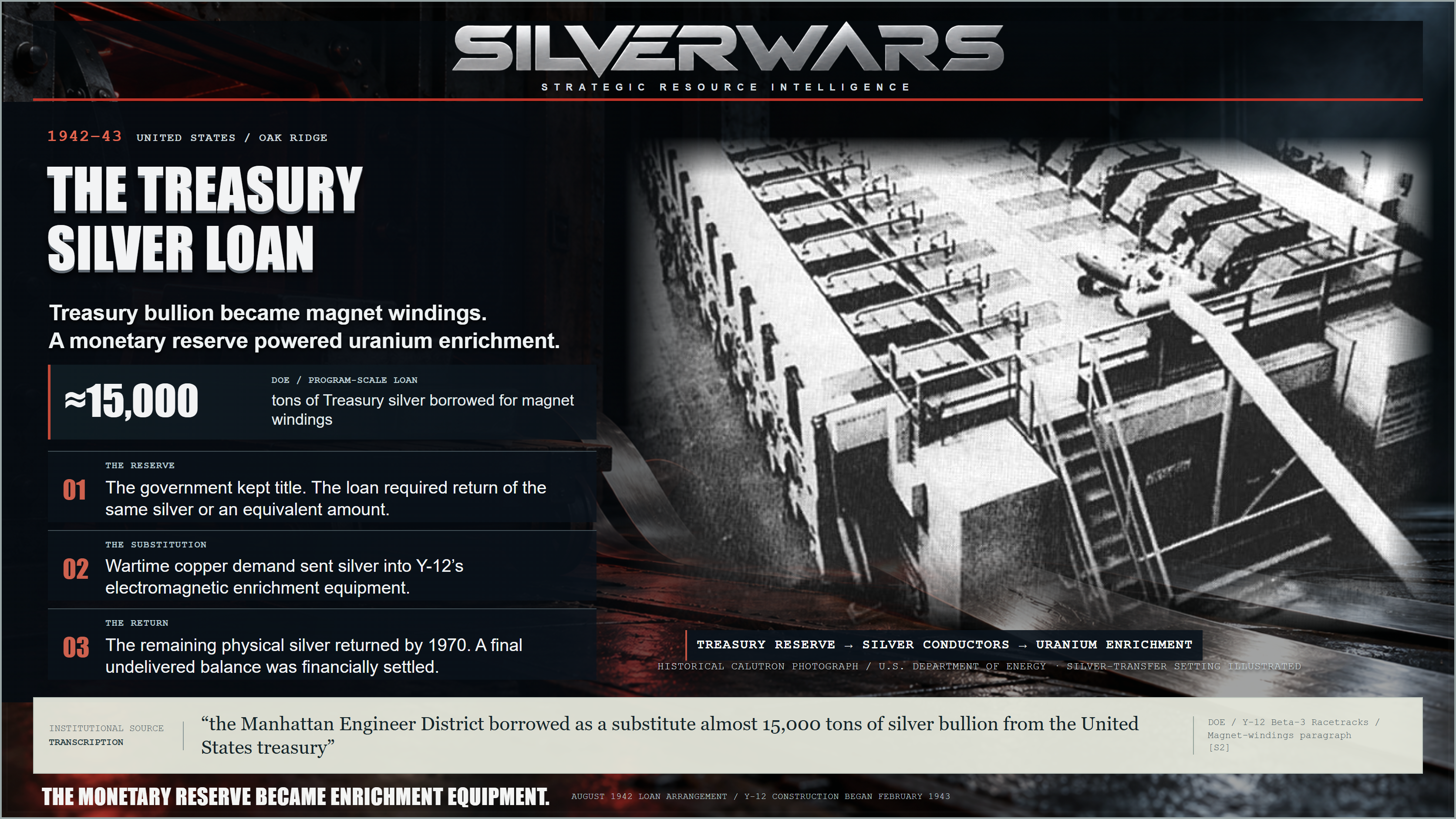
1945 / United States · U.S. war surplus / Trust and release authority
Disposal power required
public trust.
Truman announced Stuart Symington’s appointment as Surplus Property Administrator in September 1945. Decades later, Symington remembered personal confidence as part of his selection. His remark about silver concerns the integrity of the person entrusted with public property; it does not establish a bullion theft.
Open full dossier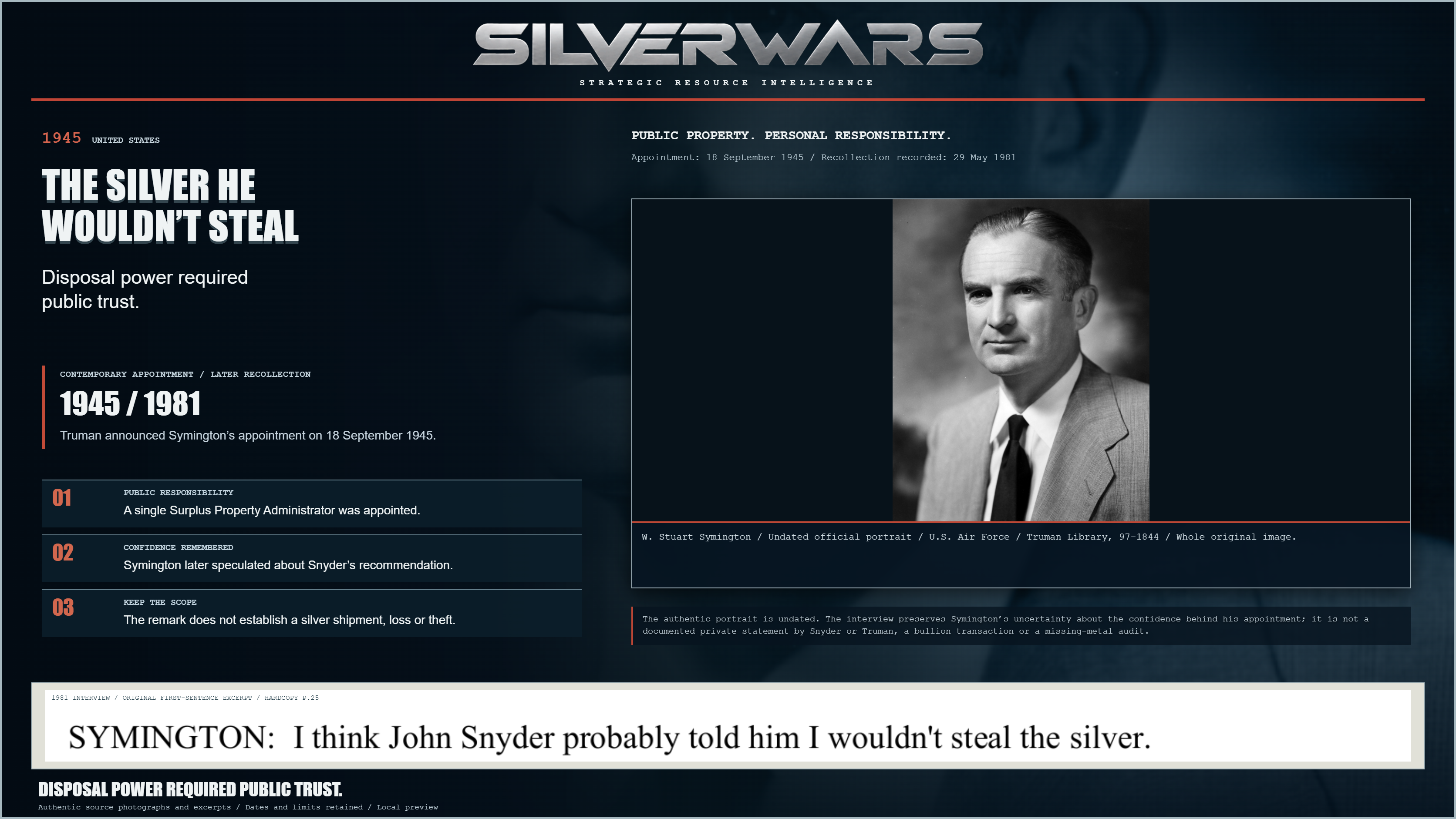
1946 / Britain · British law / Ordinary coinage and silver recovery
The face value stayed.
The silver left.
Britain’s Coinage Act 1946 authorized cupro-nickel replacements for ordinary silver coins. Hugh Dalton proposed gradual withdrawal of the old coins to recover metal for industry and Britain’s U.S. Lend-Lease obligation. The new coins were dated 1947; Maundy money retained silver.
Open full dossier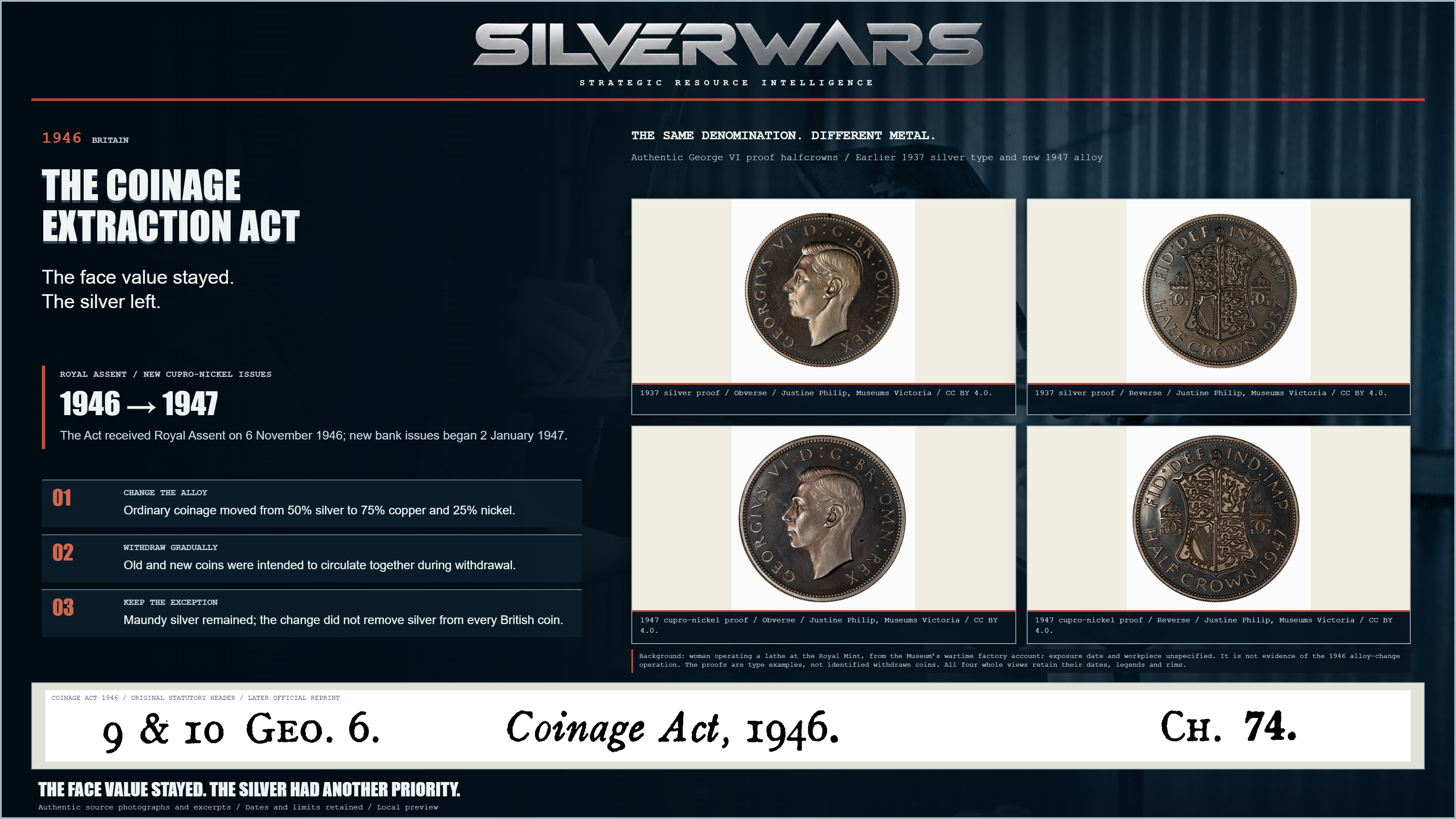
1949 / United States · U.S. strategic stockpile / Pressure and release timing
Timing was
leverage.
In a 1969 interview, David H. Stowe recalled military backing for industrial requests to release stockpile material. Copper was his example. The 1949 marker identifies his White House role; his comparison with the later military-industrial-complex terminology remained uncertain.
Open full dossier
1950 / United States · Defense Production Act / Industrial priorities / Materials allocation
Defense orders moved
to the front of the queue.
On 8 September 1950, President Truman signed the Defense Production Act. Section 101 authorized priority performance of defense contracts and allocation of materials and facilities. Title III supported productive capacity through financial assistance and purchase commitments. This established a domestic mechanism for directing industrial resources toward national defense during the Korean War. The law supplies context for strategic-material policy; a silver-specific allocation, purchase or price intervention requires its own implementing record.
Open full dossier
1951-1952 / United States / Cooperating aid-recipient countries · Battle Act / Strategic exports / Aid conditionality
Access to U.S. aid
came with strategic-trade conditions.
Congress enacted the Mutual Defense Assistance Control Act on 26 October 1951. The Battle Act tied U.S. military, economic and financial assistance to cooperation with strategic embargoes against the Soviet Union and countries under its domination. Designated shipments could trigger aid termination, with specified exceptions. The embargo provisions began operating on 24 January 1952. This established an international supply-control framework; the reviewed records do not establish a specific silver designation, affected shipment or silver-price effect.
Open full dossier
1957 / Soviet Union / Earth orbit · Silver-zinc batteries / Spaceflight / Onboard power
The first satellite carried silver power.
Three silver-zinc batteries went into orbit.
Sputnik 1 entered orbit on 4 October 1957 with three silver-zinc batteries. They powered the first artificial satellite’s onboard systems, including the radio signal heard around the world.
Open full dossier
1961 / United States · Monetary silver / Presidential direction and certificate retirement
Kennedy directed Treasury to begin withdrawing silver from monetary reserves. Coinage would draw metal released by retiring $5 and $10 silver certificates.
On 28 November 1961, President John F. Kennedy told Treasury Secretary Douglas Dillon that silver should gradually leave the monetary reserves. He immediately directed suspension of further sales of free silver and suspension of its use for coinage. Treasury could retain that stock for an orderly silver market and other special purposes. Coinage requirements were instead to be met by retiring enough five-dollar and ten-dollar silver certificates to release their backing. Kennedy also proposed repealing the silver purchase laws and expanding Federal Reserve note denominations. Those legislative proposals were a next step; the letter itself did not enact them or end certificate redemption.
Open full dossier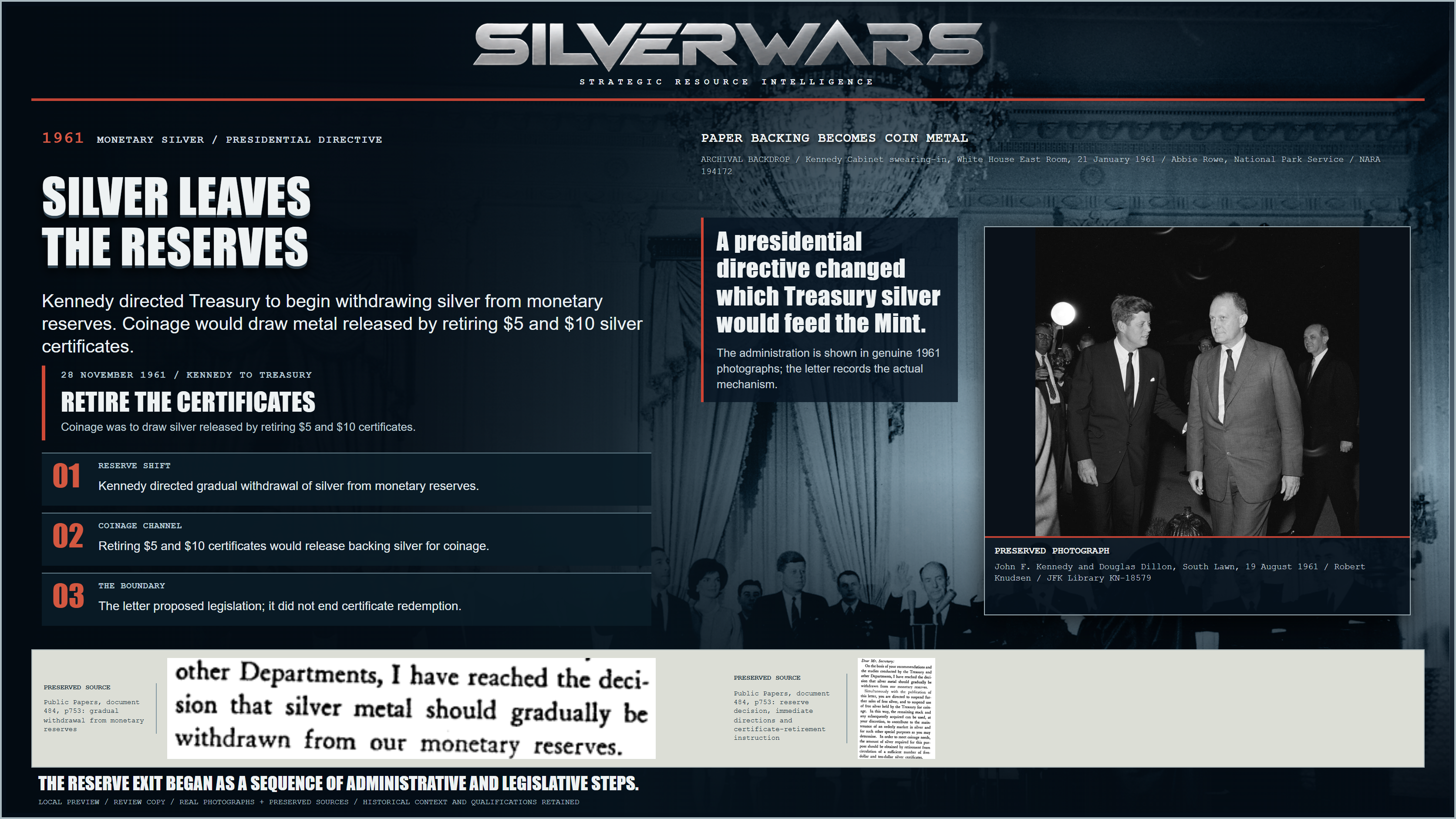
1964 / United States · Silver certificates / Change in redemption form
Treasury replaced silver-dollar payout with silver bullion. Certificate holders retained a silver claim, but the form and place of redemption changed.
Secretary Douglas Dillon's notice dated 25 March 1964 directed that silver certificates would thereafter be exchangeable for silver only at the United States Assay Offices in New York and San Francisco, and only in bullion of equivalent monetary value. The notice used a silver valuation of $1.292929292 per fine troy ounce. Certificates could still be exchanged at Treasury for other coins and currency. Congress had already authorized Treasury to redeem certificates in silver bullion at its option in Public Law 88-36. This administrative step ended the silver-dollar payout channel; silver-bullion redemption continued until its separate 1968 deadline.
Open full dossier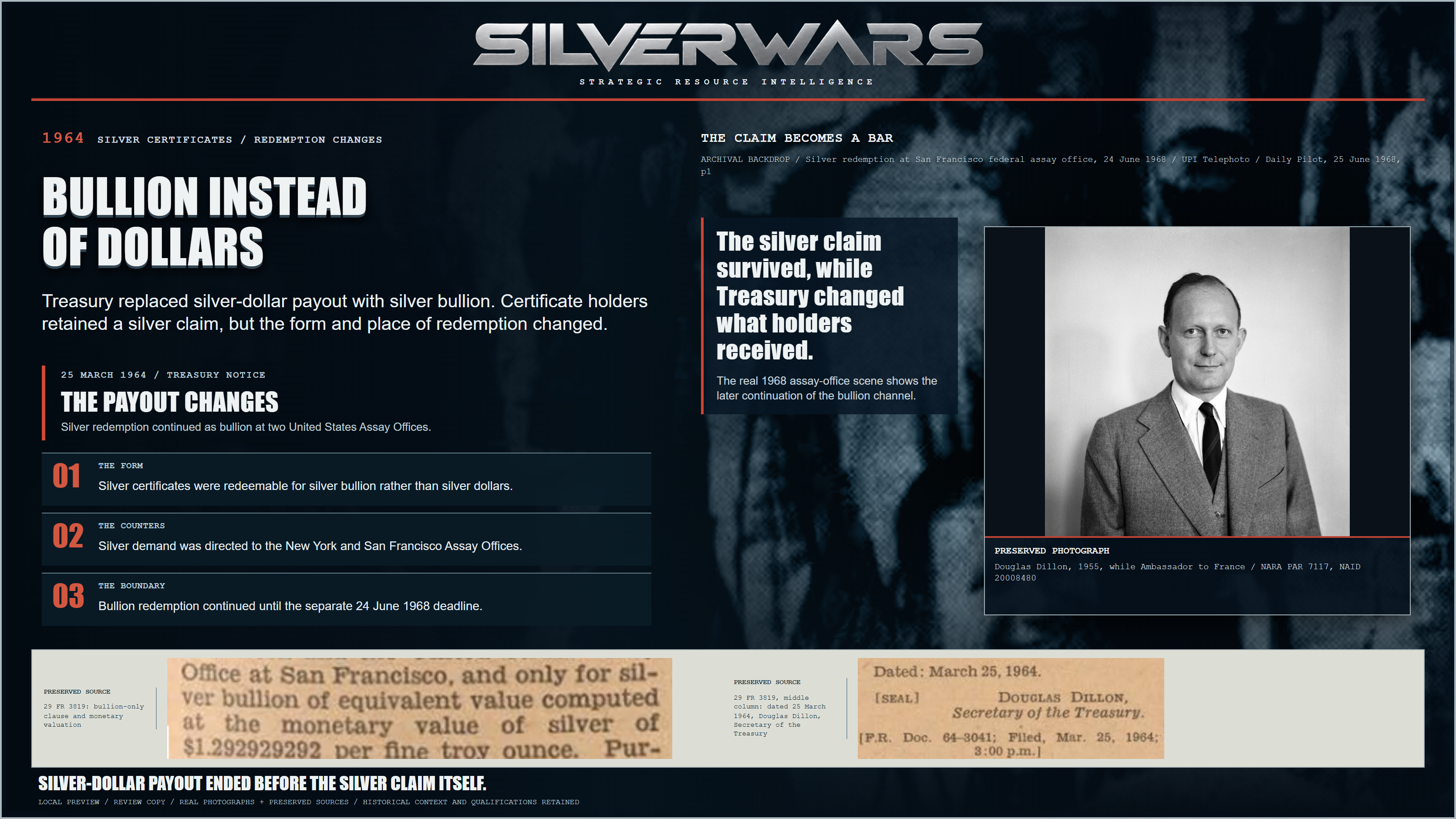
1965 / United States · U.S. law / Silver and circulating money
Coinage lost
priority.
The 1965 U.S. Act authorized new dimes and quarters without silver, while the half dollar retained 40 percent silver overall. President Johnson tied the change to worldwide demand outpacing new supply. Older silver coins continued alongside the new issues during a staged transition.
Open full dossier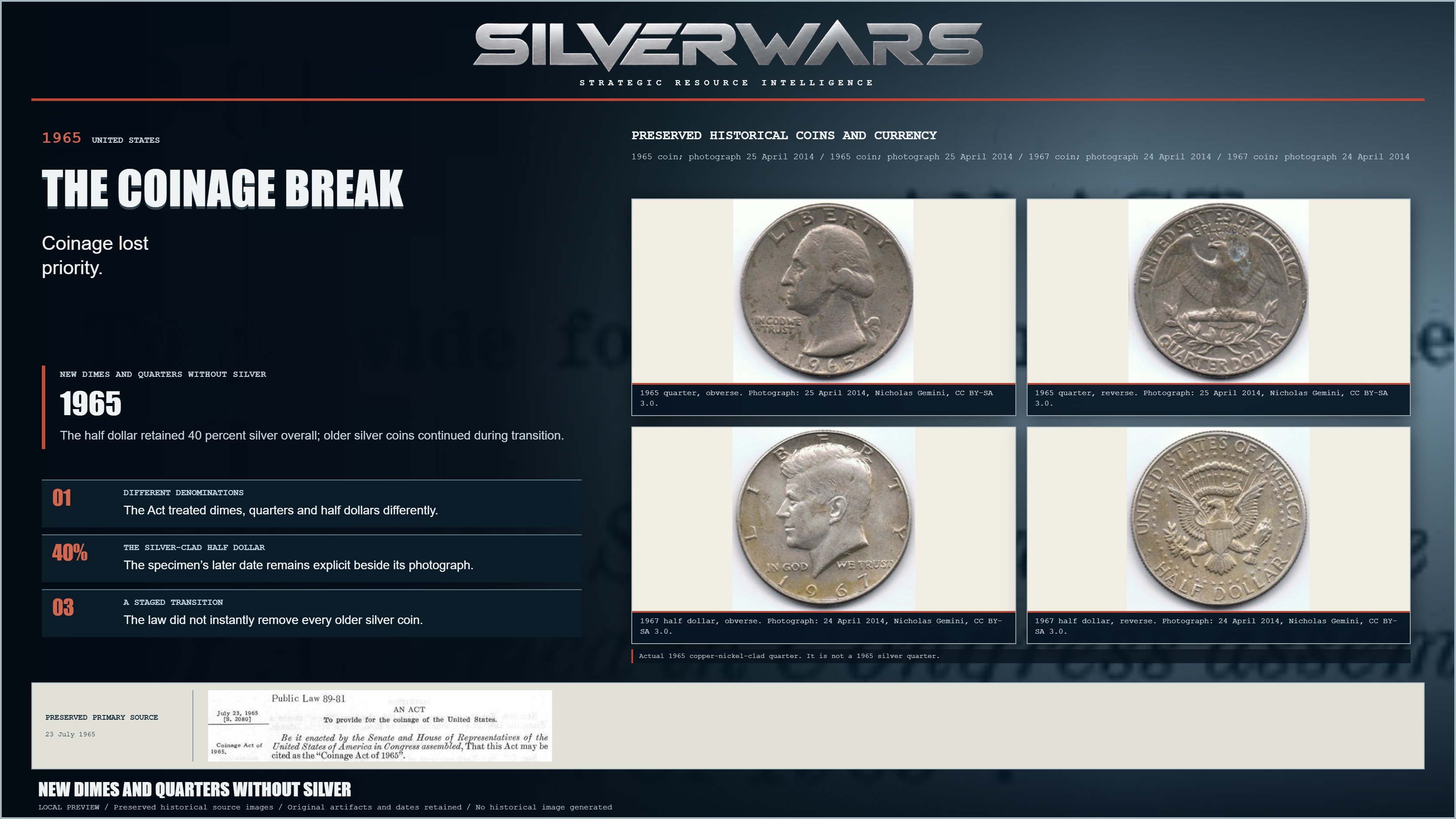
1967–72 / Southeast Asia / United States · Military weather modification / Silver and lead iodide
Silver iodide entered weather warfare.
The aim was to prolong monsoon conditions.
Operation Popeye used air-dropped silver- and lead-iodide seeding units in Southeast Asia. In a 1974 Senate briefing, the Department of Defense identified an operational phase running from 20 March 1967 until the last mission on 5 July 1972. The objective was to impede military supply routes through added rainfall.
Open full dossier
1967 / United States · Treasury silver / Purchaser eligibility and manufacturing end use
Treasury silver was reserved for domestic manufacturing use. Purchasers had to certify their requirements, while a separate rule restricted private silver-coin melting and export.
In May 1967, Treasury narrowed access to its silver before it abandoned the fixed sales price in July. New 31 CFR Part 56 allowed purchases only in amounts required for domestic manufacturing in the normal conduct of the applicant's business. Applicants had to certify that the proposed purchase plus stock on hand would not exceed normal two-month requirements; unusual quantities required approval. A companion Part 82 prohibited unauthorized melting, treating and export of U.S. silver coins, with stated exceptions, including an explicit exemption for U.S. departments and agencies. These rules controlled Treasury sales and silver coins, rather than all private bullion ownership or trade.
Open full dossier
1967 / United States · Treasury silver sales / Coin sorting
The Treasury held a price line.
Then fixed-price sales stopped.
In 1967, Treasury silver sales and the public’s treatment of older silver coins exposed two different pressures: supplying metal to users and keeping coins in circulation. The New York Fed documented the end of fixed-price domestic sales on July 14.
Open full dossier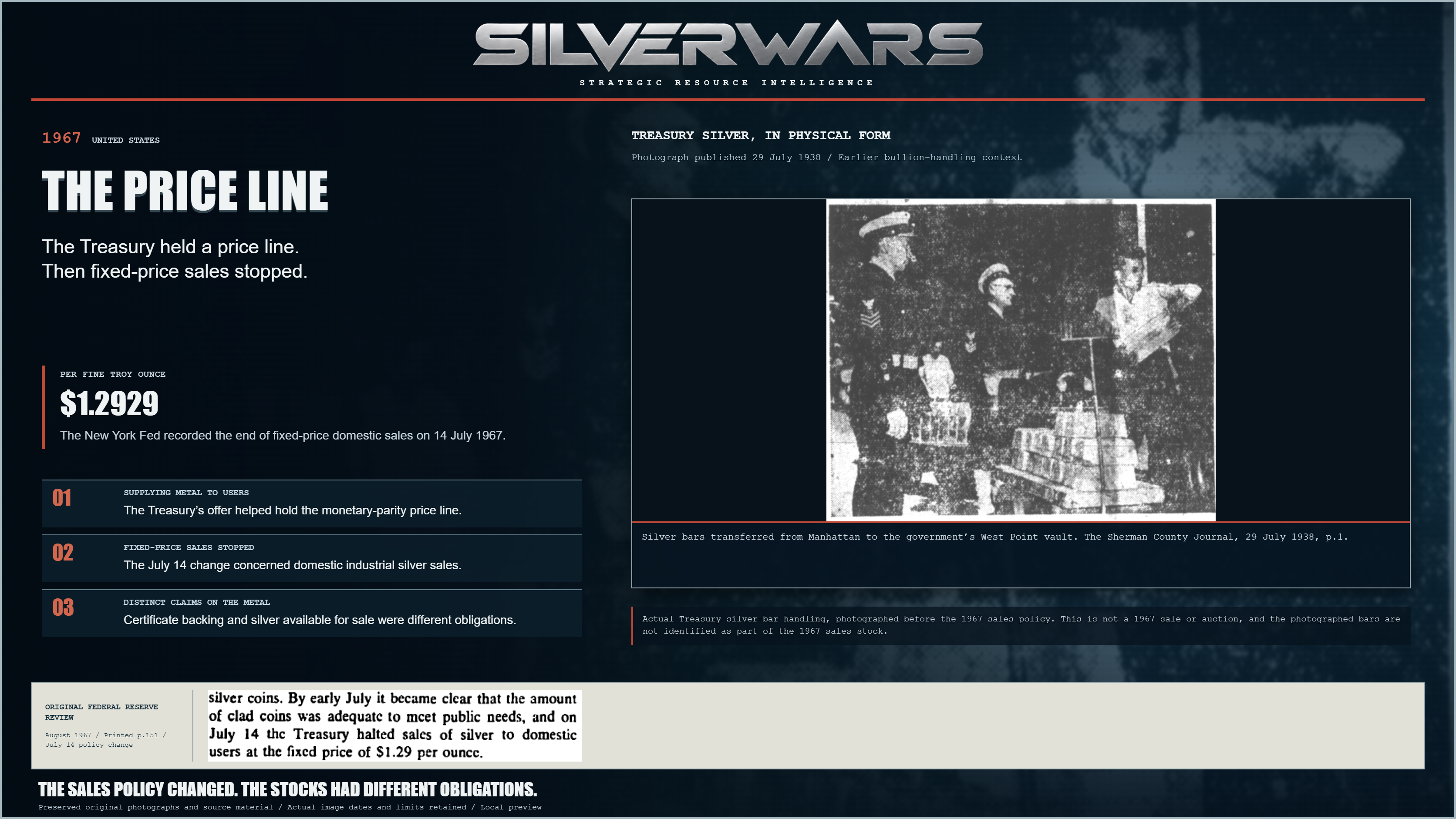
1967–1968 / Canada · Circulating coins / Silver-price pressure / Nickel substitution
The date stayed familiar.
The alloy could differ.
Canadian change lost its silver through overlapping coin-alloy transitions in 1967 and 1968. The Royal Canadian Mint lists quarters in 80 per cent silver through 1967, 50 per cent silver during 1967–1968, and nickel from 1968. Its dime history describes a 1967 reduction from 80 to 50 per cent silver, followed by nickel in 1968. The Bank of Canada Museum links these changes to rising silver prices, which forced a choice between much smaller coins and different metal. This changed everyday coin production; it does not establish one day when every older silver coin lost monetary status.
Open full dossier
1968 / United States · Silver coin recovery / Government inventories into industrial bullion
Treasury turned silver coins withheld from recirculation into bullion for industrial sales. The Mint reported recovering 30.9 million fine ounces through coin melting in fiscal 1968.
On 1 March 1968, the Joint Commission on the Coinage concurred in a Treasury proposal to melt silver coins held in government inventories and include the resulting bullion in weekly GSA sales. The Mint's fiscal 1968 annual report documents implementation: 30.9 million fine ounces were recovered by melting $38.5 million in silver quarters and $4.5 million in silver dimes separated from Federal Reserve inventories that were not recirculated. The private silver-coin melting ban continued, but its published text expressly exempted federal departments and agencies. This was a recovery and disposal channel for government-held coins, distinct from the separate 165-million-ounce strategic-stockpile transfer.
Open full dossier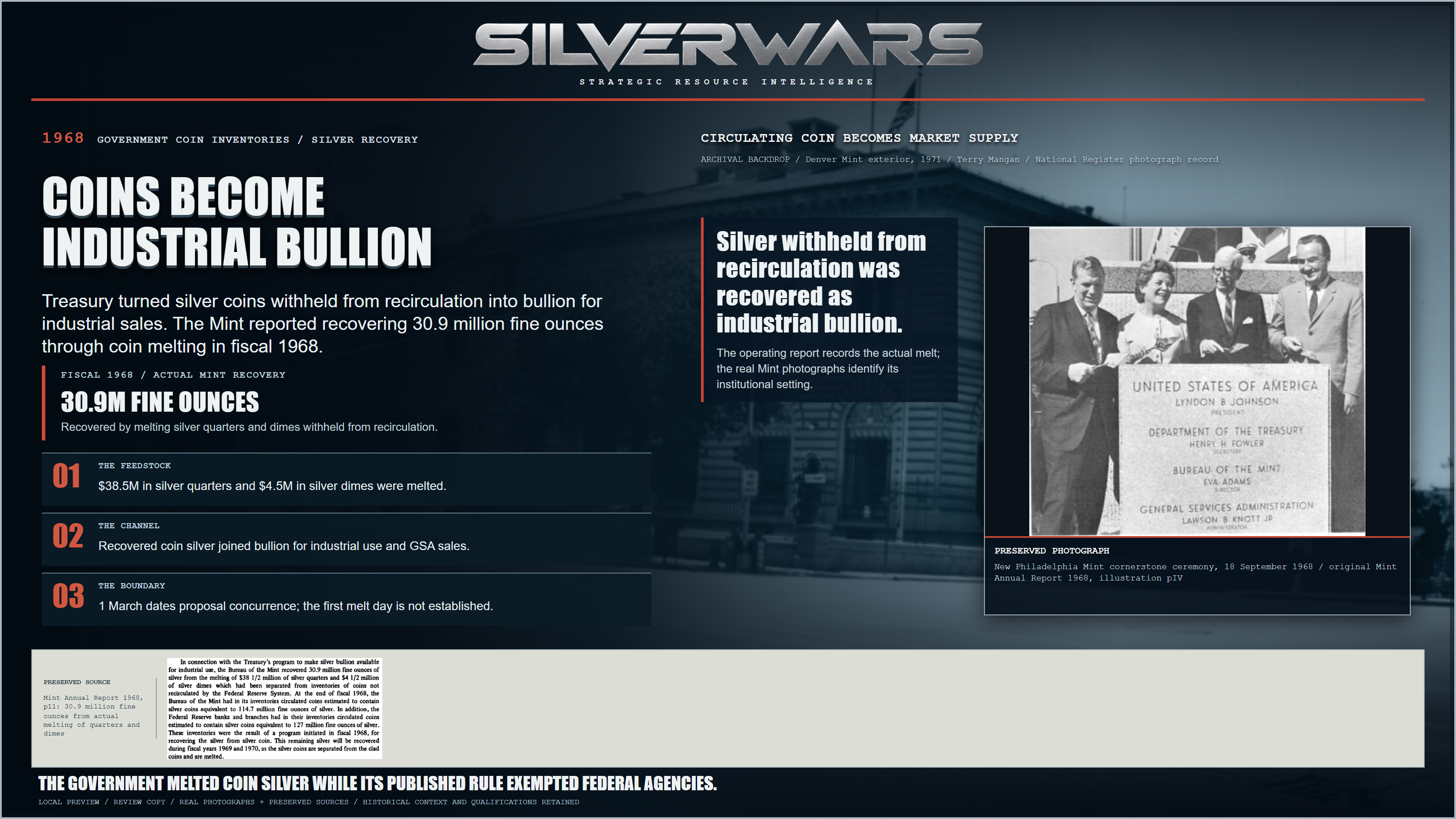
1968–1969 / Australia · Fifty-cent coin / Bullion value / Metal and shape replacement
The silver outgrew the face value.
The replacement changed metal and shape.
Australia introduced its round, 80%-silver fifty-cent coin with decimal currency on 14 February 1966. The Royal Australian Mint says rising silver prices made continued production uneconomic and dates suspension of striking to March 1968. A new twelve-sided fifty-cent piece, made from 75% copper and 25% nickel, entered circulation in September 1969. Confusion between the similar-sized round fifty- and twenty-cent coins also helped motivate the shape change. The Mint adds that metal for the 36.5 million original coins had been bought before the price rises, so the change does not prove the entire first production was made at a loss.
Open full dossier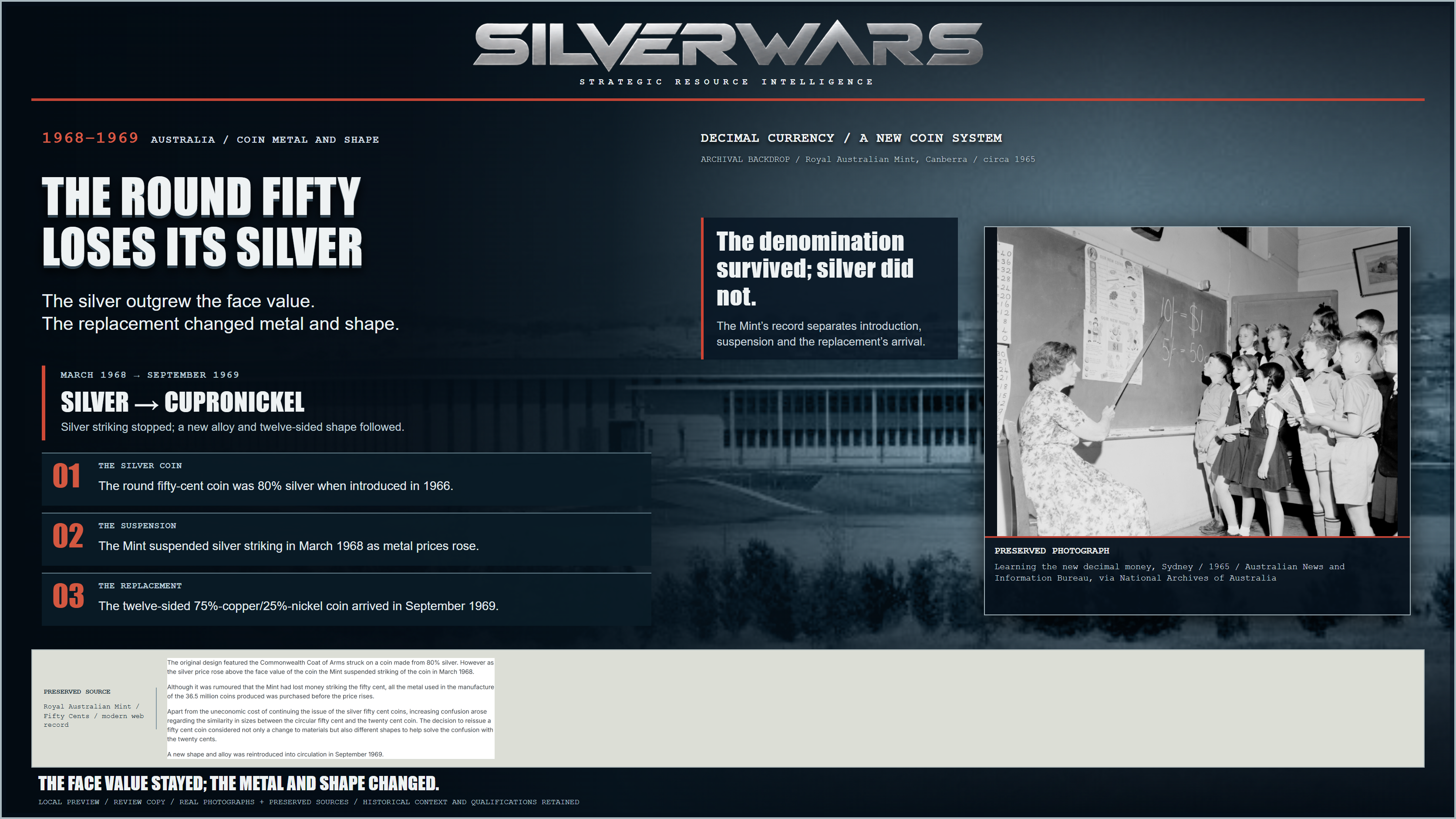
1968 / United States · Silver certificates / Redemption / Treasury metal
The paper stayed currency.
The silver claim expired.
Congress repealed key silver-purchase laws in 1963 while preserving silver-certificate backing and redemption. A 1967 law set a one-year deadline. Treasury’s final procedures made 24 June 1968 the last day certificates could be exchanged for silver bullion. The certificates remained usable as legal currency afterward, but their holders could no longer demand silver.
Open full dossier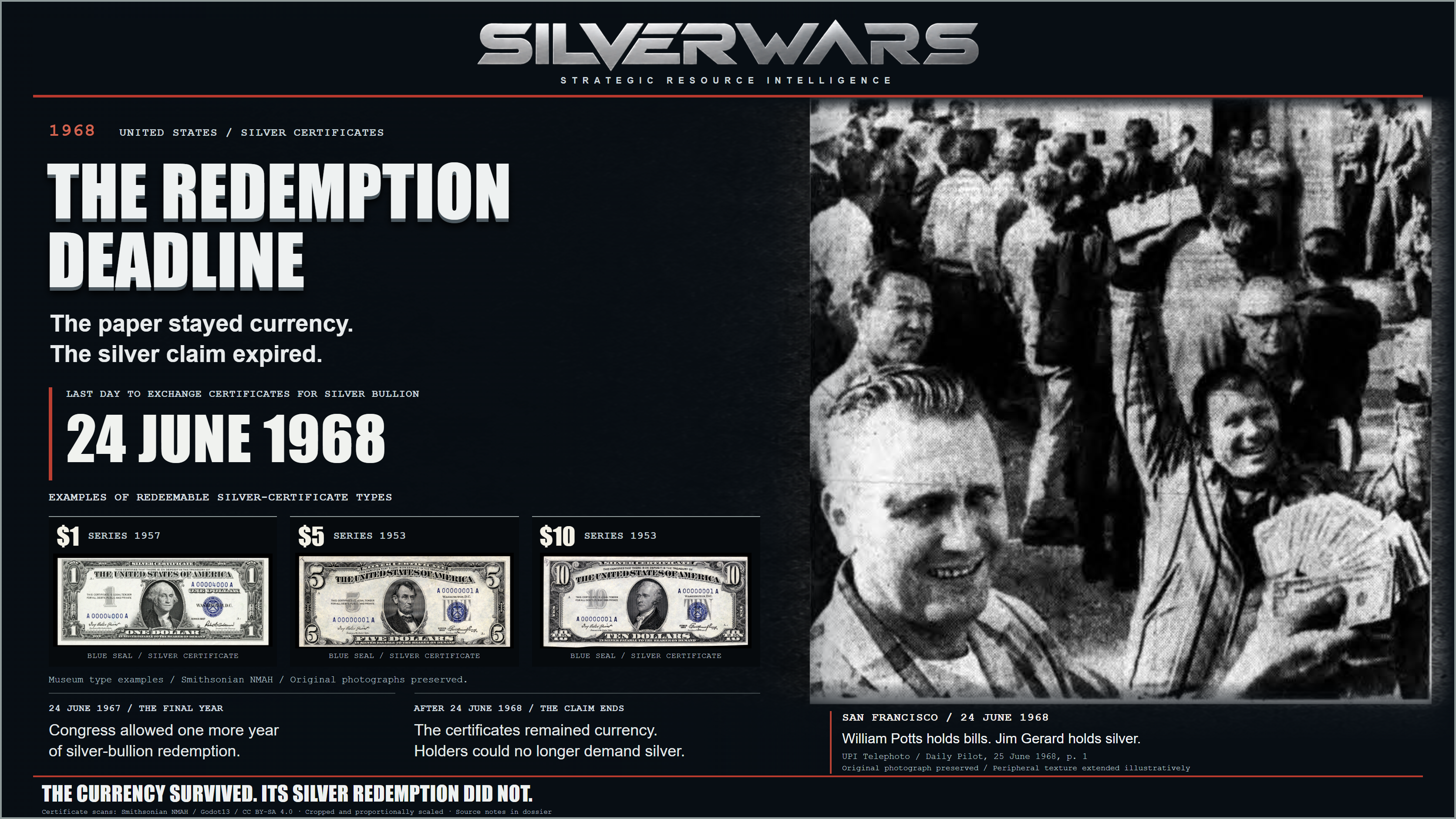
1968 / United States · U.S. law / Silver to the defense stockpile
The metal changed
ledgers.
On June 25, 1968, Treasury transferred 165 million fine troy ounces of silver to the statutory stockpiles through arrangements with the General Services Administration. The silver came from Treasury stocks, .999 fine. Mint and Atomic Energy Commission custody records identify the two components of this handoff.
Open full dossier
1969 / United States · U.S. coinage hearings / Industrial allocation
Industry wanted the silver.
Congress debated the route out of coins.
October 1969 House hearings put Treasury plans and the Silver Users Association’s industrial arguments on the public record. H.R. 13252 was a proposal; the eventual December 31, 1970 law must be read separately, including its collector-silver exception.
Open full dossier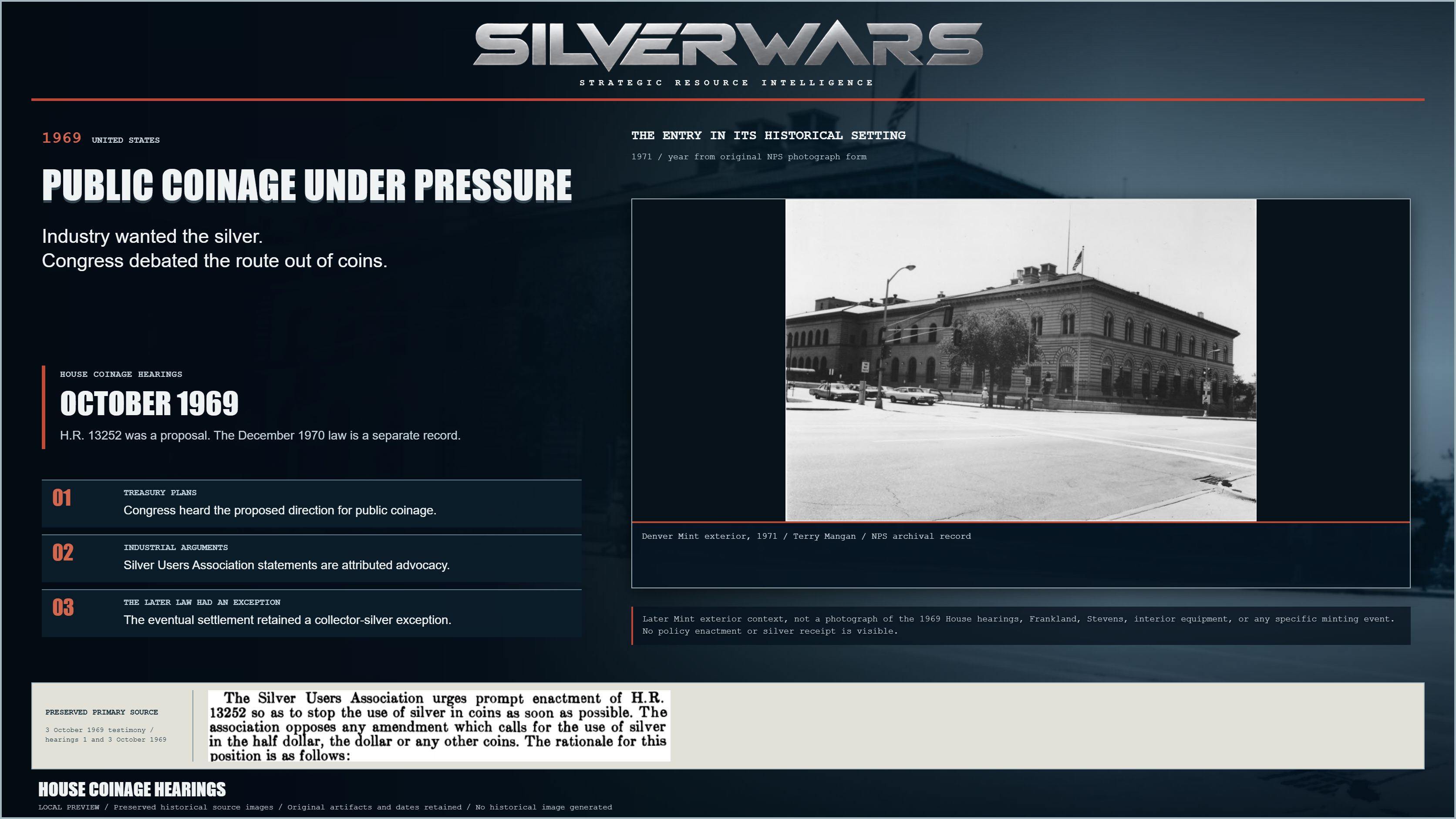
1970 / United States / World outlook · Bureau of Mines / Historical silver forecasts
The supply warning
preceded the Hunt crisis.
The Bureau of Mines’ 1970 silver assessment described demand outrunning new supply, Treasury drawdowns and a difficult transition to other sources. Its estimates used historical assumptions, generally from 1968; its forecasts are not current reserve figures or proof of later depletion.
Open full dossier
1970-1971 / United States / Denver Mint · Half-dollar composition / Collector silver / Defense-stockpile transfer
The half dollar lost its silver.
Collectors kept a separate silver channel.
Congress enacted new half-dollar composition rules on 31 December 1970, replacing the remaining 40-percent silver with copper-nickel clad construction. Denver began producing the new circulation coins on 3 February 1971. The same law authorized up to 150 million 40-percent-silver Eisenhower dollars and directed 25.5 million fine troy ounces from the national stockpile exclusively to those special dollar coins. The composition change preserved a separate collector-silver channel and did not strip existing silver coins of legal-tender status.
Open full dossier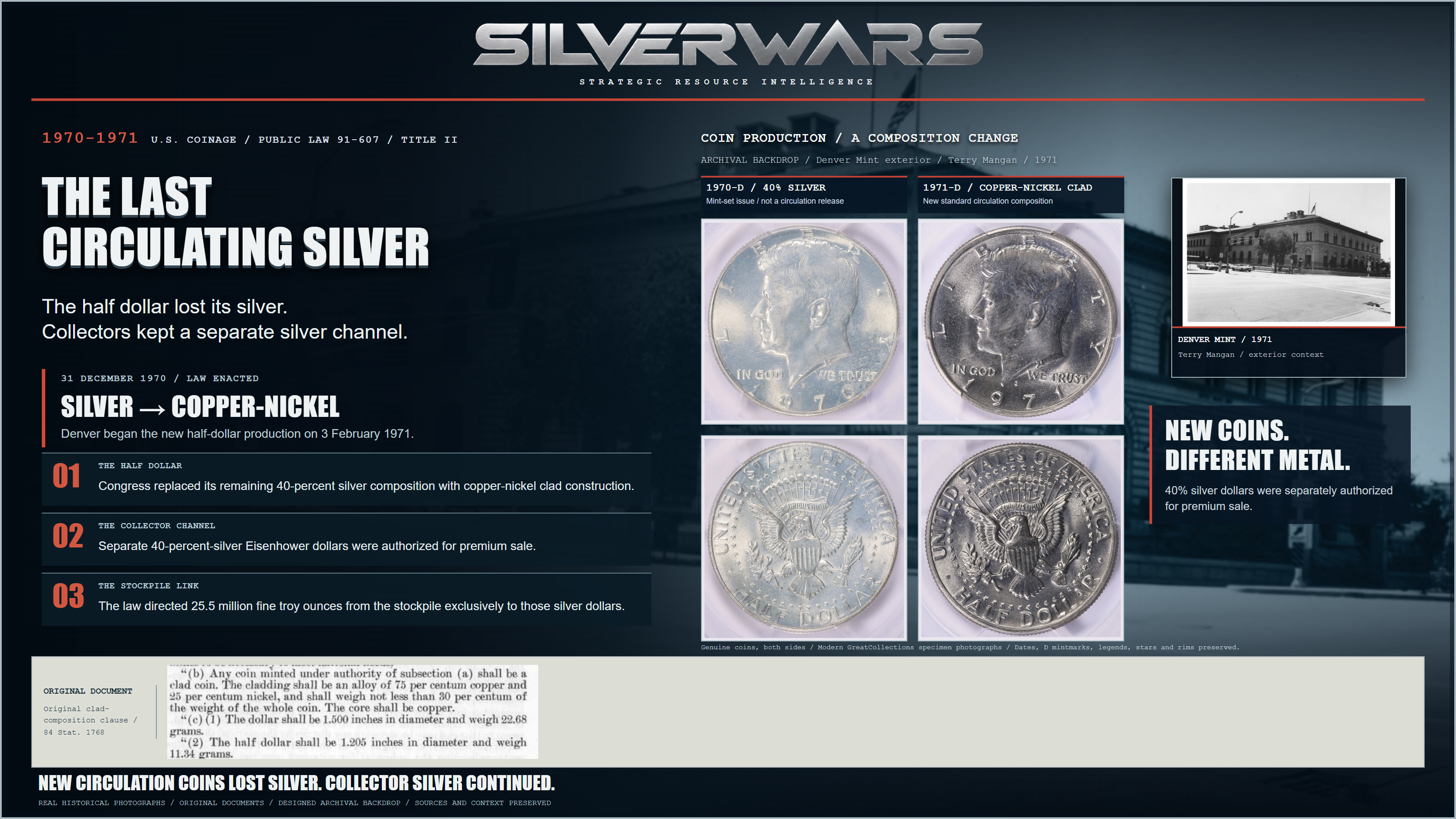
1972 / International research · Industrial silver / Contacts, portable power and miniaturization
Silver’s value
ran through technology.
Gene Smith’s June 20, 1972 New York Times report covered a Silver Institute meeting. The Institute reported Soviet work on technical literature and an electrical-contact alloy. A separate photograph showed Yardney’s silver-cell flashlight, while Paul F. Waters described miniature solid-state silver-battery development. The plate draws its industrial theme from these distinct reports.
Open full dossier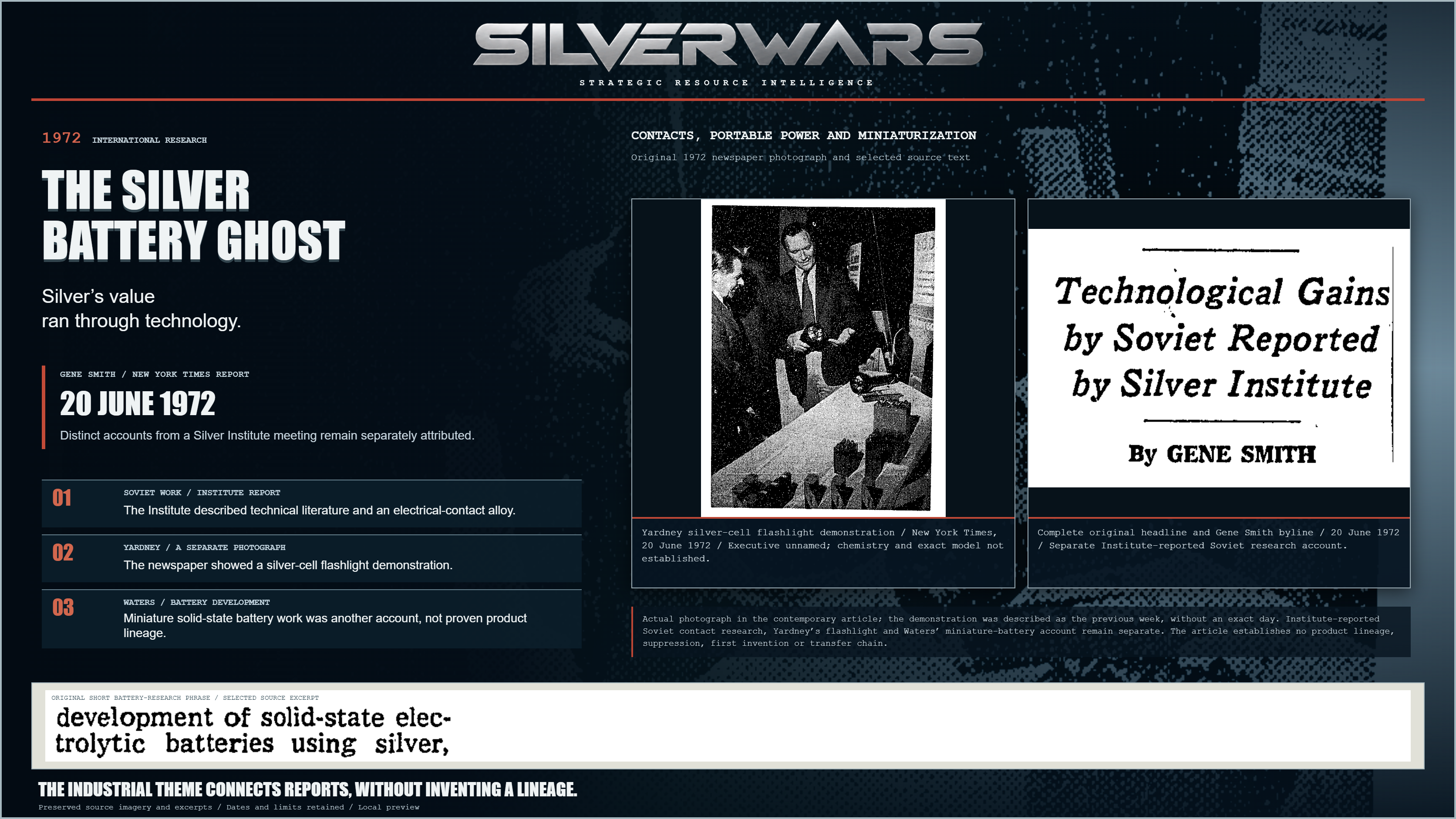
1979–82 / United States · National Defense Stockpile / Disposal / Reserve requirements
A reserve was labelled excess.
Congress demanded another look.
A planning model put the silver stockpile goal at zero. Congress later authorized disposal of 105.1 million troy ounces, then suspended the auctions pending reassessment. GAO’s 1982 report warned that defense demand and domestic supply conditions had changed.
Open full dossier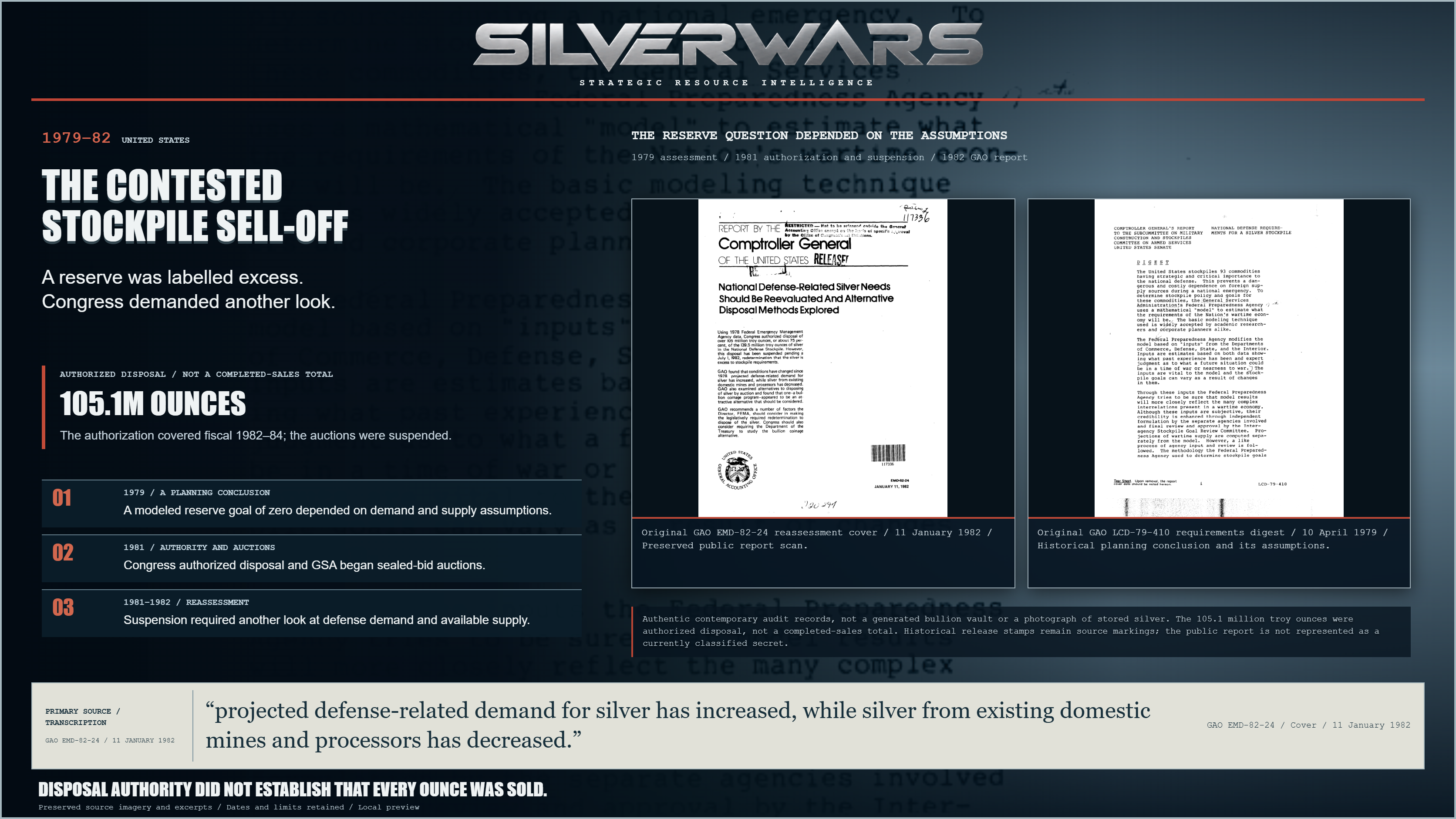
1979 / United States · Nuclear MX / Silver requirements / Reserve planning
A nuclear program projected silver demand.
Its construction needs were outside the reserve calculation.
GAO explained that nuclear MX construction requirements did not enter a silver reserve goal designed around conventional war. The same report described an earlier battery projection of about 35 million troy ounces as virtually eliminated by substitution. Defense then corrected GAO's remaining system estimate to 150,000 ounces. These were program estimates; the reserve goal and the metal actually held were separate quantities.
Open full dossier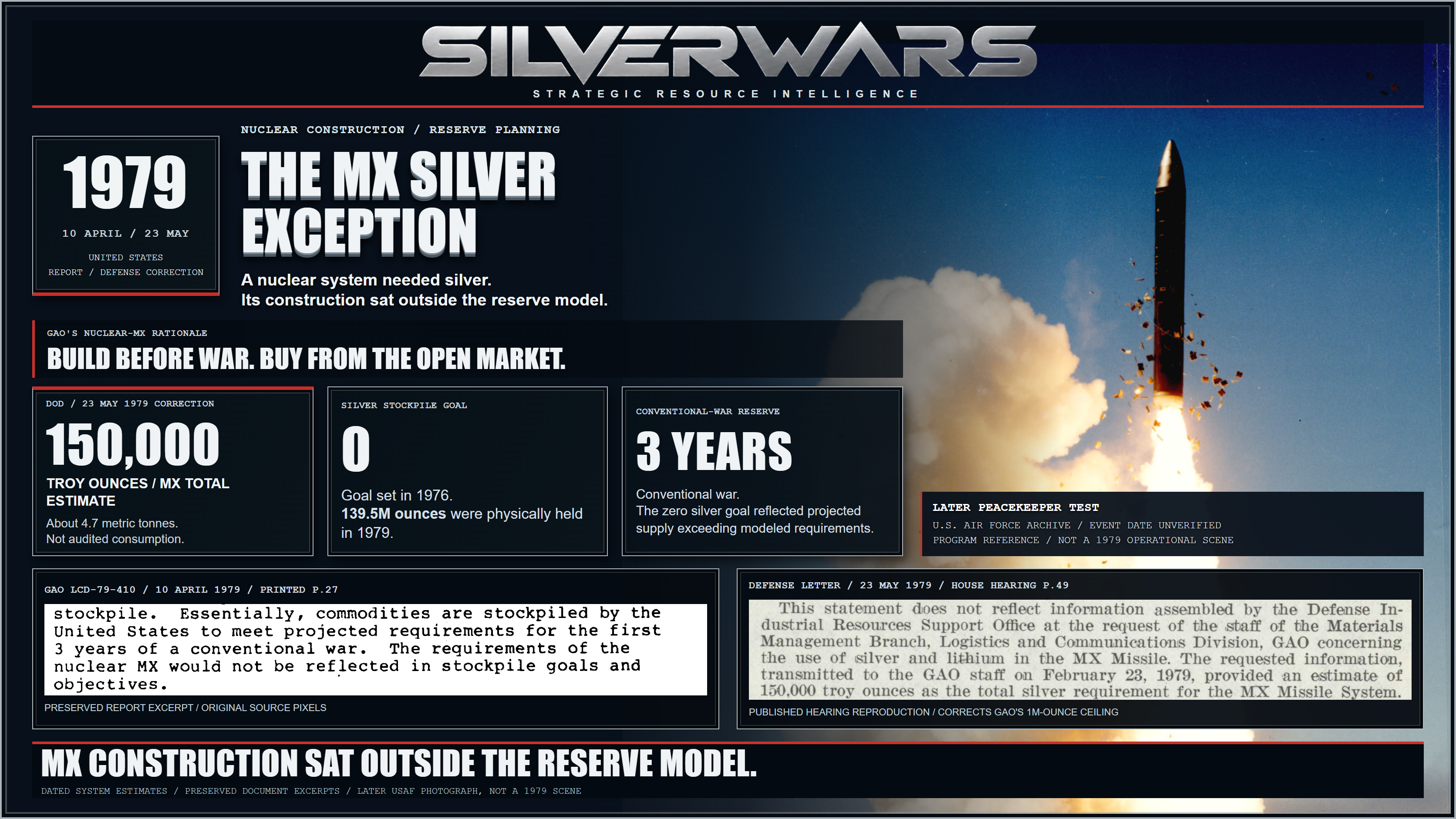
1979–1980 / United States / International storage · Hunt silver episode / Retrospective oral history
A claim on metal
was not possession of it.
In his 2007 oral history, Andrew F. Brimmer recalled the Hunts taking physical delivery, moving silver into private storage and encountering changing futures-market conditions during 1979–1980. The interview is retrospective testimony, not a contemporaneous Federal Reserve finding.
Open full dossier
1981 / United States · Photographic waste / Federal recovery / Institutional incentives
The silver was recoverable.
The system still let it go.
GAO found that only 12 of 44 selected federal laboratories recovered photographic silver effectively. Thirteen recovered partially and nineteen made no recovery attempt. The audit connected lost metal with weak incentives, upkeep and oversight.
Open full dossier
1982 / China · Industrial silver / Planned supply and conservation
The warning became
a supply plan.
China’s Ministry of Machinery Industry and People’s Bank of China set out planned supply and bank oversight for electrical-contact silver in a May 21, 1982 notice. It promoted silver-based alloy and bimetallic contacts, scheduled regional pilots and nationwide application, and set a phaseout goal for pure-silver contact production.
Open full dossier
1985–2002 / United States · Strategic stockpile / Bullion coins / Replacement sourcing
Reserve silver entered the bullion program.
Replacement silver had to be sourced.
The 1985 Liberty Coin Act directed Treasury to obtain silver for its new bullion coins by purchasing from strategic stockpiles. In 2002, Congress explicitly cited depletion of the stockpile’s silver reserves and authorized replacement sourcing to continue the American Eagle Silver Bullion Program. The laws connect a public reserve to a continuing demand for metal; they do not establish that every U.S. government silver holding was exhausted.
Open full dossier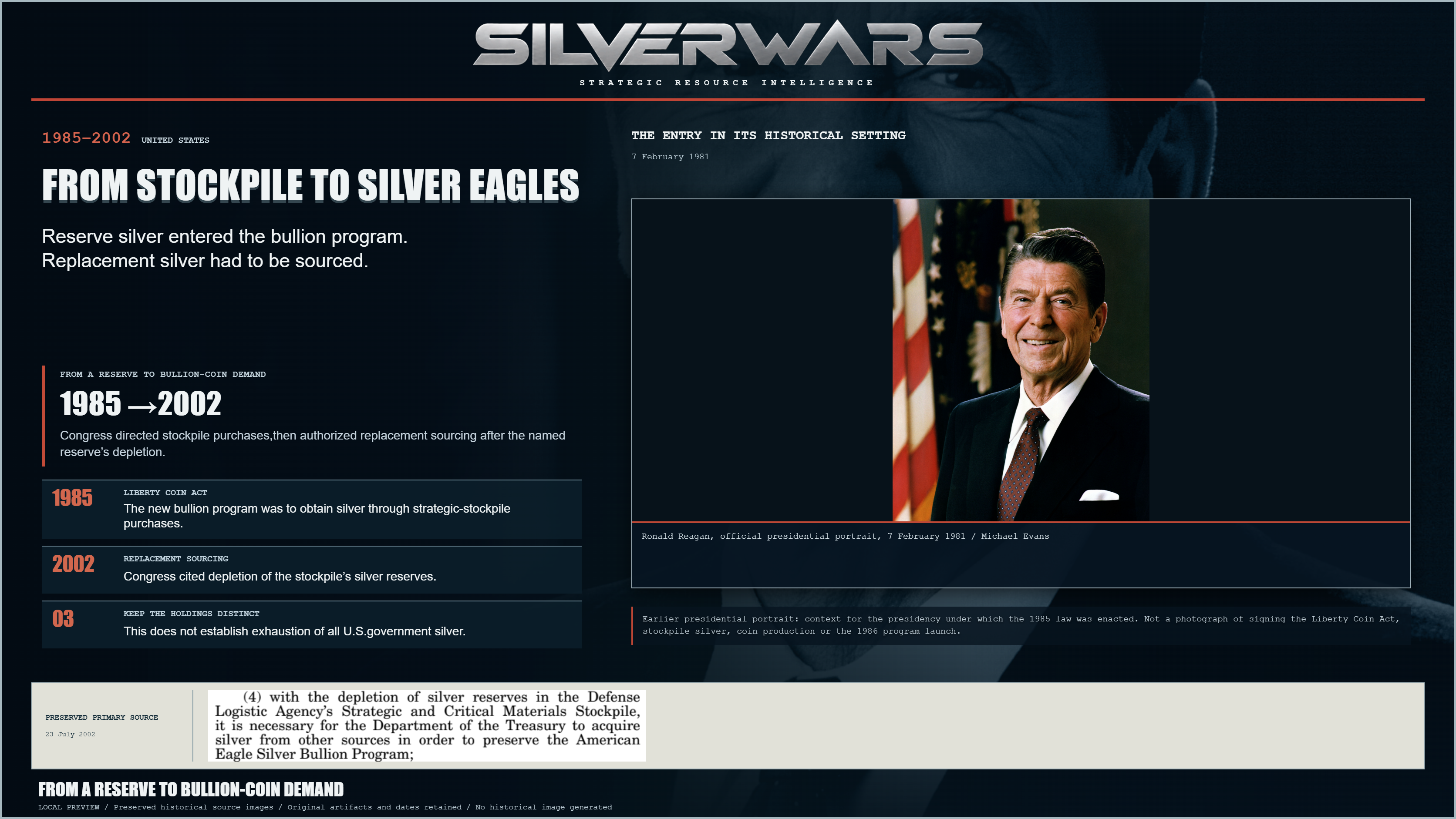
c.1987 / U.S. Navy research · Battery-material planning / Conditional forecasts and research
Power depended
on the materials.
The NSWC brochure projected battery-dependent portable power for Navy weapons and warned of material shortages if then-current use patterns persisted. It paired lithium’s promise with added research and safety demands. The surviving copy is placed at c.1987; its original publication date remains unresolved.
Open full dossier
1993 / United States · Government-furnished silver / Procurement / Accountability
Government silver entered production.
The accounts failed to keep up.
A DoD Inspector General audit found overstated silver requirements, open-market purchases despite cheaper government supply, and unresolved balances at Yardney. Some transfers changed account balances without moving physical silver.
Open full dossier
1993 / United States · Strategic minerals / Stockpile policy and author analysis
Reserves insured
against lost access.
Kent Hughes Butts challenged assumptions of reliable mineral imports and a short future conflict. His November 30, 1993 report described a roughly $6 billion stockpile and the Bush administration’s request that would leave about $440 million. He urged retention and modernization while import-supply risks persisted.
Open full dossier
1997–98 / United States / London delivery · Berkshire Hathaway / Bullion ownership / Delivery contracts
A major buyer disclosed its silver.
Ownership and delivery were different totals.
On 3 February 1998, Berkshire Hathaway disclosed a 129.71-million-ounce silver position purchased for London delivery. Its release separated 87.51 million ounces delivered during 1998 from contracts for another 42.20 million ounces due through 6 March.
Open full dossier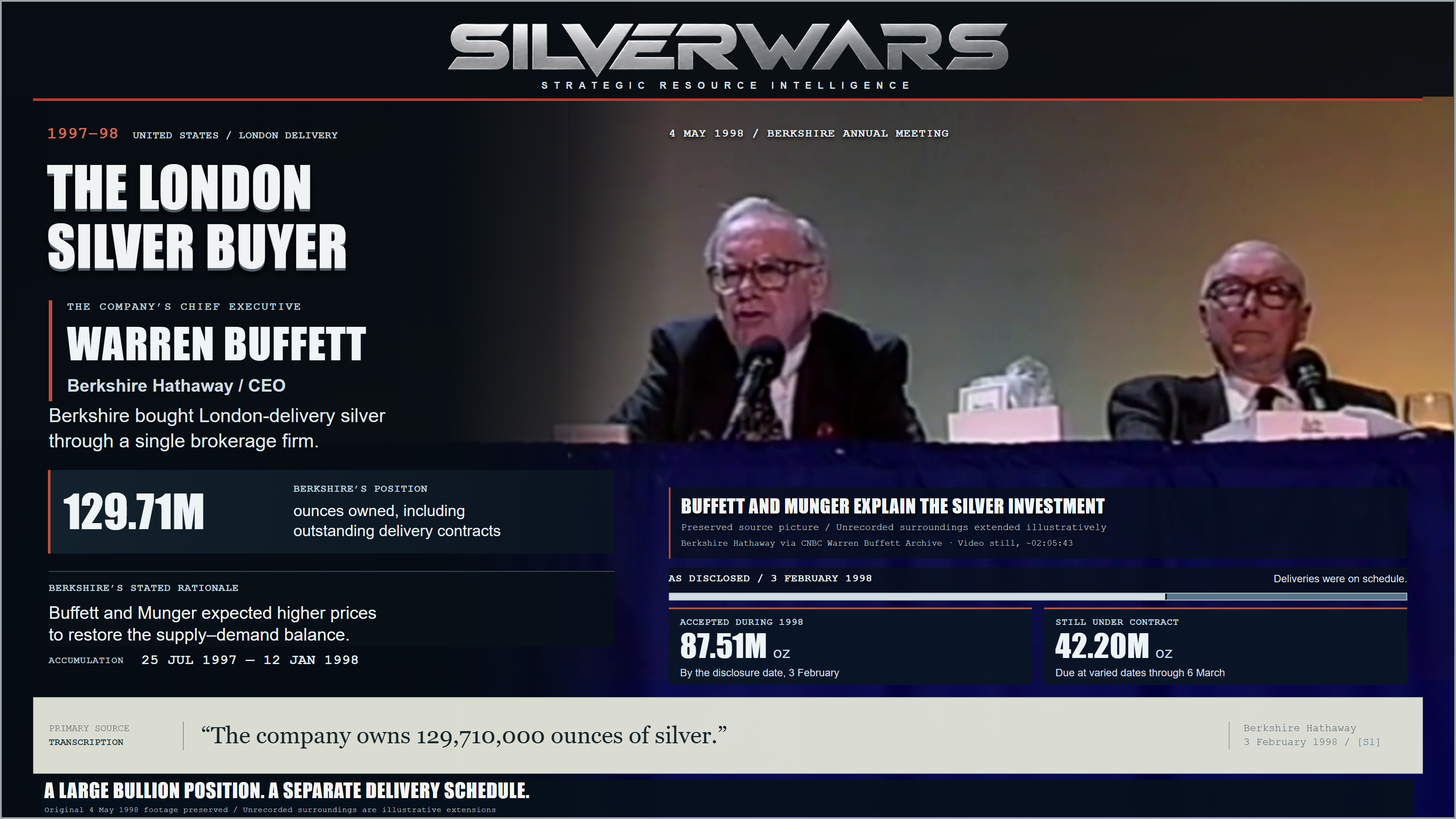
2006 / United States / London · Industrial access / ETF allocation / Bullion custody
They warned an ETF could squeeze silver.
Follow the metal already spoken for.
The Silver Users Association warned that a silver ETF would compete with manufacturers for a small physical pool. The Silver Institute’s own 2006 survey described the pressure that moving bullion into allocated holdings could create. Barclays sponsored the trust; JPMorgan’s London branch was named custodian. Later reports placed ETF metal inside reported vault totals. The question is how much silver remains available once those allocations are accounted for.
Open full dossier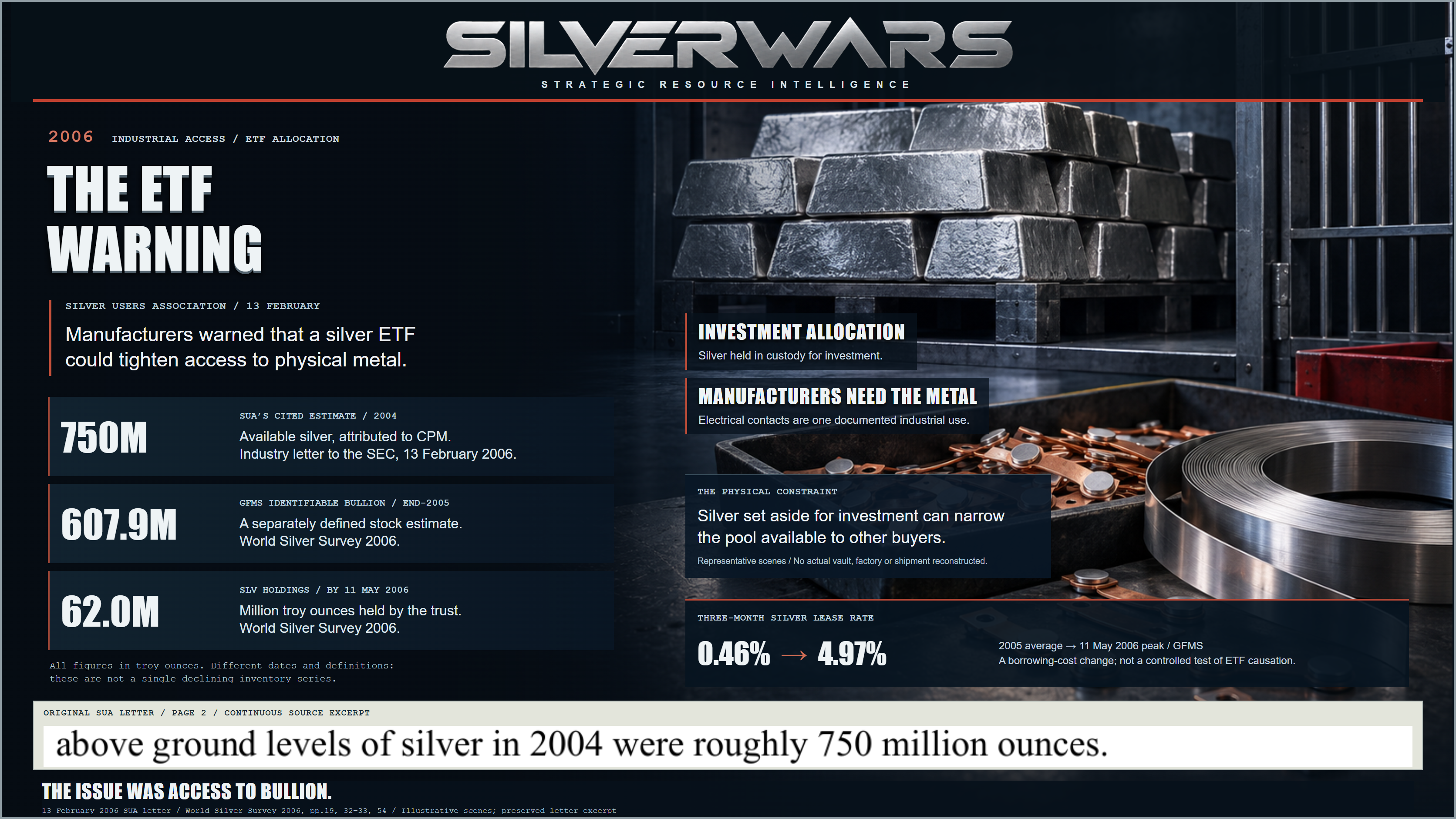
2011 / United States / COMEX clearing · Five increases in silver-futures collateral requirements
The cost of holding a leveraged silver position rose in five steps.
Four clearing notices raised the speculator initial requirement by about 84%.
Between 25 April and 4 May 2011, CME Clearing issued four notices that scheduled five increases in the minimum performance bond for the 5,000-ounce COMEX silver contract. The speculator initial requirement rose from $11,745 to $21,600 per contract after the close on 9 May, an increase of about 84%. Maintenance requirements also rose. CME attributed the changes to its volatility review and need for adequate collateral. Higher requirements can force participants to supply more eligible collateral or reduce exposure. The notices establish that financing pressure; they do not establish an intention to crash silver or quantify its effect on the market price.
Open full dossier
2012 / Global PV supply chains · Solar materials / Conditional 2012 assessment
Material dependence
shaped the forecast.
A November 2012 study by E4tech and Avalon Consulting for IEA-RETD assessed a conditional silver-supply risk for crystalline-silicon photovoltaics. The report cited that technology at 85% of the 2011 PV market. It considered additional supply, lower silver use and substitution as ways to reduce the exposure.
Open full dossier
2013 / United States / United Kingdom / Iran · Silver-bearing batteries / Military technology / Export controls
A missile battery was a controlled export.
The shipping papers concealed the transaction.
On 9 January 2013, Christopher Tappin received a 33-month federal sentence after admitting a role in an illegal attempt to export zinc/silver oxide reserve batteries for the Hawk Air Defense Missile to Iran. The case followed a 2005–2007 scheme and an undercover investigation. The silver was inside controlled military hardware.
Open full dossier
2013 / United States · AgZn industrial base / Historical capability warning
Low risk came with
a capability warning.
An AgZn industrial-base assessment reported in October 2013 described low risk under then-current conditions and several capable sources. It also linked falling sales to changes in battery technology and warned that further demand decline or effective replacement could increase risk. The report’s release year does not establish the assessment’s completion date.
Open full dossier
2014 / London, United Kingdom · Replacement of the telephone silver fixing with an electronic benchmark auction
London's silver benchmark moved from the telephone to an electronic auction.
The reference price continued, under a new platform and administration.
On 15 August 2014, the LBMA Silver Price replaced the London Silver Fix, whose final operating day was 14 August. CME Group supplied the electronic auction platform; Thomson Reuters handled administration, governance and distribution; LBMA accredited participants. The benchmark continued at noon in London, quoted in dollars per troy ounce, with Loco London physical settlement. The change matters because a widely used reference price now emerged through a different procedure and institutional structure. The operators presented the transition as a way to improve participation and transparency while preserving continuity. That claim describes the reform's stated purpose, not a finding that previous prices had been manipulated.
Open full dossier
2016 / United States · PMRP recovered silver / Federal reuse and disposal changes
Recovered silver.
A changing supply channel.
GAO’s June 2016 report recorded DLA-reported recovered-silver balances of about 713,000 troy ounces in September 2015 and about 367,000 in April 2016. Officials also reported rising silver requisitions. Direct electronics sales had begun in December 2015; lower DLA precious-metal recovery was expected, while the full effects remained unknown.
Open full dossier
2018 / United States · Critical minerals / Nonbinding House proposal and conference outcome
A proposal
was not a designation.
On May 24, 2018, the U.S. House passed the FY2019 defense authorization bill with a nonbinding proposal urging silver’s addition to the critical-minerals list. The conference agreement did not carry that proposal forward. DOI’s final 2018 list, published May 18 before House passage, did not include silver.
Open full dossier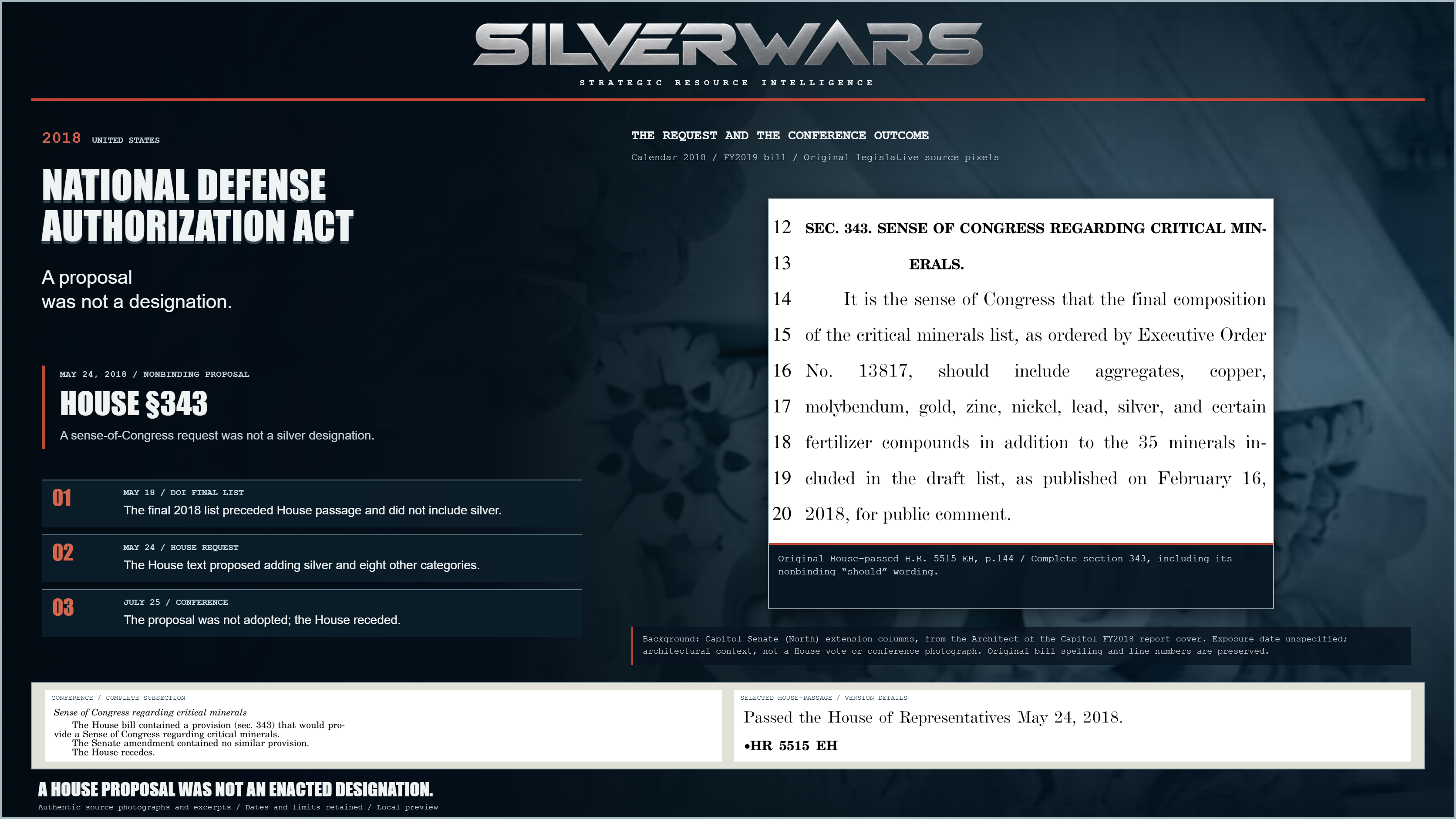
2020 / United States / Global futures markets · JPMorgan / Precious-metals futures / Admitted misconduct
The orders advertised supply and demand.
The traders intended to cancel them.
On 29 September 2020, U.S. authorities announced JPMorgan’s resolution of precious-metals and Treasury-market misconduct. Its admitted precious-metals scheme ran from approximately March 2008 to August 2016 and included silver futures. Traders placed deceptive orders they intended to cancel, misleading other market participants. The combined monetary resolution covered multiple metals and Treasuries. The company entered a deferred prosecution agreement, which later concluded with dismissal after compliance.
Open full dossier
2021 / London, United Kingdom · Correction of LBMA's March 2021 silver-vault aggregate
LBMA corrected the number it had published for March silver holdings.
The correction concerned reported data; it did not establish missing bars.
On 10 May 2021, LBMA said a data-submission error had produced an incorrect aggregate for the silver held in London vaults at the end of March. Its corrected figure was 1,143,194 in units of one thousand troy ounces: 1,143,194,000 ounces, or about 1.143 billion. The earlier release had reported 38,859 tonnes. The correction matters because market participants use the published aggregate to assess London's physical holdings, while that total includes metal held for clients and is not a measure of immediately available supply. LBMA's announcement identifies a reporting failure. It does not identify a responsible custodian or establish missing bars, fraud or a delivery default.
Open full dossier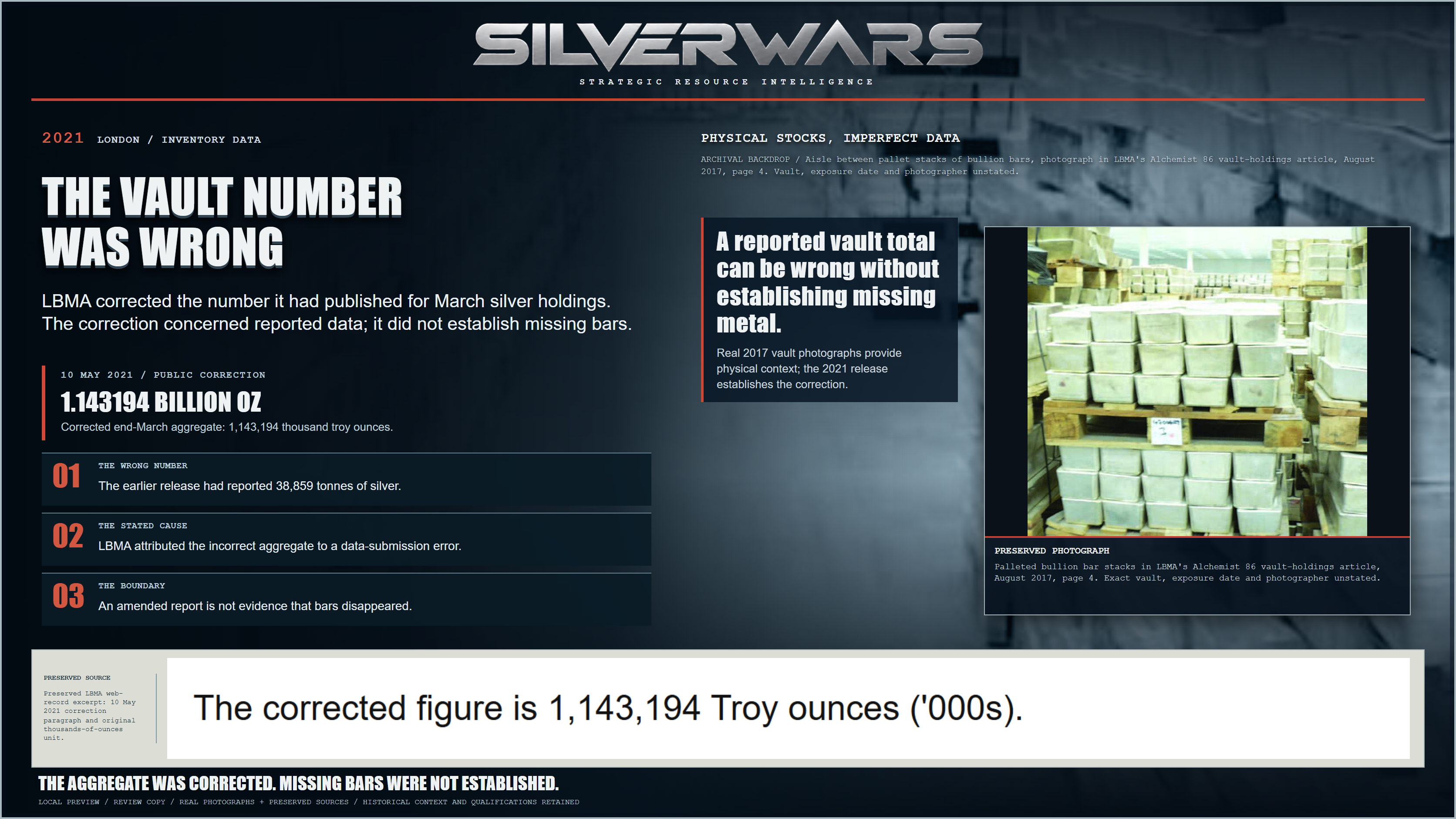
2021 / United States · U.S. Mint / Supplier blanks and product demand
Mint demand met
a blanks bottleneck.
In 2021, the U.S. Mint first used broad global-silver-shortage wording. Its later clarification, republished June 2, located the shortage it was experiencing in silver blanks available from Mint suppliers. The constraint concerned a fabricated coin input, alongside reported ordering pressure during Morgan-dollar sales.
Open full dossier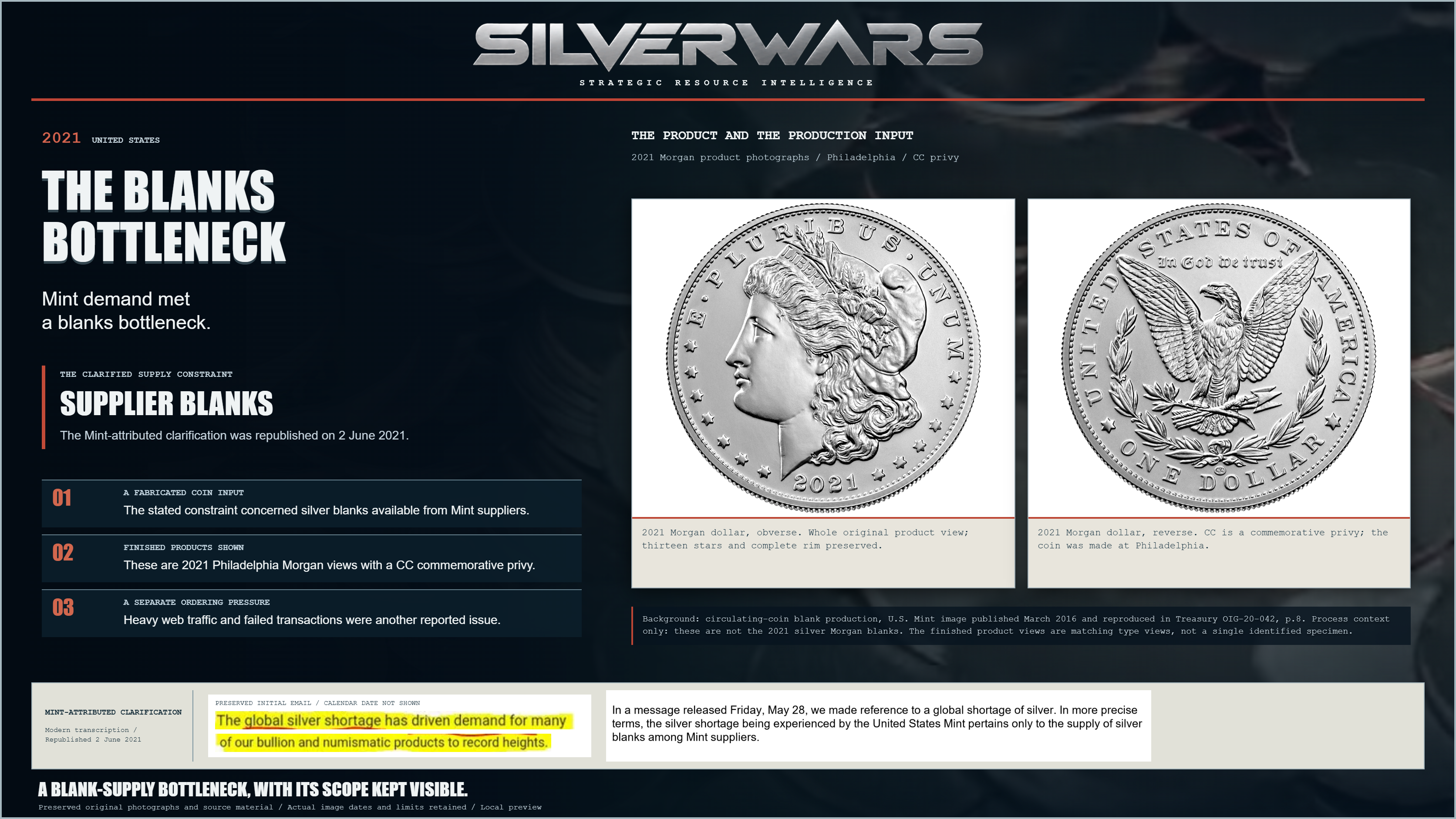
2021 / Ukraine · Silver ores / Strategic minerals / Economic and defense policy
Silver ores were named.
Mineral development became security policy.
Ukraine’s National Security and Defense Council included silver ores in a July 2021 list of minerals strategically important for economic development and defense capability. President Zelenskyy’s Decree 306/2021 put the decision into effect. The original appendix names silver at item 24 under metallic ores.
Open full dossier
2022 / United States · Navy procurement / Program silver supply and input prices
From DLA silver
to market prices.
An April 2022 Navy budget document reported an FY2021 silver-supply problem for the AN/SSQ-101B program. Its note contrasted historical DLA procurement at $3.97 per troy ounce with a cited market rate of about $30 per troy ounce after program surplus was exhausted. The same note had already appeared in May 2021.
Open full dossier
2023 / United States · Silver-zinc batteries / Industry sourcing
A question about battery materials.
An answer about silver availability.
During a public lecture on silver-zinc batteries, engineer Camie Platner described silver as difficult to source and future availability as a growing concern. She placed that warning in the context of supply-chain problems since the pandemic.
Open full dossier
2024 / Australia / Global PV supply · Solar expansion / Silver dependence and recovery
Solar scales.
The material constraint follows.
ACAP’s public report carried Rong Deng’s warning that rapid growth in annual PV installations could put severe pressure on silver supply. The feature linked that conditional scenario with the need to recover valuable materials from retired panels.
Open full dossier
2025 / India · Silver fund of funds / Domestic supply / Subscription restrictions
Domestic silver became harder to source.
A fund restricted some new money.
Effective 10 October 2025, Kotak temporarily stopped fresh or additional lump-sum investments and switch-ins to its Silver ETF Fund of Fund. Its notice cited a domestic physical-silver shortage and premiums. Systematic plans and redemptions continued.
Open full dossier
2025 / United States · USGS / Supply-chain risk / Final critical-minerals designation
Silver entered the final list.
Critical status became official.
The final U.S. List of Critical Minerals, published on 7 November 2025, included silver among 60 mineral commodities. The notice followed an August draft, public comments and interagency review under an updated supply-risk methodology. This was an actual designation, extending the policy thread beyond the unsuccessful 2018 proposal already covered in the Doom Line. Criticality concerns economic and national-security exposure to disruption; it is not a declaration that silver has run out.
Open full dossier
1717 / Britain · Newton / Gold valuation / Silver circulation
He knew why silver went east.
His cut left the price gap open.
Newton knew that Asian prices were drawing silver east. Yet in 1717 he recommended an initial cut of 6 old pence in the guinea’s payment value—a cut that left the wider Asian price gap he described open. On 22 December, George I reduced the guinea’s maximum payment value from 21 shillings and 6 pence to 21 shillings, about 2.3%. Intended to curb silver melting and exports, the valuation became part of Britain’s later development of a gold standard in practice.
Open full dossier
The relative price of two metals
Annual market ratio · ounces of silver per ounce of gold
2025 · 85.95 : 1 · New York annual market ratio
Arrow keys: one year · Page Up / Down: ten years · Home / End: first / last year
Lawrence H. Officer and Samuel H. Williamson, MeasuringWorth, 2026. The Price of Gold, 1257–Present.
These are annual market observations. Statutory mint ratios and event-day prices are separate measures. Market coverage changes from Hamburg (1717–1832), to London (1833–1914), to New York (1915–2025). Earlier measurements are not uniformly verified on a fine-ounce basis.
The source’s historical gold-price corrections and silver-fineness adjustment are retained. The line joins recorded annual values. Definitions · Data study
The historical record / Examination
Practice preview · This is a separate practice board.
99 questions / Five levels / One hour
Work from easy questions to brutal ones across the Doom Line. Choose one of four answers, flag questions to revisit, and review before submitting.
After finishing, choose a public display name for the leaderboard and your certificate.
Your answers cannot change after submission.
Completed attempts with a public display name.
Standings have not loaded.
| Rank | Name | Score | Time |
|---|
47G’s Utah summit is an opportunity for mineral producers and materials experts to help shape future systems from the first design decisions through years of maintenance.
Gunnison Copper’s October 2026 update: Johnson Camp commercial production, debt retirement, new leadership and a proposed NYSE American listing GUNN.
Army coating yields rose above 90% as cost per component fell 33%. Why process control matters for infrared optics and germanium’s optical function.
The Army’s FALCONS sensor push puts infrared optics in focus. Why germanium transmits thermal radiation, and why replacing a germanium lens can still leave the element in the glass.
NASA’s silicon-based materials research connects a critical mineral to heat protection, structural strength and the work of keeping reusable aircraft useful.
Silver catalysts help make the chemicals behind polyester, PET bottles and antifreeze. Their performance shapes feedstock use and plant operating costs.
NASA's recovered LDEF material showed a durable reflector and a changing polymer film. The main blankets survived; fastening tape on another installation tore.
A 50-pound batch of SAC305 contains nearly 22 troy ounces of silver. See how silver affects wetting, joint strength and electronics reliability.
AWS’s data centers need copper to carry power through cables, busbars and transformer windings. A two-year agreement opens a route for Nuton copper from Gunnison’s Johnson Camp mine into that equipment, connecting Arizona production with the physical infrastructure behind cloud computing.
Follow copper from cathode to finished Navy cable, and explore what product specifications, testing and qualification reveal about its supply chain.